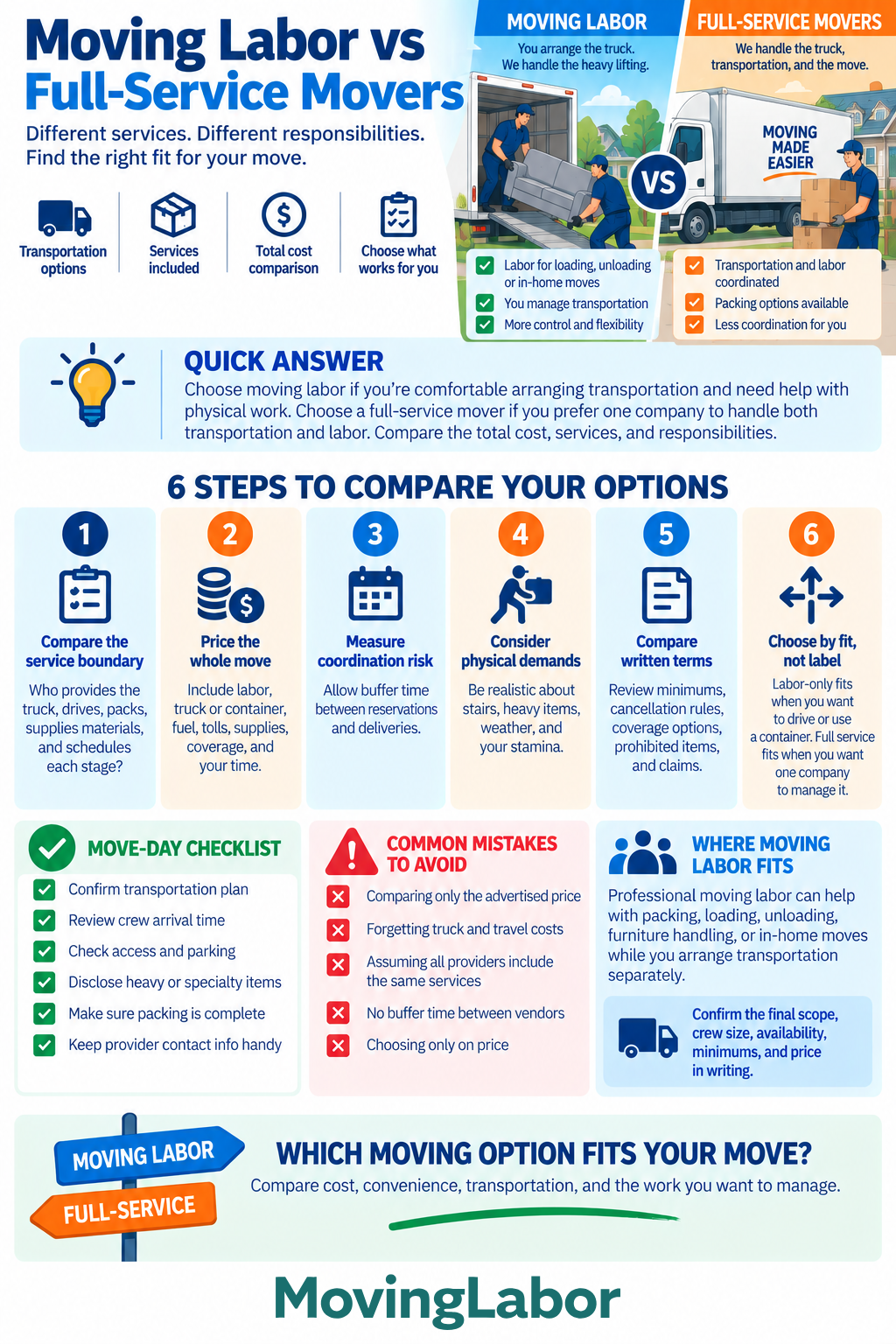
Moving labor provides a crew for selected physical moving tasks, while a full-service mover generally coordinates transportation and moving labor as part of the moving service. The better fit depends on how much responsibility you want to keep for transportation, packing, scheduling, and coordination.
This guide focuses on four important decisions: compare the service boundary, price the whole move, measure coordination risk, and consider physical demands. With labor-only moving, transportation and physical moving labor are typically arranged separately. Understanding exactly what each option includes makes it easier to compare costs, responsibilities, and convenience.
Quick Answer
Choose moving labor when you are comfortable arranging transportation separately and primarily need help with physical tasks such as packing, loading, unloading, furniture handling, or an in-home move.
Consider a full-service mover when you prefer to have transportation and moving labor coordinated through the moving company. Before choosing, compare the complete cost, services included, responsibilities, schedule, and written terms rather than relying only on the advertised price.
Step-by-Step Plan
1. Compare the Service Boundary
Start by identifying exactly what each option includes.
Determine who provides the moving vehicle, who drives, who handles loading and unloading, whether packing or unpacking is included, who supplies packing materials, and who coordinates each stage of the move.
Do not assume that every moving labor provider or full-service mover includes the same services.
2. Price the Whole Move
Compare the complete expected cost rather than an hourly labor rate against a full-service moving quote.
For a labor-only move, the total budget may include moving labor, a rental truck or portable moving container, fuel, mileage, tolls, supplies, parking, applicable protection or coverage, storage, and other transportation expenses.
For a full-service move, review exactly which services and charges are included in the quote and which may be additional.
3. Measure Coordination Risk
Labor-only moves often involve separate reservations for the crew and transportation. Portable containers may also require separate delivery, pickup, transit, and unloading arrangements.
Build enough time between these stages so one delay does not automatically disrupt the rest of the move.
With full-service moving, more of this coordination may be handled through the moving company, depending on the services purchased.
4. Consider Physical Demands
Think realistically about what work you want to perform yourself.
Consider packing, stairs, long carries, furniture preparation, heavy items, weather, loading conditions, and the physical demands of driving and managing the move.
Professional moving labor can reduce the amount of lifting and carrying while allowing you to retain control of separately arranged transportation.
5. Compare Written Terms
Review each provider's written terms before choosing.
Compare minimum hours, cancellation and rescheduling policies, included services, additional charges, heavy or prohibited items, liability or valuation options where applicable, and procedures for reporting damage or other service issues.
Make sure you understand which responsibilities belong to the moving provider and which remain with you.
6. Choose by Fit, Not Label
Choose the service model that matches the amount of responsibility you want to manage.
Moving labor may be a good fit when you:
- Want to drive a rental truck yourself
- Plan to use a portable moving container
- Already have transportation arranged
- Mainly need help with loading or unloading
- Want help moving furniture within the same home
- Are comfortable coordinating different parts of the move
Full-service moving may be a good fit when you:
- Want the moving company to provide transportation
- Prefer fewer separate reservations
- Do not want to drive a moving truck
- Want more of the move coordinated through one provider
- Need a service package beyond loading and unloading
The exact services vary by provider, so compare written scopes rather than relying on service labels alone.
Decision Checkpoints
- Before requesting quotes: Decide which responsibilities you are comfortable handling yourself, including transportation, driving, packing, and scheduling.
- Before comparing prices: Calculate the expected all-in cost of each option using comparable services and move requirements.
- Before booking: Review the service scope, schedule, heavy or specialty items, access conditions, cancellation terms, and applicable protection options.
- Before move day: Confirm that every part of the move has an assigned provider, reservation, time window, and responsible contact.
Move-Day Checklist
- Confirm who is responsible for transportation
- Verify crew arrival and service windows
- Review the agreed scope of work
- Confirm truck or container availability
- Check parking and building access
- Disclose heavy or specialty items
- Keep provider and rental contact information available
- Review important written terms
- Make sure packing is completed as planned
- Allow time between separately scheduled services
Common Mistakes to Avoid
- Comparing only the advertised prices. An hourly moving labor rate and a full-service moving quote may cover very different services. Compare the expected all-in cost.
- Forgetting transportation costs in a labor-only move. Include the truck or container and applicable fuel, mileage, tolls, parking, and other transportation expenses.
- Assuming all providers include the same services. Packing, unpacking, furniture preparation, materials, specialty-item handling, and other services vary by provider.
- Creating a schedule with no buffer. Separate crew, truck, container, or facility reservations can create timing dependencies.
- Choosing only on price. Consider convenience, physical demands, driving, scheduling responsibility, and the amount of coordination you are comfortable managing.
- Not comparing written terms. Review the scope, minimums, additional charges, cancellation terms, and applicable liability or valuation information before booking.
Where Professional Moving Labor Fits
Professional moving labor is designed for customers who need help with physical moving tasks but want or need to arrange transportation separately.
Depending on the provider and agreed scope, moving labor can help with packing, loading a rental truck or portable moving container, unloading, furniture handling, or moving belongings within the same home.
This option can work well when you are comfortable managing the transportation and scheduling portions of the move but do not want to handle all of the lifting and carrying yourself.
Use Moving labor cost or the DIY vs Movers Calculator to compare your options.
Before booking moving labor, confirm the final scope, crew size, availability, minimums, arrival window, and price in writing.