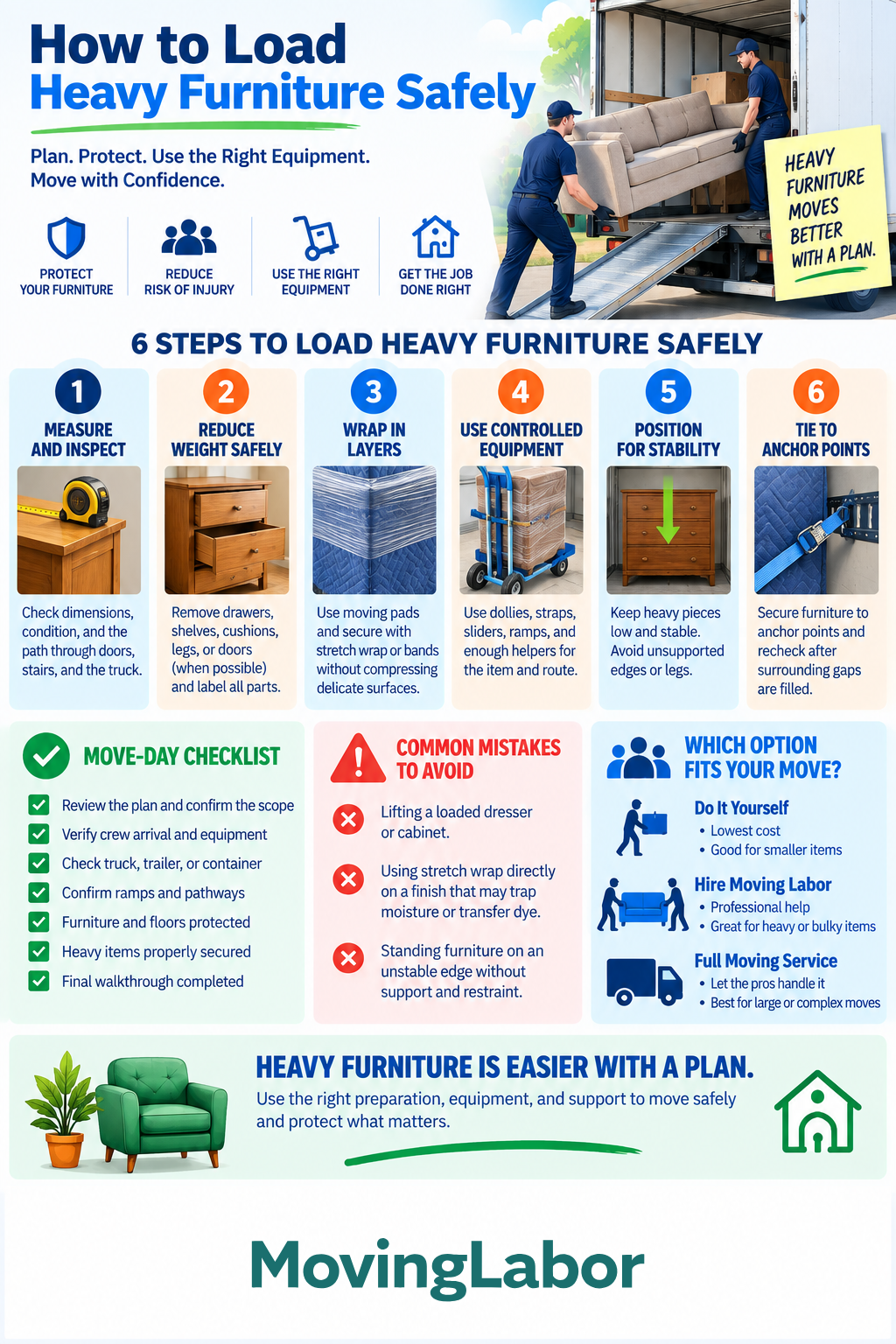
Heavy furniture should be measured, emptied, disassembled where appropriate, padded before movement, controlled with enough people and appropriate moving equipment, placed low and stable, and secured without crushing finished surfaces.
This guide connects four decisions in the Loading & Unloading plan: measure and inspect, reduce weight safely, wrap in layers, and use controlled equipment. Loading and unloading are safety-critical stages. The useful standard is not merely fitting everything inside; it is controlling each item through the route, distributing weight, protecting surfaces, and keeping the load stable during transit.
Quick Answer
Start with the Measure and inspect step, then complete Reduce weight safely, and verify Wrap in layers before the move becomes time-critical.
Before the active move window, document what will happen for the Measure and inspect, Reduce weight safely, and Wrap in layers steps. If one assumption changes, review the remaining steps instead of forcing the original estimate or schedule.
Step-by-step plan
1. Measure and inspect
Confirm furniture dimensions, loose parts, weak joints, glass, stone, and the entire moving path through doors, hallways, stairs, elevators, ramps, and the truck, trailer, or container.
2. Reduce weight safely
Remove drawers, shelves, cushions, legs, leaves, or doors only when the furniture design permits, and label every part.
Reducing the weight of a load and using mechanical assistance where practical can reduce the physical demands of material handling.
3. Wrap in layers
Use moving pads against finished surfaces, then secure the pads with stretch wrap or bands that do not contact or compress delicate materials.
4. Use controlled equipment
Select appropriate furniture dollies, appliance dollies, lifting straps, sliders, ramps, and enough helpers for the furniture and route. Use mechanical assistance rather than relying on manual lifting when an item is too heavy, bulky, or difficult to control safely.
5. Position for stability
Keep dense pieces low, avoid unsupported legs or edges, and do not let one item bear pressure it was not designed to carry.
6. Tie to anchor points
Restrain furniture against padded, stable surfaces using appropriate securement points and recheck it after surrounding gaps are filled. Furniture should not be able to shift significantly during transportation.
Decision checkpoints
- Before booking — Reduce weight safely: Record who owns this step, its deadline, and the written or visible confirmation that it is complete.
- Before work begins — Use controlled equipment: Record who owns this step, its deadline, and the written or visible confirmation that it is complete.
- Before closing out the job — Tie to anchor points: Record who owns this step, its deadline, and the written or visible confirmation that it is complete.
Move-day checklist
- Review the “Measure and inspect” decision
- Verify the “Wrap in layers” details
- Complete the “Position for stability” step
- Truck, trailer, or container inspected
- Ramp and pathway secured
- Furniture and floors protected
Common mistakes to avoid
- Lifting a loaded dresser or cabinet. Revisit reduce weight safely and update the plan before this assumption changes safety, timing, equipment, or cost.
- Applying stretch wrap directly to a finish that may trap moisture or transfer dye. Revisit wrap in layers and make sure appropriate protective material separates the finished surface from the outer wrap.
- Standing furniture on an unstable edge without support and restraint. Revisit tie to anchor points and update the plan before this assumption changes safety, timing, equipment, or cost.
Where professional moving labor fits
For How to Load Heavy Furniture Safely, professional labor can provide the crew for the planned loading or unloading work. Share the inventory, difficult-item photos, furniture dimensions, access conditions, equipment type, and deadline so the crew can evaluate the route and load rather than relying on a generic room count.
Use Heavy-item moving help or the Move Difficulty Score Calculator on MovingLabor.com to continue planning. For this guide, apply the result to the Measure and inspect step and confirm the final scope, availability, minimums, and price in writing.