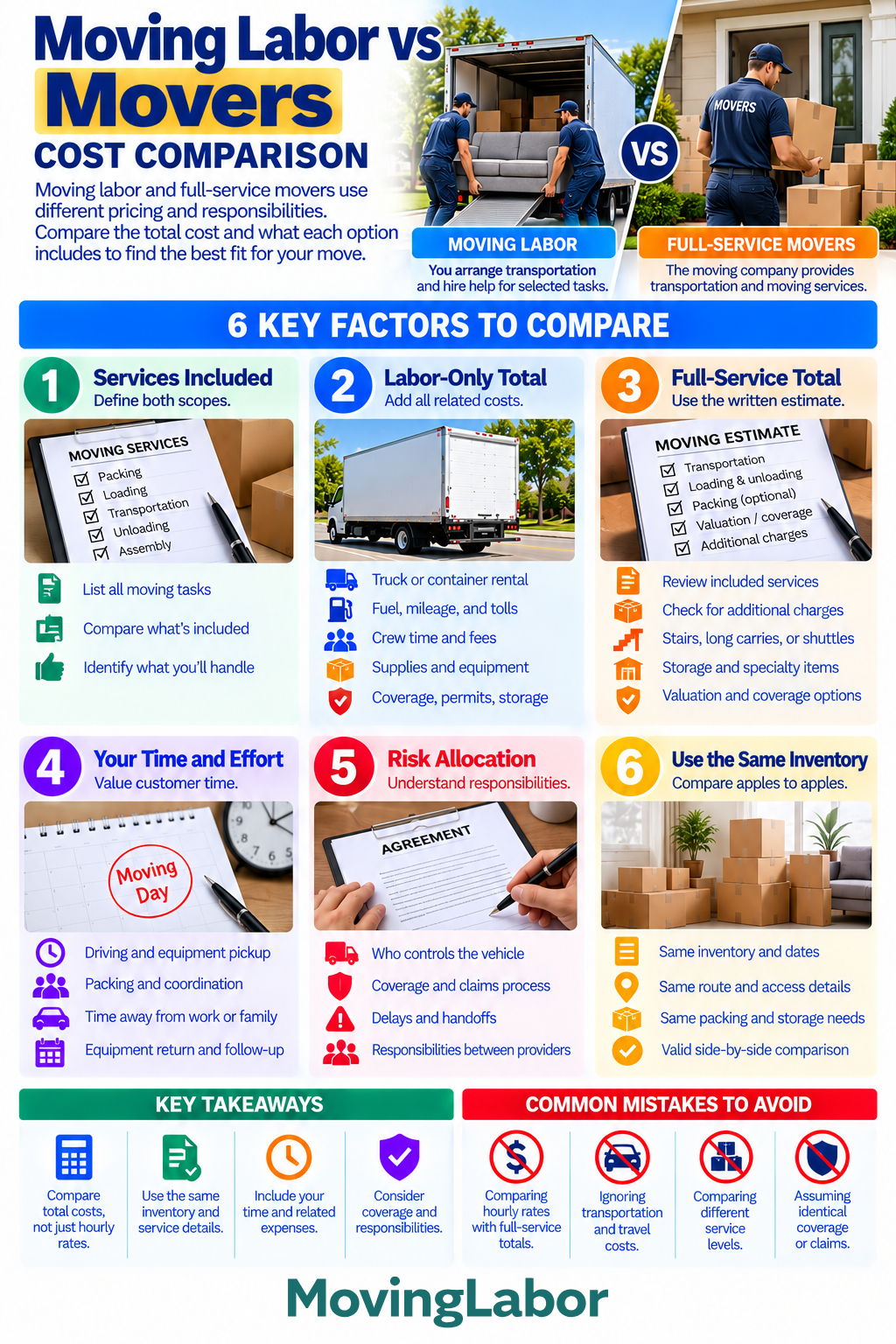
Moving labor and full-service moving companies offer different levels of service, pricing, and responsibility. With labor-only moving, you arrange transportation and hire professionals for tasks such as loading and unloading. Full-service movers typically provide transportation and the moving services included in your agreement.
The best choice depends on your total moving cost, available time, transportation needs, and the amount of work you want to handle yourself.
Quick Answer
The main difference between moving labor and full-service movers is who handles transportation and coordination.
- Moving labor: You rent a moving truck or arrange a moving container and hire professionals for selected tasks, such as loading, unloading, or packing.
- Full-service movers: A moving company provides transportation and the services included in your estimate, generally including loading and unloading.
- Cost comparison: Moving labor may reduce direct service costs, but you must also account for transportation, fuel, equipment, supplies, and your time.
Compare the complete cost of both options—not just moving labor's hourly rate against a full-service moving estimate.
Moving labor vs. full-service movers
| Factor |
Moving labor |
Full-service movers |
| Transportation |
Customer arranges |
Moving company provides |
| Loading and unloading |
Available as booked |
Generally included |
| Packing |
Optional when offered |
Depends on service package |
| Driving |
Customer or transportation provider |
Moving company |
| Equipment |
Confirm what is included |
Depends on agreement |
| Pricing |
Often hourly with minimums and fees |
Varies by move and service |
| Scheduling |
Customer coordinates transportation and labor |
Moving company coordinates its services |
| Coverage and claims |
Depends on separate agreements |
Governed by mover agreement and applicable rules |
| Best suited for |
Customers managing their own transportation |
Customers wanting transportation and moving services together |
Neither option is automatically cheaper. The total cost depends on the move's distance, inventory, access conditions, service requirements, and available transportation.
Step-by-step plan
1. Define the services you need
Start by identifying which moving tasks you want professionals to handle.
Consider:
- Packing and unpacking
- Packing materials
- Furniture preparation
- Loading
- Transportation
- Unloading
- Furniture assembly
- Heavy or specialty items
- Temporary storage
With moving labor, you generally arrange transportation separately.
With full-service movers, transportation and loading or unloading are typically included, while packing and other services depend on the agreement.
Cost comparison tip: Compare the same services for both options so you understand which responsibilities remain yours.
2. Calculate the total cost of moving labor
Moving labor companies commonly charge based on crew size and booked or actual labor time, subject to their pricing terms.
Start with the estimated labor cost, then add applicable transportation expenses.
Include:
- Hourly labor rates
- Crew size and minimum hours
- Travel or service-area fees
- Additional labor time
- Truck or moving container rental
- Mileage and fuel
- Tolls and parking
- Rental equipment
- Packing supplies
- Applicable coverage options
- Storage, if needed
Moving Labor Total = Labor Charges + Transportation + Supplies + Other Applicable Expenses
For a move requiring separate loading and unloading crews, include the cost of both appointments.
Cost comparison tip: Ask about minimum booking hours, billing increments, travel charges, and equipment availability before booking.
3. Calculate the total cost of full-service movers
Full-service moving estimates generally include transportation and the moving services specified in the agreement.
Review the written estimate to understand what is included and what may cost extra.
Check for:
- Transportation and loading or unloading
- Packing and unpacking services
- Packing materials
- Stairs or long carries
- Shuttle services
- Specialty-item handling
- Storage
- Valuation options
- Additional services or schedule changes
For interstate household-goods moves, federal requirements may apply to estimates and valuation. Intrastate moving requirements vary by state.
Full-Service Total = Written Moving Estimate + Applicable Additional Expenses
Understand the estimate type and conditions that could change the final charges.
Cost comparison tip: Request estimates based on the same inventory, addresses, dates, access conditions, and services.
4. Consider your time and responsibilities
Moving labor can reduce physical work while leaving transportation and coordination to you.
Depending on your moving plan, you may still need to:
- Reserve and pick up a rental truck
- Drive the truck
- Coordinate loading and unloading appointments
- Purchase packing supplies
- Return rental equipment
- Arrange storage or other services
- Manage scheduling changes
Consider time away from work, personal commitments, and the difficulty of coordinating separate providers.
Full-service moving may reduce these responsibilities, but the services included depend on your agreement.
Cost comparison tip: Consider both financial expenses and the time required to manage each option.
5. Compare coverage and responsibilities
Moving labor and full-service moving arrangements may have different terms for property damage, loss, and service-related claims.
Before booking, review:
- Who is responsible for the transportation vehicle
- Who loads and secures the shipment
- What services are included
- Applicable damage or loss protection
- Exclusions and limitations
- Claims procedures
- Responsibilities when separate providers are involved
For a hybrid move, the rental truck company, transportation provider, and moving labor company may each have separate agreements.
Do not assume that protection offered by one provider applies to work performed by another.
Cost comparison tip: Review the applicable agreements so you understand responsibilities before moving day.
6. Compare both options using the same moving details
A useful comparison requires consistent assumptions.
Use the same:
- Moving inventory
- Origin and destination
- Moving dates
- Loading and unloading requirements
- Stairs and access conditions
- Packing services
- Storage requirements
- Specialty items
Then compare the complete estimated costs and responsibilities.
| Cost category |
Moving labor + transportation |
Full-service movers |
| Loading and unloading |
Labor charges |
Included as agreed |
| Transportation |
Separately arranged |
Included as agreed |
|
Fuel and mileage
|
Based on transportation agreement |
Usually reflected in transportation pricing |
|
Packing
|
DIY or additional service |
DIY or additional service |
| Equipment |
Confirm rental and labor inclusions |
Confirm estimate inclusions |
| Additional charges |
Labor and transportation terms |
Moving agreement terms |
| Customer time |
More coordination and possible driving |
Less transportation coordination |
Cost comparison tip: Choose based on total cost, required effort, and service responsibilities rather than price alone.
Decision checkpoints
- Before requesting quotes: Finalize your inventory, moving dates, and required services.
- Before comparing prices: Confirm both options cover the same moving tasks and property access conditions.
- Before booking moving labor: Verify transportation, crew size, minimum hours, equipment, and scheduling.
- Before booking full-service movers: Review the written estimate, included services, and potential additional charges.
- Before moving day: Confirm who handles transportation, loading, unloading, and any specialty items.
- After the move: Review final charges and reconcile deposits or refunds where applicable.
Moving cost comparison checklist
- Moving inventory finalized
- Moving distance confirmed
- Loading and unloading needs identified
- Packing requirements reviewed
- Moving labor estimates collected
- Crew size and hourly rates confirmed
- Labor minimums and additional fees reviewed
- Truck or container costs estimated
- Mileage and fuel included
- Equipment and supplies accounted for
- Full-service moving estimates collected
- Included services confirmed
- Property access conditions disclosed
- Storage needs considered
- Coverage and claims terms reviewed
- Personal time and coordination considered
- Contingency funds included
- Total estimated costs compared
Common mistakes to avoid
Comparing hourly labor rates with full-service estimates
A moving labor hourly rate does not include all transportation expenses. Compare the complete labor-plus-transportation cost against the full-service estimate.
Forgetting rental truck expenses
Fuel, mileage, rental equipment, coverage options, and additional rental time can affect the total cost of a hybrid move.
Comparing different service levels
One estimate may include packing or specialty-item handling while another does not. Confirm the same services are included before comparing prices.
Underestimating coordination time
Hiring separate transportation and moving labor providers requires scheduling and communication. Allow time for equipment pickup, loading, driving, and unloading.
Assuming identical coverage
Moving labor providers and full-service movers may have different agreements, protection terms, and claims procedures. Review each provider's responsibilities.
Ignoring property access
Stairs, long carries, restricted parking, and elevator requirements can affect labor time and moving charges. Disclose these conditions before booking.
Where professional moving labor fits
Professional moving labor provides an alternative to both doing everything yourself and purchasing a full-service move.
You manage transportation through a rental truck or moving container while hiring professionals for selected moving tasks.
This arrangement can be useful when:
- You are comfortable arranging transportation.
- You want assistance with loading or unloading.
- You have heavy or bulky furniture.
- You prefer to handle your own packing.
- You want more control over which moving services you purchase.
Moving labor may be particularly practical for rental truck and moving container moves.
Before booking, confirm hourly rates, crew size, minimum hours, equipment availability, travel fees, and the services included.
Use loading help or the DIY vs. Movers Calculator to continue planning. For this guide, apply the result to the Define both scopes step and confirm the final scope, availability, minimums, and price in writing.