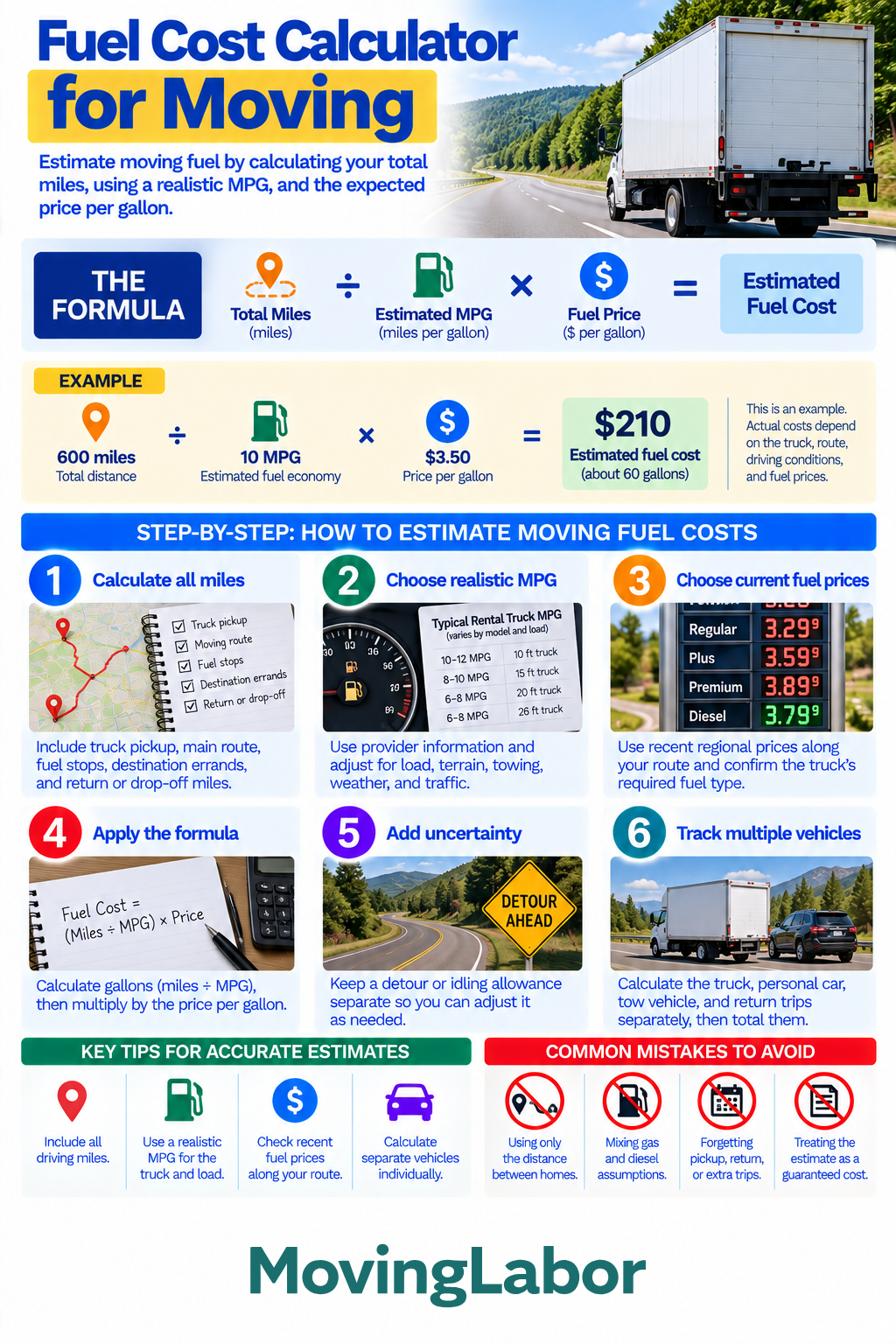
Estimating fuel costs is an important part of budgeting for a DIY move. Rental trucks can use significantly more fuel than passenger vehicles, especially when loaded or traveling through hilly terrain. To estimate your moving fuel expenses, calculate the total driving distance, choose a realistic fuel economy estimate, and multiply the expected gallons by the price per gallon. Include equipment pickup, drop-off, detours, and any additional vehicles in your calculations.
Quick Answer
To estimate fuel costs for a DIY move, use three key figures:
-
Total miles: Include the moving route, truck pickup and return, and any additional driving.
-
Estimated MPG: Use a realistic fuel economy estimate for your rental truck, accounting for cargo weight, towing, and driving conditions.
-
Fuel price per gallon: Check recent gasoline or diesel prices along your route.
Fuel Cost = (Total Miles ÷ Estimated MPG) × Price per Gallon
Example:
For a 600-mile move with an estimated fuel economy of 10 MPG and a fuel price of $3.50 per gallon:
-
Estimated fuel needed: 60 gallons
-
Estimated fuel cost: $210
This is an illustrative estimate, not a guaranteed cost. Actual fuel expenses depend on the truck, route, driving conditions, and fuel prices.
Calculate separately driven vehicles and additional trips individually, then add their estimated fuel costs to your moving budget.
Step-by-step plan
1. Calculate your total driving distance
Start with the distance between your current home and destination.
Then include any additional driving required for:
-
-
Travel from the rental location to your home
-
-
Fuel stops or route detours
-
-
Rental truck return or drop-off
-
Additional trips, if needed
For a one-way rental, include the actual pickup and drop-off locations rather than assuming the truck travels only between the two homes.
For a round-trip rental, include both directions.
2. Estimate realistic fuel economy
Fuel economy is measured in miles per gallon (MPG).
Check your rental provider's information for the specific truck model or vehicle class when available.
Actual fuel economy can vary based on:
-
-
-
-
-
-
-
Weather and road conditions
Use a reasonable planning estimate rather than assuming the truck will achieve its best advertised fuel economy.
If loaded and empty portions of a trip are substantially different, calculate them separately when you have supportable MPG estimates.
3. Check fuel prices along your route
Use recent fuel prices for the areas where you expect to refuel.
Prices can vary between states, cities, and fuel stations.
Confirm whether your rental truck requires gasoline or diesel before estimating costs. Use the price for the correct fuel type.
For longer moves, consider prices along the route rather than relying entirely on the price near your starting location.
4. Apply the fuel cost formula
First, calculate how many gallons of fuel your move will require.
Estimated Gallons = Total Miles ÷ Estimated MPG
Then calculate the expected fuel expense.
Moving Cost Formula
Estimated Fuel Cost = Estimated Gallons × Price per Gallon
Example:
-
Total distance: 900 miles
-
Estimated fuel economy: 9 MPG
-
Fuel price: $3.60 per gallon
Step 1: 900 ÷ 9 = 100 gallons
Step 2: 100 × $3.60 = $360
Estimated Fuel Cost: $360
This is a planning estimate. Actual fuel costs may vary based on the truck, cargo weight, route, driving conditions, and fuel prices.
5. Allow for additional fuel expenses
Your planned route may not account for every mile or driving condition.
Consider possible changes such as:
Keep any extra-mile allowance visible in your budget.
For uncertainty about MPG or fuel prices, consider calculating a second, more conservative estimate rather than hiding the difference inside the original assumptions.
6. Calculate additional vehicles separately
If more than one vehicle is involved, estimate fuel expenses for each vehicle.
For example:
-
-
Personal car driven separately
-
-
Each vehicle may have different mileage, fuel economy, and fuel requirements.
If a personal vehicle is towed rather than driven separately, account for the towing arrangement when estimating the truck's fuel economy instead of treating the towed vehicle as a separately driven trip.
Add the individual estimates to determine your combined fuel budget.
Decision checkpoints
-
Before reserving a truck: Estimate the full route, including pickup and return requirements.
-
Before calculating fuel costs: Confirm the vehicle's fuel type and select a reasonable MPG estimate.
-
Before moving day: Check recent fuel prices along your planned route.
-
Before departure: Review the distance and any additional stops or detours.
-
During the move: Track fuel purchases and actual mileage when practical.
-
After returning the truck: Include final refueling and reconcile the estimate with actual spending.
Moving fuel cost checklist
-
Total moving distance estimated
-
Rental pickup miles included
-
Rental return or drop-off miles included
-
Additional driving considered
-
Truck fuel type confirmed
-
-
Cargo weight and towing considered
-
-
Detour allowance considered
-
Round-trip mileage included if applicable
-
Additional vehicles calculated separately
-
Final refueling requirements reviewed
-
-
Actual fuel expenses recorded
Common mistakes to avoid
Using only the distance between homes
The moving truck may also need to travel to and from rental locations, make additional stops, or complete a return trip. Include all planned driving.
Assuming passenger-car fuel economy
Rental moving trucks generally have different fuel consumption characteristics than passenger vehicles. Use information appropriate to the actual truck.
Mixing gasoline and diesel assumptions
Confirm the truck's required fuel type and use the corresponding price when calculating costs.
Ignoring towing and cargo weight
A loaded truck or a truck towing another vehicle may achieve different fuel economy than an empty vehicle.
Forgetting return-trip fuel
A round-trip rental can require substantially more driving than a one-way move. Include the entire rental route.
Treating the estimate as a guaranteed cost
Actual MPG, fuel prices, traffic, and additional driving can change the final amount. Keep your fuel estimate separate from actual spending.
Where professional moving labor fits
Professional moving labor does not usually change who is responsible for fuel when you rent and drive your own moving truck.
However, hiring help for loading and unloading may reduce the amount of time you spend performing physically demanding tasks.
When comparing a DIY move with a hybrid or full-service move, account for both transportation expenses and any hired labor.
If you use a moving container or hire a moving company that provides transportation, fuel may already be reflected in the quoted transportation charge rather than billed separately. Review the service agreement to understand what is included.
Use Moving Labor Unloading help or the DIY vs. Movers Calculator to continue planning. For this guide, apply the result to the Calculate all miles step and confirm the final scope, availability, minimums, and price in writing.