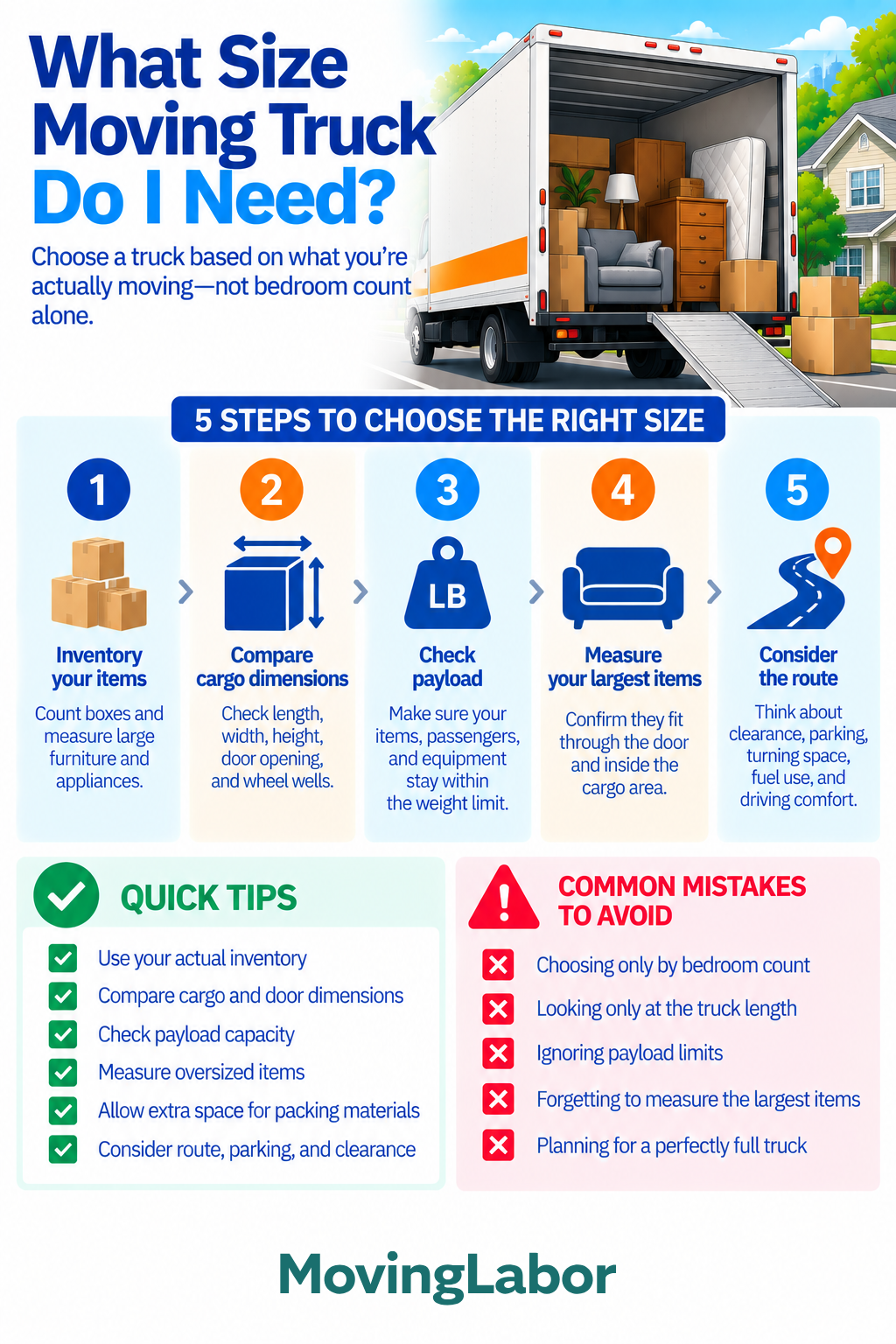
Choose a moving truck based on what you are actually moving, not bedroom count alone.
Start with your inventory, then compare the truck's usable cargo space, interior dimensions, cargo-door opening, payload capacity, and loading features. Measure your largest furniture and appliances, and consider whether a larger truck will create additional challenges with clearance, parking, fuel, or driving.
If your estimated load is close to a truck's capacity, compare the next suitable size rather than assuming everything will fit.
Quick Answer
To choose a moving truck size:
- Inventory your boxes, furniture, appliances, and other belongings
- Measure large or unusually shaped items
- Compare usable cargo dimensions and door openings
- Check the truck's payload capacity
- Allow some room for imperfect stacking and last-minute items
- Consider clearance, parking, fuel, and driving comfort before choosing a larger truck
Bedroom-count recommendations can be useful as a starting point, but they are not a guarantee that your belongings will fit.
Step-by-Step Plan
1. Inventory What You Are Moving
Start with the actual contents of your move.
Count boxes and identify larger items such as:
- Sofas and sectionals
- Beds and mattresses
- Dressers and tables
- Appliances
- Garage and workshop items
- Outdoor furniture and equipment
- Exercise equipment
- Other bulky or unusually heavy belongings
Pay particular attention to dense items such as books, tools, files, and weights. They may use relatively little cargo space while adding significant weight.
2. Compare Usable Cargo Dimensions
Truck length alone does not tell you how much usable space you will have.
Compare available specifications such as:
- Cargo length
- Cargo width
- Cargo height
- Cargo-door opening
- Wheel-well intrusion
- Ramp or loading height
- Over-cab storage, when available
Trucks advertised in the same general size class can have different dimensions and configurations.
Verify the specifications associated with your rental and check the actual vehicle at pickup.
3. Check Payload Capacity
Cargo volume and payload capacity are different limits.
A truck can run out of allowable payload before its cargo area is completely full, particularly when moving dense or unusually heavy belongings.
Review the payload and weight information for the specific vehicle. Account for your cargo along with other weight associated with the vehicle's operating load, such as passengers and equipment where applicable.
Do not assume empty cargo space means additional weight can safely be added.
4. Measure Your Largest Items
Measure furniture and appliances that could be difficult to load.
Compare their dimensions with the truck's:
- Cargo-door opening
- Interior height
- Interior width
- Available floor space
Consider whether furniture can be safely disassembled when appropriate.
A truck may have enough overall cubic volume for your move while still being unsuitable for a particular oversized item.
5. Consider the Route and Access
Moving to the next truck size can provide additional cargo capacity, but a larger vehicle can also affect the driving portion of the move.
Consider:
- Overhead clearance
- Parking space
- Driveways
- Apartment loading areas
- Storage-facility access
- Turning space
- Fuel use
- Driver comfort
Choose a truck that works for both your belongings and the places it needs to travel and park.
6. Allow a Reasonable Capacity Buffer
Do not plan around perfectly filling every inch of the cargo area.
Real-world loading can be less efficient because of:
- Irregularly shaped furniture
- Fragile items
- Loading equipment
- Packing materials
- Items that cannot be stacked
- Last-minute additions
If your inventory appears very close to a truck's usable capacity, compare the next appropriate size.
Balance the benefit of additional capacity against its price, fuel use, availability, clearance, parking requirements, and driving characteristics.
Decision Checkpoints
- Before requesting a quote: Create an inventory and identify bulky or unusually heavy items.
- Before choosing a truck: Compare cargo dimensions, door opening, payload, and loading features.
- Before booking: Measure your largest items and confirm they can be loaded.
- Before sizing up: Consider the additional cost, clearance, parking, fuel, and driving impact.
- At pickup: Verify the actual truck and relevant specifications before loading.
Move-Day Checklist
- Confirm the truck size or class
- Verify cargo dimensions
- Check the cargo-door opening
- Review payload information
- Measure oversized items
- Identify unusually heavy items
- Confirm loading equipment
- Check route and overhead clearance
- Verify parking and unloading access
- Keep vehicle specifications accessible
Common Mistakes to Avoid
- Choosing only by bedroom count. Two homes with the same number of bedrooms can contain very different amounts of furniture, boxes, and equipment.
- Looking only at advertised truck length. Interior dimensions, door openings, wheel wells, and vehicle configurations can differ.
- Confusing cargo space with payload. Available physical space does not necessarily mean the truck has remaining weight capacity.
- Forgetting the largest item. Overall cargo volume is not useful if a sofa, appliance, or other essential item cannot pass through the cargo opening.
- Planning for a perfectly packed truck. Real loads contain irregular, fragile, and non-stackable items.
- Automatically choosing the largest truck. Extra capacity can also mean different clearance, parking, fuel, cost, and driving considerations.
Where Professional Moving Labor Fits
Professional moving labor can load or unload a customer-rented truck, but the customer typically remains responsible for selecting, renting, and driving the vehicle.
Provide the moving labor company with an accurate inventory, including large, unusually heavy, or specialty items, before move day. Also provide the truck size and relevant access details once known.
An experienced crew can help use the available cargo space efficiently, but professional loading does not increase the truck's payload rating or guarantee that an undersized truck will hold the entire move.
Use Truck loading and unloading help or the Truck and Container Calculator to continue planning.
Confirm the truck separately, and confirm the moving labor scope, crew size, heavy-item requirements, minimums, availability, arrival window, and price in writing.