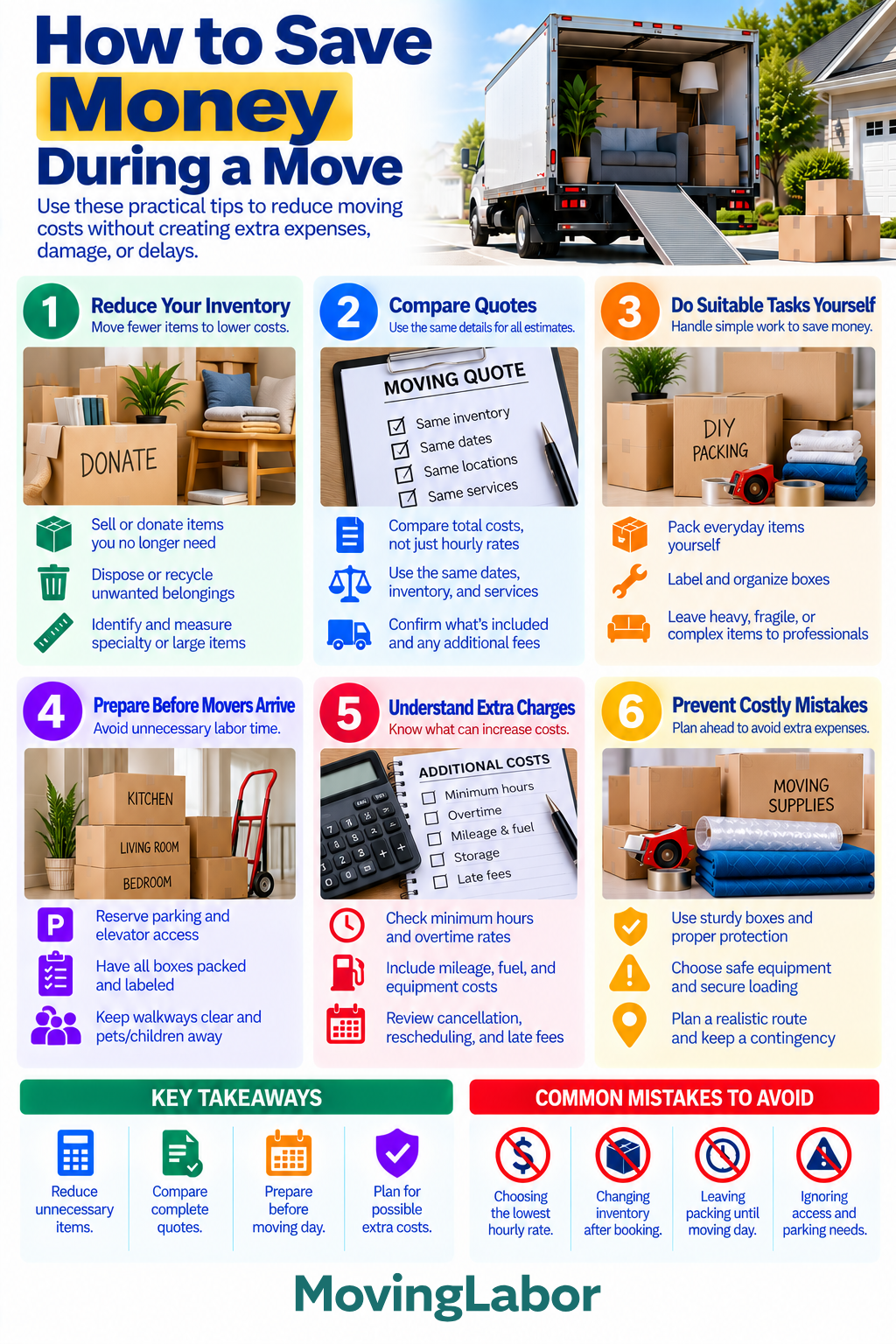
Saving money during a move starts with planning ahead, reducing unnecessary expenses, and choosing the right combination of DIY work and professional assistance. Comparing moving estimates, preparing before moving day, and understanding potential extra charges can help keep costs under control.
The goal is to lower your total moving expenses without compromising safety, protecting your belongings, or creating avoidable delays.
Quick Answer
Here are six practical ways to save money during a move:
- Reduce your inventory: Sell, donate, or dispose of belongings you no longer need before requesting final quotes.
- Compare complete estimates: Use the same inventory, dates, locations, and services when comparing moving options.
- Handle suitable tasks yourself: Pack everyday items and complete basic preparation when practical.
- Prepare before movers arrive: Have boxes packed, access arranged, and furniture ready to reduce unnecessary labor time.
- Understand additional charges: Review hourly minimums, mileage, rental extensions, and cancellation policies.
- Prevent costly problems: Use appropriate packing materials, safe equipment, and realistic moving schedules.
The most effective savings come from reducing unnecessary work and avoiding expenses that could have been planned for in advance.
Step-by-step plan
1. Finalize your moving inventory
The amount of belongings you move affects packing supplies, transportation space, and loading time.
Before requesting final estimates:
- Sell or donate items you no longer need.
- Recycle or properly dispose of unwanted belongings.
- Identify heavy, oversized, or specialty items.
- Measure furniture that may be difficult to move.
- Create an accurate inventory for moving estimates.
Avoid making significant inventory changes after booking without notifying your provider. Additional items may affect the required equipment, labor time, and final charges.
Money-saving tip: Declutter before obtaining final quotes so you're not paying to move belongings you don't intend to keep.
2. Compare moving quotes fairly
Moving estimates can differ in the services, equipment, and charges they include.
When comparing options, use the same:
- Moving inventory
- Origin and destination
- Moving dates
- Packing requirements
- Loading and unloading needs
- Stairs and property access conditions
- Transportation requirements
- Storage needs, if applicable
Review the total estimated price rather than focusing only on hourly rates or advertised rental charges.
For moving labor, check crew size, minimum booking hours, travel fees, and additional labor rates.
For rental trucks or containers, include fuel, mileage, equipment, and applicable rental charges.
Money-saving tip: Request written estimates and compare what is included before selecting a provider.
3. Handle suitable moving tasks yourself
You may be able to reduce paid moving time by completing some preparation independently.
Tasks you can consider handling include:
- Packing clothing and everyday household items
- Labeling boxes by destination room
- Organizing small belongings
- Removing items from drawers when appropriate
- Preparing furniture according to manufacturer guidance
- Cleaning and organizing rooms before moving day
Leave tasks requiring specialized equipment, difficult lifting, or more experience to capable professionals when necessary.
If you plan to disassemble furniture, confirm whether the moving provider has specific preparation requirements.
Money-saving tip: Focus paid moving assistance on tasks where professional help provides the most practical value.
4. Reduce unnecessary labor time
When movers charge by the hour, avoidable waiting and disorganization can increase costs.
Before the moving crew arrives:
- Finish packing boxes.
- Label belongings clearly.
- Identify items that are not moving.
- Reserve parking when required.
- Confirm elevator access.
- Clear walkways and loading areas.
- Arrange building access.
- Keep pets and children safely away from work areas.
- Confirm truck or container availability.
Communicate special handling instructions before loading begins.
For labor-only moves, coordinate the crew's arrival with your rental truck or container schedule.
Money-saving tip: Have the property and belongings ready so the moving crew can begin the booked work without unnecessary delays.
5. Control scheduling and additional charges
Some moving expenses increase when the work takes longer or plans change.
Review applicable terms for:
- Minimum labor hours
- Hourly billing increments
- Additional labor time
- Overtime or after-hours charges
- Rental truck extensions
- Mileage and fuel
- Container rental periods
- Storage renewals
- Cancellation or rescheduling
- Late equipment returns
Compare alternative moving dates when your schedule allows. Availability and pricing vary by provider, location, and season.
Booking ahead may improve your choices, although it does not guarantee a lower rate.
Money-saving tip: Understand how extra time and schedule changes are charged before making reservations.
6. Prevent avoidable moving expenses
Cutting costs in the wrong places can lead to damaged belongings, additional trips, or delays.
Protect your moving budget by:
- Using sturdy boxes suited to their contents
- Packing fragile items appropriately
- Protecting furniture and floors
- Choosing suitable transportation equipment
- Securing belongings during transportation
- Planning a realistic route and schedule
- Confirming loading and unloading assistance
- Allowing for likely unexpected expenses
Keep a contingency based on the specific risks of your move, such as additional labor, storage, fuel, or rental time.
Money-saving tip: Prioritize safe handling and appropriate equipment over small savings that could create larger expenses.
Decision checkpoints
- Before requesting estimates: Finalize your inventory and identify the moving services you need.
- Before booking: Compare complete written estimates using the same moving requirements.
- Before purchasing supplies: Estimate what you need and identify suitable reusable materials.
- Before moving day: Confirm packing, parking, elevators, equipment, and moving labor arrangements.
- Before work begins: Verify that belongings are ready and the crew understands the agreed scope.
- After the move: Review final charges, rental returns, and refundable deposits.
Money-saving moving checklist
- Unwanted belongings removed
- Moving inventory finalized
- Multiple moving options compared
- Written estimates reviewed
- Included services confirmed
- Moving dates compared
- Transportation reserved
- Packing supplies estimated
- Suitable items packed in advance
- Boxes labeled
- Furniture preparation completed
- Moving labor booked if needed
- Parking and elevator access confirmed
- Labor minimums and additional charges reviewed
- Fuel and mileage budgeted
- Rental return deadlines confirmed
- Refundable deposits tracked separately
- Contingency funds included
- Final expenses recorded
Common mistakes to avoid
Choosing the lowest hourly rate
A lower hourly rate does not always mean a lower total cost. Crew size, minimum hours, travel fees, and the time required can affect the final expense.
Changing your inventory after booking
Adding belongings may increase labor time or require different transportation equipment. Communicate changes before moving day.
Leaving packing until movers arrive
Unfinished packing can increase paid labor time or delay loading. Complete agreed DIY preparation before the crew arrives.
Forgetting property access requirements
Unavailable parking, restricted loading areas, or elevator delays can slow the move. Confirm access arrangements in advance.
Cutting corners on packing protection
Weak boxes and inadequate cushioning can result in damaged belongings. Use appropriate protection for fragile and valuable items.
Ignoring potential additional charges
Rental extensions, extra labor, mileage, and storage can increase the final cost. Review service terms and allow for realistic changes.
Where professional moving labor fits
Professional moving labor can help reduce the physical demands of moving while allowing you to manage transportation independently.
Instead of hiring a full-service moving company, you can arrange a rental truck or moving container and book help for selected tasks.
Common services include:
- Loading rental trucks
- Unloading rental trucks
- Loading or unloading moving containers
- Heavy furniture handling
- Packing or furniture preparation, when offered
This approach may be useful when you can manage transportation but want help with physically demanding work.
To control costs, complete suitable packing and preparation before the crew arrives.
Use Moving labor cost or the DIY vs. Movers Calculator to continue planning. For this guide, apply the result to the Freeze the inventory step and confirm the final scope, availability, minimums, and price in writing.