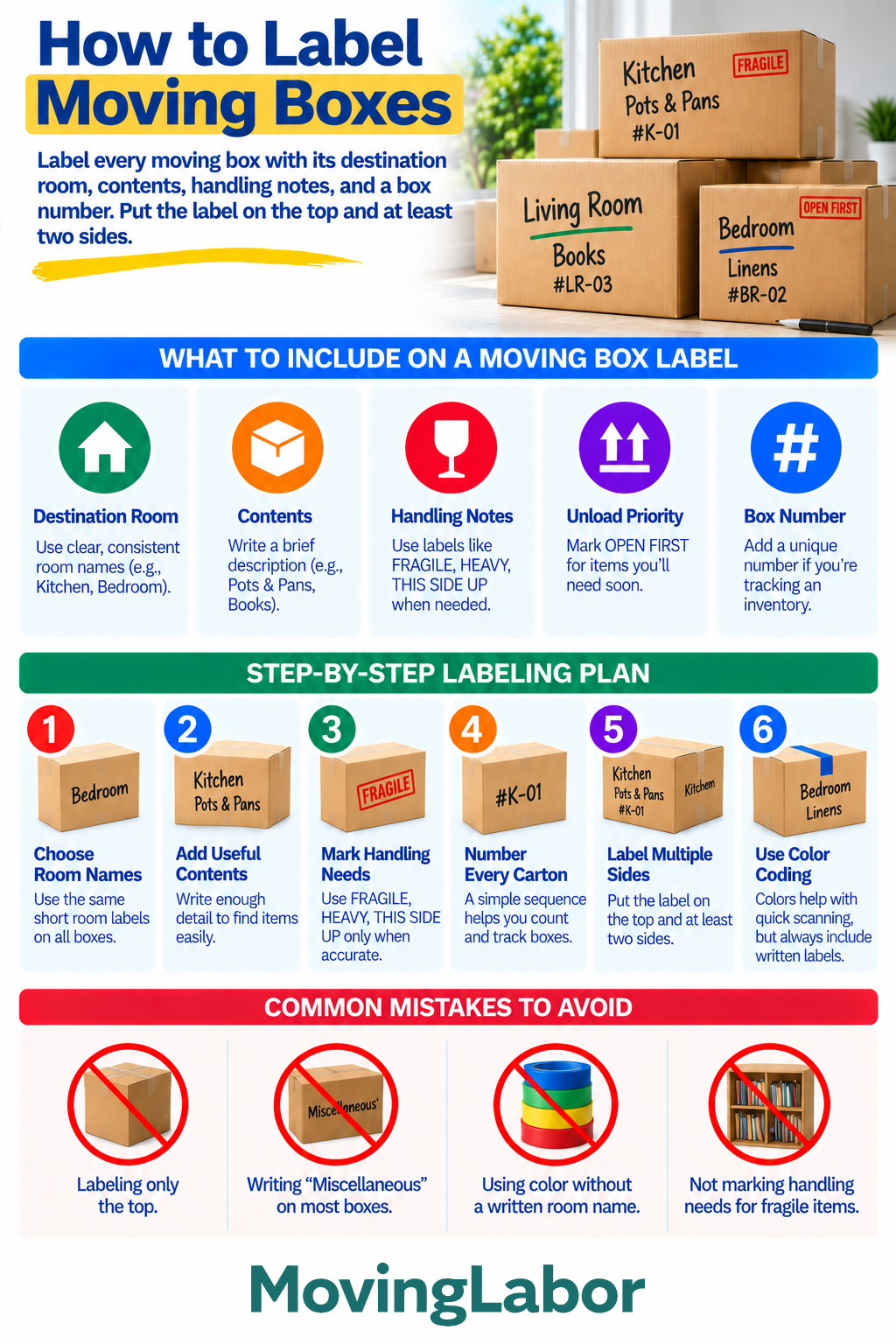
Label every moving box with its destination room, useful contents, handling instructions, and unload priority when needed. For easier identification while boxes are stacked, place the main label on the top and at least two sides.
A consistent labeling system makes boxes easier to organize, load, unload, and unpack. Keep labels short, readable, and consistent throughout the move.
Quick Answer
Label each moving box with the destination room and a short description of the contents. Add handling instructions such as FRAGILE, HEAVY, or THIS SIDE UP when needed, and mark boxes you will need right away as OPEN FIRST.
If you are keeping a moving inventory, give each box a unique number so you can track it from packing through unloading.
Write the label on the top and at least two sides of the box. This keeps the important details visible even when boxes are stacked.
Step-by-step plan
1. Choose consistent room names
Decide on short destination names before you begin labeling.
For example:
Use the same room names on boxes and, if helpful, temporary signs at the destination.
Avoid switching between labels such as "Bedroom," "Main Bedroom," and "Primary" for the same room.
2. Add useful contents
Include enough information to identify the contents without writing a complete packing list.
Instead of:
Kitchen — Miscellaneous
Use:
Kitchen — Pots & Pans
or:
Kitchen — Baking Supplies
Specific descriptions make it easier to find belongings without opening several boxes.
Avoid putting sensitive information or descriptions of valuable belongings on the outside of a box.
3. Mark handling needs accurately
Add handling instructions only when they actually apply.
Common examples include:
- FRAGILE
- HEAVY
- THIS SIDE UP
- DO NOT STACK
- OPEN FIRST
Make these markings large enough to notice quickly.
A FRAGILE label does not replace proper packing and cushioning. The contents should still be packed appropriately for handling and transportation.
4. Number boxes when using an inventory
Assigning each carton a unique number can make it easier to track boxes throughout the move.
For example:
Kitchen — K-01
Kitchen — K-02
Primary Bedroom — PB-01
Alternatively, use a simple sequence such as Box 001, Box 002, and Box 003.
If you maintain an inventory, record the box number, destination room, and a brief description of the contents.
5. Label multiple sides
Do not label only the top.
Once boxes are stacked, the top may no longer be visible. Put the destination room and other important information on the top and at least two adjacent sides.
Labeling before the box enters the loading area is easier than trying to identify cartons after they have been stacked.
6. Use color coding as a supplement
Assigning a color to each room can make boxes easier to scan quickly.
For example:
- Blue — Kitchen
- Green — Living Room
- Yellow — Primary Bedroom
- Orange — Bedroom 2
Use colored tape, stickers, or markers if desired.
Always include the written room name as well as the color. Written labels ensure the system still works when colors are difficult to distinguish or when someone handling the boxes does not know the color system.
Decision checkpoints
- Before packing: Choose one consistent name or abbreviation for each destination room.
- As each box is sealed: Add the room, useful contents, and any necessary handling instructions.
- Before staging boxes: Make sure important information is visible from the top and at least two sides.
- If using an inventory: Confirm that every box number matches an entry before loading.
- Before unloading: Make sure destination rooms are clearly identifiable so boxes can be placed correctly.
Moving box labeling checklist
- Destination room clearly written
- Brief contents listed
- Handling instructions added when needed
- OPEN FIRST marked where appropriate
- Unique number added if using an inventory
- Label visible on top
- Label visible on at least two sides
- Writing large enough to read quickly
- Room names used consistently
- Sensitive or valuable contents not advertised
- Color coding paired with written labels
Common mistakes to avoid
Labeling only the top
Top labels disappear when boxes are stacked. Repeat the important information on at least two sides.
Writing "Miscellaneous" on too many boxes
A vague description makes unpacking harder. Use a short description such as Desk Supplies, Bakeware, or Winter Clothes.
Using inconsistent room names
If Bedroom 2, Guest Room, and Upstairs Bedroom all refer to the same destination, movers may have to stop and ask where boxes belong. Pick one name and use it consistently.
Using color without written labels
Color coding can speed up identification, but it should supplement rather than replace written room names.
Marking every box FRAGILE
Handling instructions are more useful when they identify boxes that genuinely require special attention.
Making labels too detailed
Long inventories are difficult to scan during loading and unloading. Keep the exterior label brief and place detailed information in a separate inventory if needed.
Where professional moving labor fits
If professional packers are preparing your belongings, confirm how they will label completed cartons and whether they use room names, box numbers, contents descriptions, or another inventory system.
If you are packing yourself and hiring moving labor for loading or unloading, consistent destination labels can help the crew identify where boxes belong without repeatedly stopping for instructions.
Use Professional packing help or the Packing Materials Calculator to continue planning. For this guide, apply the result to the Choose room names step and confirm the final scope, availability, minimums, and price in writing.