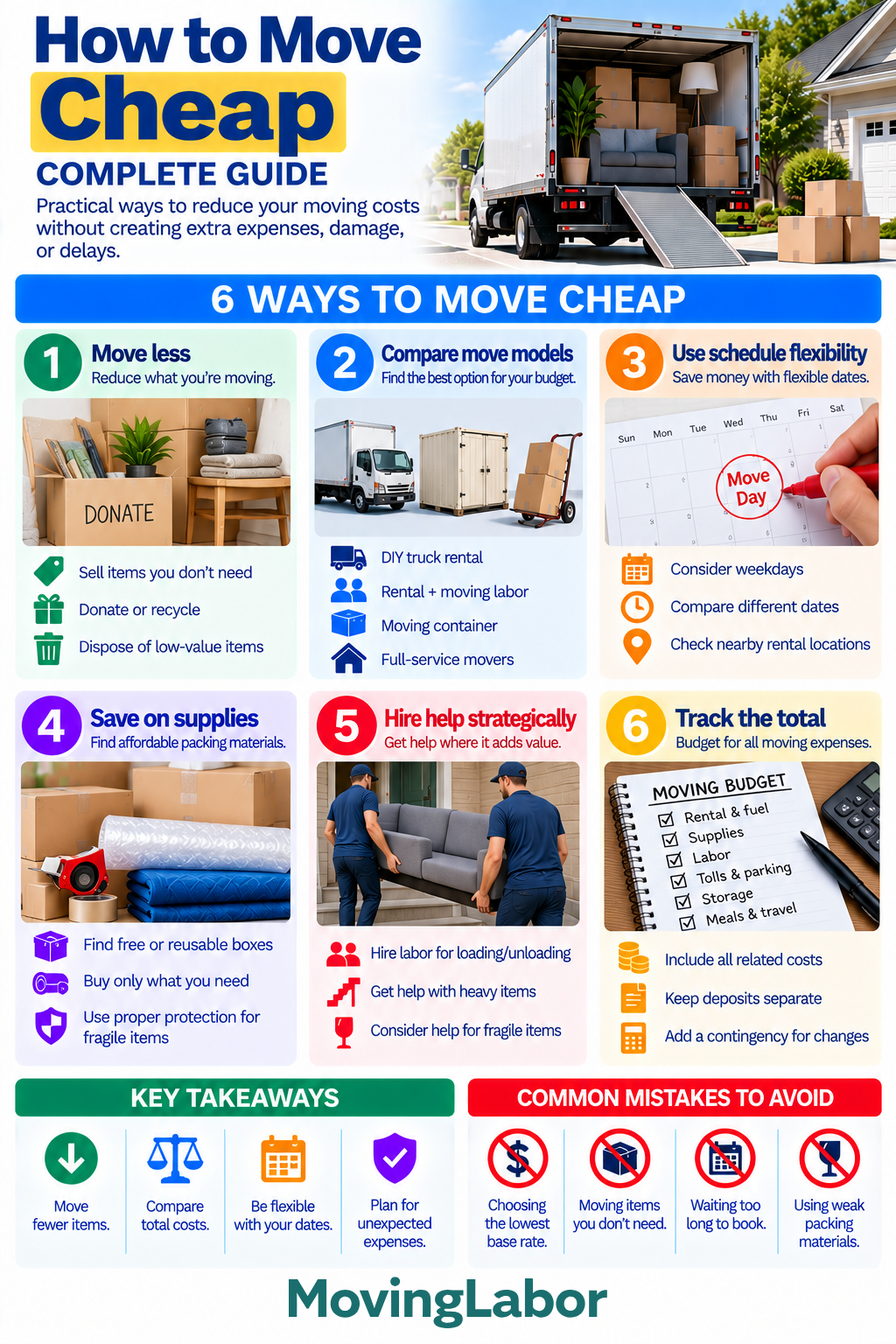
Moving on a budget doesn't mean sacrificing safety or taking on every task yourself. The best way to save money is to reduce what you're moving, compare transportation options, find affordable packing supplies, and avoid unnecessary expenses.
Whether you're renting a moving truck, using a moving container, or hiring professional movers, the goal is to reduce your total moving cost without creating additional expenses, damage, or delays.
Quick Answer
To move cheaply, focus on six practical ways to save money:
- Move fewer belongings: Sell, donate, or dispose of items you no longer need.
- Compare moving options: Get complete estimates for DIY, hybrid, and full-service moving.
- Choose flexible dates: Compare moving dates and booking options when your schedule allows.
- Save on packing supplies: Find free boxes, reuse suitable materials, and purchase protection where needed.
- Hire help strategically: Consider professional loading, unloading, or heavy-item assistance instead of full-service moving.
- Avoid surprise expenses: Budget for fuel, mileage, equipment, storage, and possible delays.
The cheapest moving option isn't always the one with the lowest advertised price. Compare the full cost of each approach before booking.
Step-by-step plan
1. Reduce what you're moving
One of the simplest ways to lower moving costs is to move fewer belongings.
Less inventory can mean fewer packing supplies, less loading time, and potentially a smaller truck or moving container.
Before packing:
- Sell furniture and household items you no longer use.
- Donate clothing, books, and usable household goods.
- Recycle or properly dispose of unwanted items.
- Avoid moving damaged or low-value items that are impractical to transport.
- Measure large furniture to confirm it will fit in your new home.
For bulky items, compare the cost of moving them with the cost of replacing them after the move.
Money-saving tip: Declutter before requesting final moving estimates so your quotes reflect the belongings you actually plan to move.
2. Compare affordable moving options
Different moving methods have different cost structures.
| Moving option |
How it works |
Main costs to compare |
| DIY truck rental |
You rent, load, drive, and unload the truck. |
Rental, mileage, fuel, equipment, supplies |
| Truck rental + moving labor |
You manage transportation and hire loading or unloading help. |
Rental, fuel, labor, equipment |
| Moving container |
You load a container and the provider transports it. |
Delivery, transportation, rental period, labor if needed |
| Full-service movers |
A moving company provides transportation and agreed moving services. |
Transportation, labor, services, possible additional charges |
Request estimates using the same inventory, dates, route, and service requirements.
Compare the total estimated expense, including charges that may not appear in the advertised base price.
Money-saving tip: A hybrid move can be worth comparing when you want to manage transportation but need help with heavy lifting.
3. Be flexible with your moving schedule
Moving costs and availability can vary by date, location, and provider.
If your schedule allows, compare:
- Weekday and weekend availability
- Different moving dates
- Nearby rental truck pickup locations
- Alternative equipment sizes
- One-way and round-trip rental arrangements
- Different reservation times
Some dates may offer better availability or pricing, but lower rates are not guaranteed.
Booking early can also give you more time to compare providers and equipment options.
Consider your lease, work schedule, and property access requirements before changing dates to save money.
Money-saving tip: Compare the total cost of alternative dates, including any extra rent, storage, or travel expenses caused by changing your schedule.
4. Save money on packing supplies
Packing materials can become a noticeable moving expense, especially for larger households.
Look for opportunities to reduce costs without compromising protection.
Consider:
- Asking local retailers for clean, sturdy boxes
- Reusing suitable boxes from previous purchases
- Using towels and linens to cushion appropriate items
- Borrowing or renting moving equipment when practical
- Purchasing only the supplies you need
- Returning unused supplies when the retailer permits it
Avoid weak, damaged, or poorly sized boxes for heavy and fragile belongings.
Electronics, glassware, mirrors, and other delicate items may require appropriate protective materials.
Money-saving tip: Estimate your box and packing supply needs before shopping to avoid unnecessary purchases.
5. Hire moving help where it adds value
Doing everything yourself isn't always the most economical choice.
Heavy furniture, stairs, difficult access, and limited helpers can increase loading time and the risk of damage or injury.
Professional moving labor can provide assistance with:
Hiring movers for selected tasks may be more practical than paying for a full-service move.
Before booking, compare hourly rates, crew size, minimum hours, travel charges, equipment availability, and other applicable fees.
Money-saving tip: If you're comfortable driving a rental truck, consider hiring labor for loading and unloading while handling transportation yourself.
6. Track your total moving expenses
A low initial estimate doesn't always mean a low final cost.
Build a moving budget that includes applicable expenses such as:
- Truck or container rental
- Mileage and fuel
- Tolls and parking
- Moving labor
- Packing supplies
- Rental equipment
- Coverage options
- Travel meals and lodging
- Storage
- Cleaning and disposal
- Building or permit fees
- Additional rental time
Keep refundable deposits and temporary payment holds separate from permanent expenses, while accounting for their impact on available funds.
Include contingency funds for realistic risks such as unexpected delays, additional labor, or rental extensions.
Money-saving tip: Track estimated and actual spending so you can identify extra charges before they become larger expenses.
Decision checkpoints
- Before requesting quotes: Reduce your inventory and identify which moving services you actually need.
- Before booking transportation: Compare rental trucks, moving containers, and professional moving options using complete estimated costs.
- Before selecting a moving date: Check whether alternative dates reduce total expenses without creating new costs.
- Before purchasing supplies: Estimate your packing needs and identify suitable free or reusable materials.
- Before moving day: Confirm helpers, labor bookings, equipment, property access, and transportation arrangements.
- After the move: Review final charges, equipment returns, and any refundable deposits.
Budget-friendly moving checklist
- Unwanted belongings sold, donated, or disposed of
- Moving inventory finalized
- Truck or container size estimated
- Multiple moving options compared
- Written estimates reviewed
- Flexible moving dates considered
- Transportation booked
- Free or reusable boxes sourced
- Packing supplies estimated
- Heavy furniture needs evaluated
- Moving labor considered
- Fuel and mileage budgeted
- Parking and building requirements confirmed
- Rental equipment arranged
- Storage needs reviewed
- Refundable deposits tracked
- Contingency funds included
- Final moving expenses recorded
Common mistakes to avoid
Choosing the cheapest advertised price
A low rental rate may exclude mileage, fuel, equipment, or other charges. Compare complete estimates rather than base prices.
Moving belongings you don't need
Unnecessary items increase packing, transportation, and handling requirements. Declutter before paying to move them.
Waiting too long to book
Delaying reservations can reduce your equipment and scheduling choices. Compare and reserve services once your plans are reasonably certain.
Using inadequate packing materials
Weak boxes and insufficient protection can lead to damaged belongings. Save on supplies without compromising appropriate packing.
Relying on unconfirmed helpers
Friends or family may be willing to help, but availability can change. Confirm your moving crew and consider backup assistance.
Underestimating moving time
Packing, loading, driving, unloading, and equipment returns can take longer than expected. Allow enough time to avoid preventable extensions and delays.
Where professional moving labor fits
Professional moving labor offers a middle ground between doing everything yourself and hiring a full-service moving company.
You arrange transportation through a rental truck or moving container provider, while a moving labor crew assists with selected tasks.
This approach may be especially useful when:
- You want to control transportation expenses.
- You are comfortable driving a rental truck.
- You need help loading or unloading.
- You have heavy furniture or difficult property access.
- You want to reduce physical work without purchasing full-service moving.
Compare the complete cost of transportation and moving labor against other moving options.
Use loading help or the DIY vs. Movers Calculator to continue planning. For this guide, apply the result to the Move less step and confirm the final scope, availability, minimums, and price in writing.