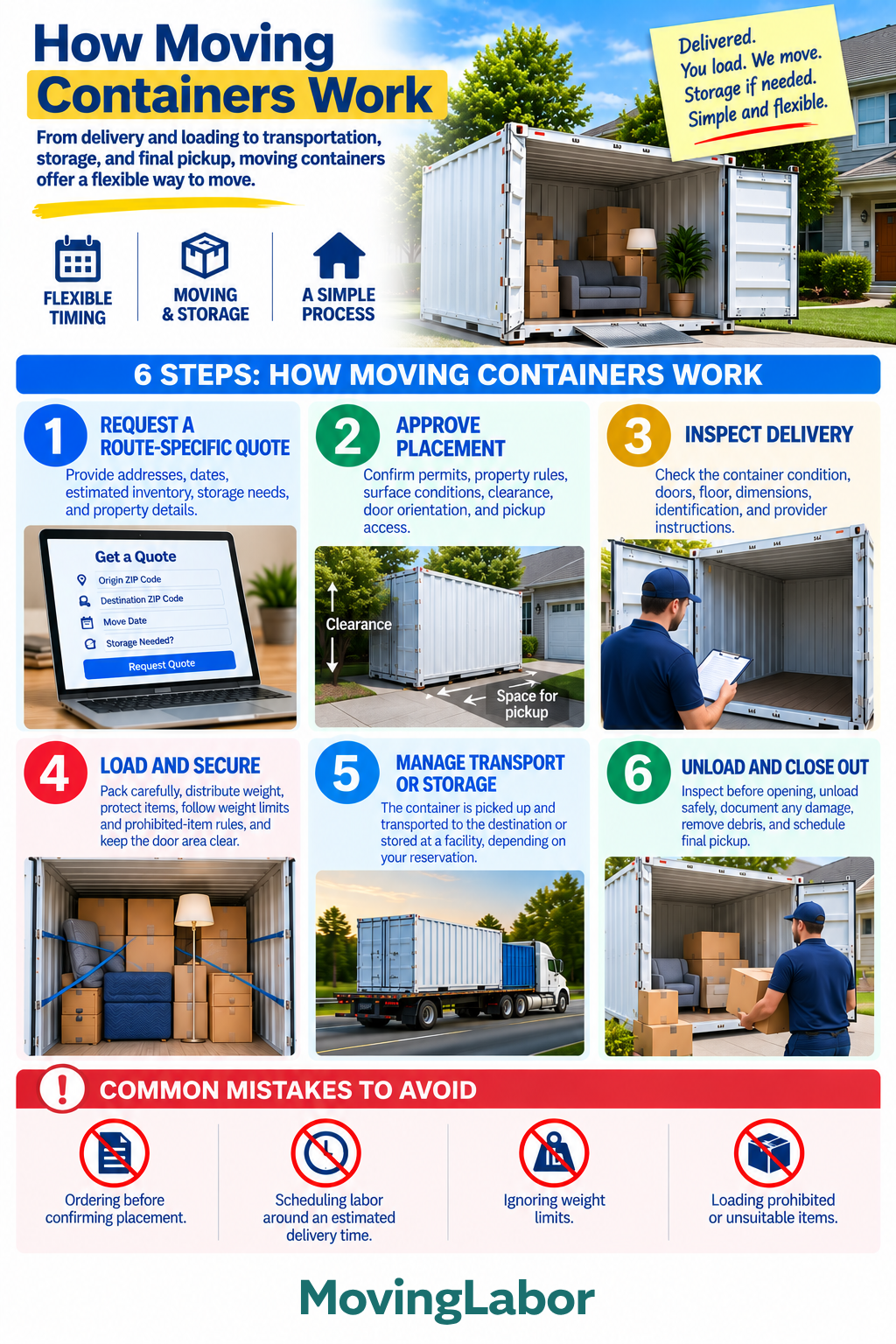
A portable moving container is delivered to an approved location, loaded during the available loading period, picked up for transportation or storage, delivered to the destination, unloaded, and removed. Depending on the provider and reservation, the customer coordinates placement, packing, loading and unloading, locks, access, and compliance with prohibited-item rules.
Container sizes, availability, service areas, loading rules, storage options, and pricing vary by provider and route. Confirm the specific equipment, placement requirements, weight limits, schedule, and reservation terms before the container is delivered.
Quick Answer
Moving containers combine transportation and, when available, storage without requiring the customer to drive a moving truck.
The basic process is reserve the container, approve its placement, inspect it when delivered, load and secure your belongings, have it transported or stored, and unload it at the destination. Exact timing, access, equipment, and rules depend on the provider and reservation.
Step-by-step plan
1. Request a route-specific quote
Provide the origin and destination, expected dates, estimated inventory, storage needs, and relevant property-access information.
Confirm what the quote includes, such as container rental, delivery, pickup, transportation, storage, coverage, and other applicable charges.
2. Approve placement
Determine where the container can be legally and practically placed before delivery.
Check applicable property or building rules, permits where required, driveway or parking conditions, slope, overhead clearance, delivery access, door orientation, and space for later pickup.
If the container will be placed on a driveway or other private surface, also confirm the provider's placement requirements.
3. Inspect the delivered container
Before loading, confirm that the delivered container matches the reservation and inspect its condition.
Check the doors, floor, walls, visible damage, water intrusion, available tie-down or anchor points, and any identification or equipment information provided.
Review the current weight limit, loading instructions, prohibited-item rules, and lock requirements before putting belongings inside.
4. Load and secure
Distribute weight appropriately and build stable sections as you load.
Protect furniture and boxes from contact damage, keep heavier belongings low, control gaps, and use suitable restraints where appropriate. Keep the door area clear enough that belongings cannot shift against the doors.
Follow the provider's weight limits and prohibited-item rules.
5. Manage transportation or storage
Confirm when the loaded container will be picked up and what happens next.
Depending on the reservation, the container may travel toward the destination, remain temporarily at the property, or be stored at a provider facility.
Keep track of pickup timing, estimated transit or redelivery windows, storage charges, billing periods, storage-access rules, and destination readiness.
6. Unload and close out
Inspect the container before opening it at the destination, particularly if belongings may have shifted during transportation.
Open the doors carefully, unload in a controlled order, and document significant container or property damage before cleanup when appropriate.
Remove your belongings and debris, complete any required container check, and confirm final pickup or removal.
Decision checkpoints
- Before booking: Confirm route availability, container size, estimated cost, storage needs, and placement requirements.
- Before delivery: Make sure the placement area and delivery path are accessible and any required permissions or permits are handled.
- Before pickup: Check weight distribution, load stability, restraints, prohibited items, lock requirements, and the door area.
- Before destination delivery: Confirm placement access and coordinate unloading labor if needed.
Move-day checklist
- Confirm the delivered container matches the reservation
- Inspect the container before loading
- Review the weight limit
- Review prohibited-item rules
- Confirm lock requirements
- Keep heavy belongings low
- Distribute weight appropriately
- Secure the load against shifting
- Keep the door area clear
- Coordinate loading labor with container availability
- Confirm loaded-container pickup arrangements
Common mistakes to avoid
Ordering before confirming placement
A container needs adequate delivery, placement, and pickup access. Check property restrictions and applicable permit requirements before finalizing the reservation.
Scheduling labor around an estimated delivery time
Do not assume an estimated delivery window guarantees that the container will be ready for loading at a specific time. Coordinate labor around the provider's confirmed schedule and allow for possible changes.
Ignoring weight limits
A container can reach its allowable weight before all of its interior space is used. Dense belongings such as books, tools, boxed files, gym equipment, and other heavy items deserve extra attention during planning.
Loading prohibited or unsuitable items
Review the provider's current prohibited-item rules before loading. Also consider whether belongings that are wet, perishable, or sensitive to temperature or humidity are appropriate for the planned transportation or storage conditions.
Where professional moving labor fits
Professional moving labor can load or unload a customer-arranged portable moving container.
Coordinate the crew with confirmed container delivery, pickup, placement, and destination availability. When booking labor, provide the container type and size, inventory, heavy or difficult items, stairs, walking distance, and property-access conditions.
Use Moving storage or the Truck and Container Calculator to continue planning. For this guide, apply the result to the Request a route-specific quote step and confirm the final scope, availability, minimums, and price in writing.