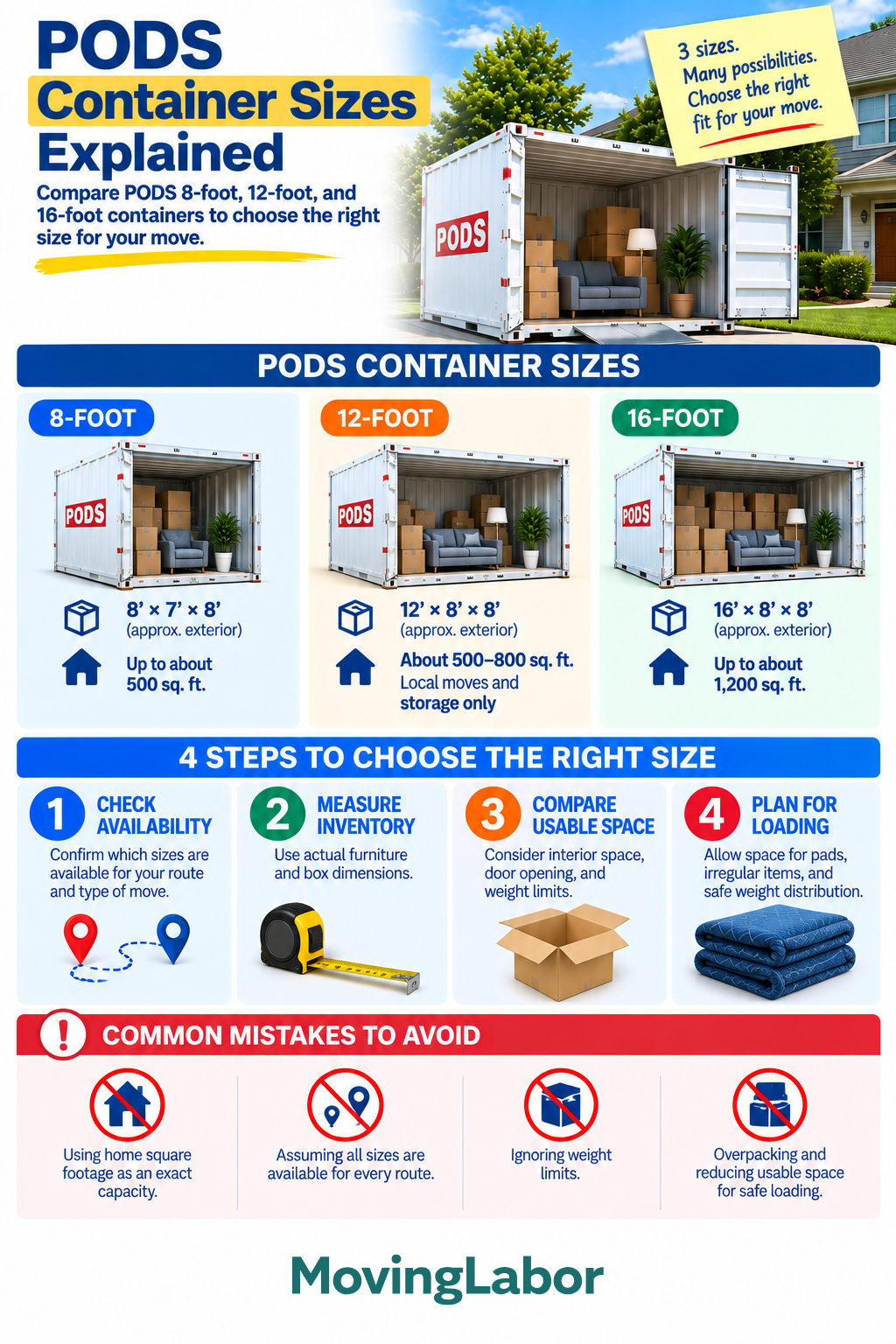
PODS currently offers three portable container sizes: 8-foot, 12-foot, and 16-foot. The right size depends on how much you are moving, the dimensions of your furniture, whether the move is local or long-distance, available weight capacity, property access, and how efficiently the container can be loaded.
PODS notes that container dimensions are approximate and can vary slightly by model. The 12-foot container is currently available for local moves and storage rather than long-distance moves. Confirm current availability and the specific equipment offered for your ZIP codes before booking.
Quick Answer
PODS currently lists three container sizes: 8-foot, 12-foot, and 16-foot.
8-foot container
Approximately 8' × 7' × 8'. PODS suggests it for belongings from spaces up to about 500 sq. ft.
12-foot container
Approximately 12' × 8' × 8'. PODS suggests it for roughly 500–800 sq. ft. and currently offers it for local moves and storage.
16-foot container
Approximately 16' × 8' × 8'. PODS suggests it for belongings from spaces up to about 1,200 sq. ft.
These size guidelines are planning estimates, not capacity guarantees. The amount that actually fits depends on your furniture, boxes, inventory density, loading efficiency, protective materials, and the container's weight limit.
Step-by-step plan
1. Check which sizes are available
Start with the origin, destination, and type of move.
For local moving or storage, PODS currently lists 8-, 12-, and 16-foot options. For long-distance moves, the 12-foot container is not currently offered, so available choices differ. Availability can also vary by location.
2. Measure your inventory
Use your actual belongings rather than relying entirely on home square footage or bedroom count.
Pay particular attention to:
- Sectional sofas
- Mattresses and bed frames
- Dining tables
- Appliances
- Dressers
- Patio furniture
- Garage contents
- Large quantities of boxes
Square-footage recommendations are useful starting points, but two similarly sized homes can require very different amounts of container space.
3. Compare usable space
Do not choose a container based only on its advertised length.
Confirm the dimensions of the equipment being reserved and consider the door opening, usable interior space, weight limits, and how your largest belongings will fit.
PODS notes that its published dimensions are based on exterior measurements and that individual container models may vary slightly.
4. Allow for real-world loading
Theoretical volume is not the same as usable moving capacity.
Moving pads, irregular furniture shapes, fragile belongings, safe stacking, restraints, and weight distribution all consume or affect usable space.
Leave enough flexibility to build a stable load rather than forcing belongings into every available gap.
5. Plan multiple containers when needed
Larger inventories may require more than one container.
When using multiple containers, decide which belongings will go into each one before loading. Keep each load appropriately balanced and label belongings so unloading priorities remain clear.
PODS' current sizing guidance also includes multi-container combinations for larger household inventories.
6. Inspect the delivered container
Before loading, confirm that the delivered equipment matches your reservation.
Inspect its condition, doors, floor, usable space, and available tie-down points. Review the current weight limit, loading requirements, prohibited-item rules, and lock requirements.
Do not assume every container in the fleet has exactly the same measurements simply because it carries the same nominal size designation.
Decision checkpoints
- Before booking: Confirm which PODS sizes are available for the origin, destination, and type of move.
- Before selecting a size: Measure large furniture and estimate the complete inventory rather than relying solely on home square footage.
- Before deciding on one or multiple containers: Consider usable space, weight, loading efficiency, and oversized belongings.
- Before loading: Inspect the delivered container and confirm its specifications and condition.
Move-day checklist
- Confirm the delivered container size
- Inspect the container before loading
- Review the applicable weight limit
- Measure unusually large belongings
- Keep heavy belongings low
- Distribute weight appropriately
- Protect furniture and finished surfaces
- Build stable load sections
- Secure belongings against movement
- Keep the door area clear
- Confirm lock and pickup requirements
Common mistakes to avoid
Treating square footage as an exact capacity formula
Home size is only a starting point. Furniture quantity, oversized belongings, garage contents, boxes, and packing efficiency can significantly change the amount of container space required.
Assuming all three sizes work for every move
They do not. PODS currently limits its 12-foot container to local moves and storage, while long-distance moves use other available sizes. Confirm availability for the specific route.
Comparing only exterior length
An 8-, 12-, or 16-foot label does not tell you everything about usable capacity. Consider actual dimensions, door access, inventory shape, and loading efficiency.
Filling the container by volume while ignoring weight
Available space does not necessarily mean available weight capacity. Dense belongings can create weight limitations before the container appears full.
Where professional moving labor fits
Professional moving labor can load or unload a customer-arranged PODS container.
When booking labor, provide the container size and quantity, inventory, heavy or difficult items, stairs, walking distance, and property-access conditions. If multiple containers are being used, identify how the inventory will be divided.
Use PODS loading and unloading help or the Truck and Container Calculator to continue planning. For this guide, apply the result to the Start with current availability step and confirm the final scope, availability, minimums, and price in writing.