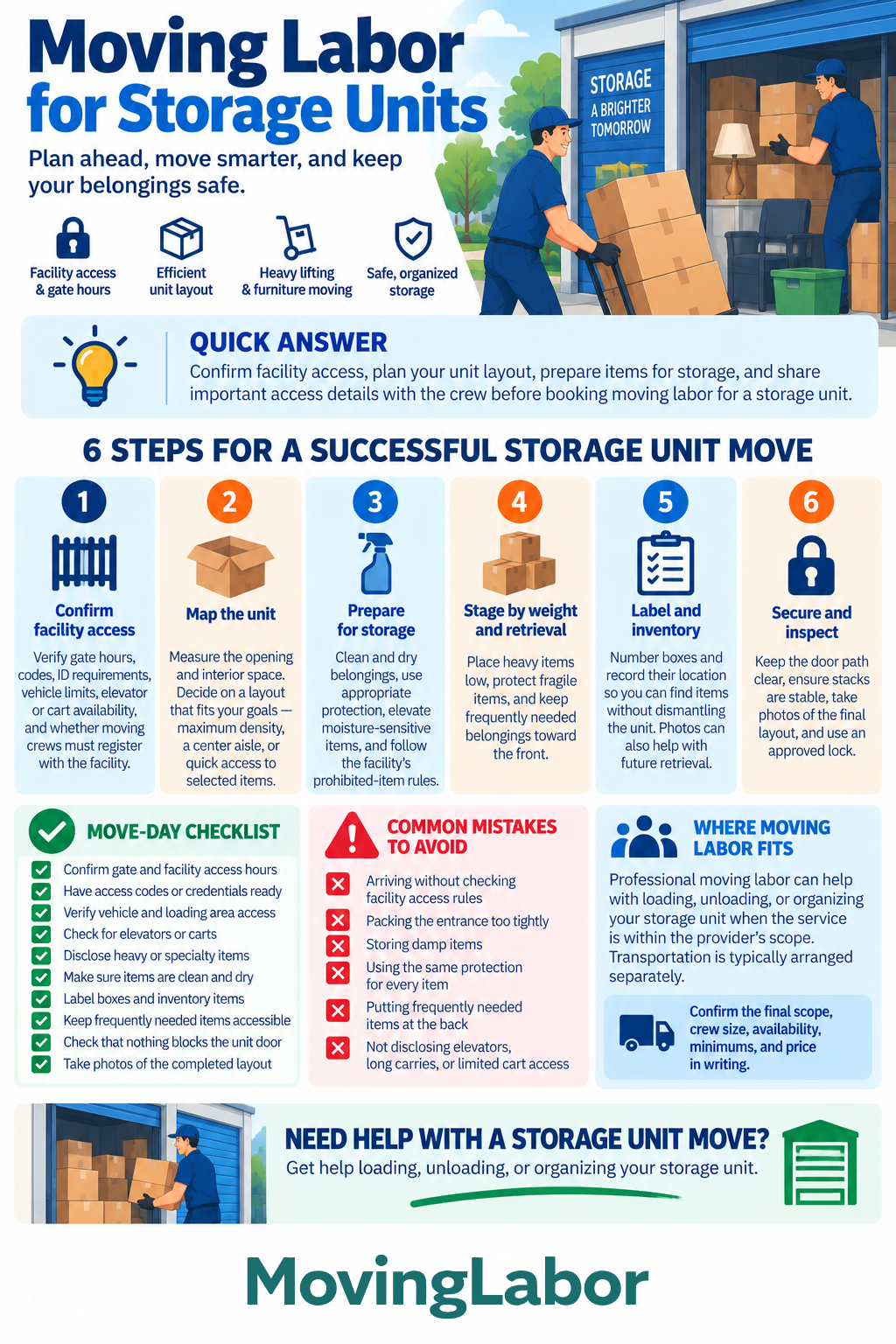
Moving labor can help load items into a storage unit, unload items from storage, or reorganize belongings within a unit. Good planning depends on facility access, vehicle clearance, walking distance, elevators or carts, unit dimensions, storage conditions, and a layout that keeps important items accessible.
This guide focuses on four important decisions: confirm facility access, map the unit, prepare for storage, and stage by weight and retrieval. With labor-only moving, transportation and physical moving labor are typically arranged separately. A clear inventory, accurate access details, and written scope help the crew understand the job and plan the work.
Quick Answer
Before booking moving labor for a storage unit, confirm the facility's gate hours, access procedures, vehicle restrictions, elevator or cart availability, and any rules for outside moving crews.
Then plan how the unit should be loaded. Decide which belongings need to remain accessible, prepare items appropriately for storage, and tell the crew about long carries, elevators, stairs, or other conditions between the vehicle and the unit.
Step-by-Step Plan
1. Confirm Facility Access
Check gate and office hours, entry codes or credentials, identification requirements, vehicle restrictions, loading areas, elevator access, and cart availability.
Ask the facility whether outside moving crews need to register, check in, provide documentation, or follow specific loading procedures.
2. Map the Unit
Measure the unit entrance and available interior space when needed. Decide how you want the unit organized before loading begins.
If you expect to retrieve belongings regularly, consider maintaining an accessible path and keeping frequently needed items near the front. If long-term storage is the priority, discuss how the available space should be used while maintaining safe access to the door.
3. Prepare for Storage
Make sure belongings are clean and dry before placing them into storage. Protect furniture and other items using materials appropriate for the item and storage conditions, and avoid trapping moisture where ventilation is needed.
Follow the storage facility's rules regarding prohibited or restricted items. Consider the facility's conditions when deciding how to protect moisture-sensitive belongings.
4. Stage by Weight and Retrieval
Place stable, heavier belongings where they can support the planned layout without creating an unstable stack. Protect fragile items from crushing or shifting.
Keep belongings that will be needed soon toward the front or along an accessible path. Avoid burying frequently needed items behind belongings intended for long-term storage.
5. Label and Inventory
Label boxes clearly and consider numbering them or assigning them to zones within the storage unit.
Keep a simple inventory showing what is stored and where important items are located. Photos of the completed layout can also make future retrieval easier.
6. Secure and Inspect
Before leaving, make sure boxes, furniture, and other belongings are stable and do not interfere with the storage unit door.
Photograph the completed layout, verify that important items remain accessible as planned, and secure the unit using a lock permitted or recommended by the facility.
Decision Checkpoints
- Before booking: Confirm facility access, gate hours, loading procedures, vehicle restrictions, elevators, carts, and any requirements for outside moving crews.
- Before loading begins: Decide which belongings need frequent access and explain the planned unit layout to the crew.
- Before items enter storage: Make sure belongings are appropriately prepared, dry, labeled, and organized according to their weight, fragility, and expected retrieval.
- Before leaving the facility: Check that the unit door operates freely, stacks appear stable, priority belongings remain accessible, and the unit is properly secured.
Move-Day Checklist
- Confirm gate and facility access hours
- Have access codes or required credentials available
- Verify the vehicle can access the designated loading area
- Confirm elevator and cart availability when applicable
- Tell the crew about long carries or difficult access
- Make sure belongings are clean and dry
- Disclose heavy or specialty items
- Label boxes before loading
- Identify items that need to remain accessible
- Keep an inventory or photos of stored belongings
- Check that nothing blocks the unit door
- Secure the unit before leaving
Common Mistakes to Avoid
- Arriving without checking facility access rules. Gate hours, vehicle restrictions, loading procedures, elevators, and requirements for outside crews can affect the move.
- Packing the entrance too tightly. Leave enough clearance for the unit door to operate properly and consider access to belongings you may need later.
- Storing belongings before they are dry. Moisture trapped in or around stored belongings can contribute to damage during storage.
- Using the same protection for every item. Furniture, mattresses, electronics, boxes, and other belongings may have different storage and ventilation needs.
- Putting frequently needed belongings at the back. Decide what you are likely to retrieve before the crew begins loading the unit.
- Failing to disclose long carries or elevator access. Tell the moving labor provider how far the crew will travel between the vehicle and storage unit and whether elevators, stairs, or carts are involved.
Where Professional Moving Labor Fits
Professional moving labor can help with agreed physical work such as loading belongings into a storage unit, unloading belongings from storage, moving items between a storage unit and separately arranged transportation, or reorganizing items within a unit when the provider offers that service.
With labor-only service, the customer typically remains responsible for arranging the rental truck, moving container, or other transportation. The customer is also responsible for securing access to the storage facility and unit.
Provide the moving labor provider with the facility address, unit location, inventory, heavy or specialty items, elevator or stair access, walking distance, loading conditions, and the work you want completed.
Use Storage moving help or the Move Inventory Builder to continue planning.
Confirm the final scope, crew size, availability, minimums, arrival window, and price in writing before the scheduled work.