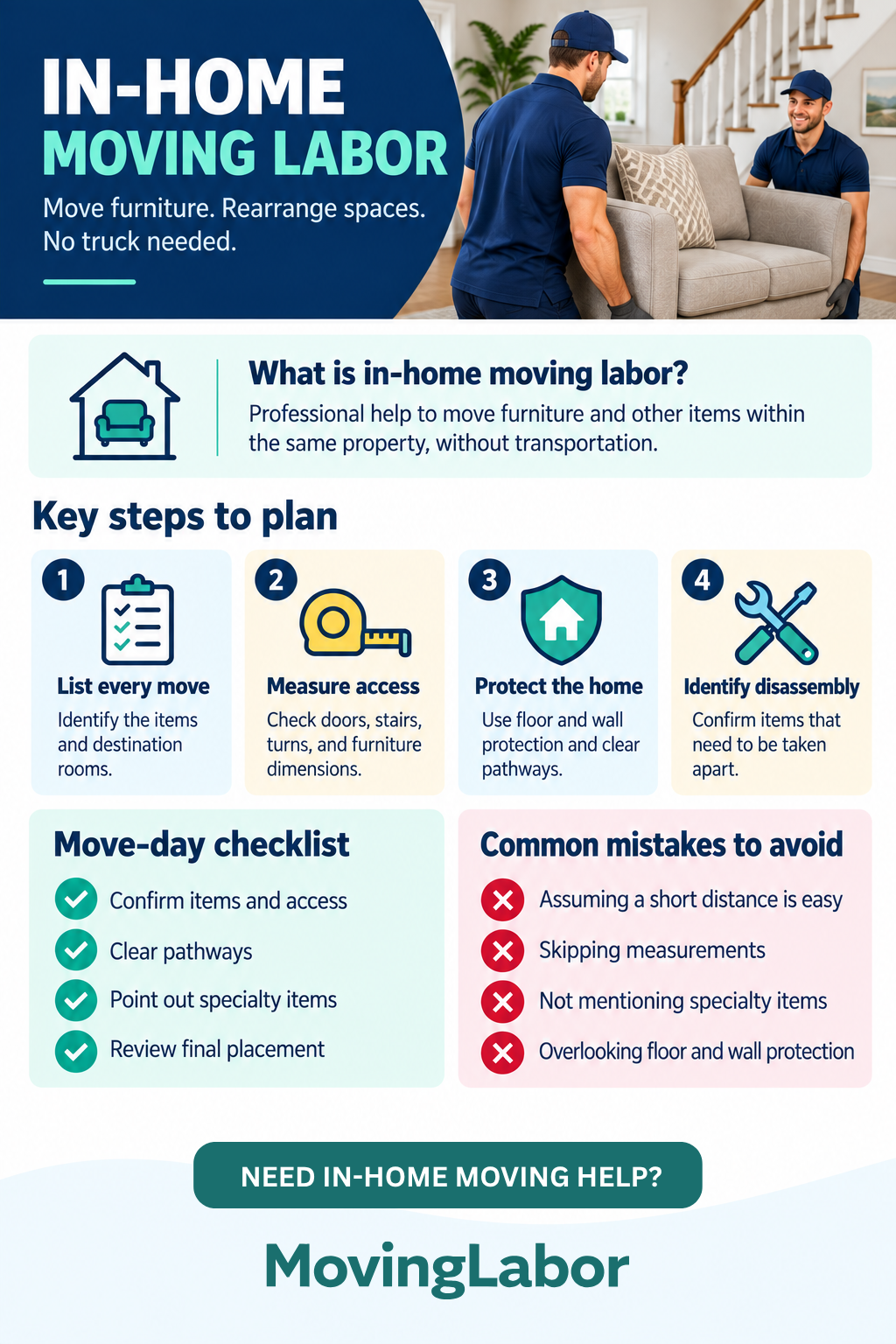
In-home moving labor covers furniture rearranging, room-to-room moves, stair carries, assembly or disassembly, and other moving tasks performed within the same property. Because furniture does not need to travel far, it can be easy to underestimate the work involved. Weight, dimensions, stairs, tight turns, flooring, and specialty-item requirements can all affect how the job should be planned.
This guide covers four important decisions when planning in-home moving help: list every move, measure before lifting, protect the home, and identify disassembly. A clear inventory, accurate access details, and a written scope can help the moving labor provider estimate the time needed and arrive prepared for the job.
Quick Answer
In-home moving labor helps move furniture and other household items within the same property, without transportation. Before booking, list everything you want moved, measure the route and furniture, identify stairs or other access challenges, and tell the provider about specialty items or furniture that may require disassembly.
If the inventory, access conditions, or scope changes before move day, update the moving labor provider so the crew size, estimated time, equipment needs, and scope can be reviewed.
Step-by-step plan
1. List every move
Identify each item you want moved, its current room, destination room, floor level, and desired placement or orientation.
Include furniture, appliances, boxes, exercise equipment, and other household items involved in the job. A complete list gives the moving labor provider a clearer picture of the work before the crew arrives.
2. Measure before lifting
Measure large furniture and check the route it will need to travel. Review doorways, hallways, stairs, ceilings, landings, turns, railings, and the final placement area.
Do not assume an item will fit simply because it was previously moved into the home. Furniture may have been assembled after delivery, or the original route may have been different.
3. Protect the home
Clear the moving path and discuss appropriate protection for floors, walls, corners, doors, and furniture before work begins.
Depending on the home and the job, this may include furniture pads, floor runners, corner guards, or door-jamb protection. Pay particular attention to newly finished floors, narrow hallways, tight doorways, and staircases.
4. Identify disassembly
Determine whether any furniture may need to be taken apart before it can be safely moved through the planned route.
Photograph hardware and assembly details when helpful, and confirm in advance whether disassembly and reassembly are included in the booked service. Some items may have manufacturer requirements or limitations that affect whether the crew can disassemble them.
5. Flag specialty items
Tell the moving labor provider about unusually heavy, oversized, fragile, or difficult-to-handle items before booking.
Safes, pianos, stone tops, oversized appliances, aquariums, exercise machines, and similar items may require special handling, additional crew members, or equipment. Providing dimensions, approximate weight, photos, and access information can help the provider determine whether the item is within the scope of service.
6. Approve final placement
Decide where furniture should go before the crew begins moving it whenever possible.
Once an item reaches its destination, check clearance for drawers, doors, vents, outlets, cords, and walking paths. Review the final placement before the crew leaves to reduce unnecessary repeated moves.
Decision checkpoints
- Before booking — Measure the route: Confirm furniture dimensions and check doorways, hallways, stairs, turns, railings, and other tight spaces.
- Before work begins — Confirm disassembly: Identify furniture that may need to be taken apart and confirm that any required disassembly and reassembly are included in the booked scope.
- Before the crew leaves — Approve final placement: Check furniture placement, clearance, and room layout before closing out the job.
Move-day checklist
- Confirm each item and its destination room
- Review stairs, tight turns, and other access challenges
- Clear pathways before moving begins
- Confirm floor, wall, and doorway protection as applicable
- Identify furniture requiring disassembly or reassembly
- Point out heavy, fragile, or specialty items
- Walk through priorities with the crew lead before work begins
- Review final furniture placement before the crew leaves
Common mistakes to avoid
- Assuming a short distance means an easy move. Moving a piece from one room to another can still be difficult when stairs, narrow doorways, tight turns, oversized furniture, or significant weight are involved.
- Trying to force furniture through an unmeasured space. Measure the furniture and planned route first. Some pieces may need to be safely disassembled before they can be moved.
- Waiting until move day to mention specialty items. Heavy, oversized, fragile, or difficult-to-handle items may affect crew size, equipment needs, time, or whether the item is within the provider's scope.
- Overlooking floors, walls, and doorways. Discuss appropriate protection before work begins, especially when the home has newly finished floors, narrow hallways, tight doorways, or stairs.
- Deciding furniture placement after the move begins. Knowing where each item should go can reduce repeated moves and unnecessary labor time.
Where professional moving labor fits
Professional in-home moving labor can help rearrange furniture, move items between rooms or floors, handle stair carries, and perform agreed furniture disassembly or reassembly without transporting your belongings to another property.
When requesting in-home moving help, provide an inventory, identify the destination for each item, describe stairs and other access conditions, and disclose heavy or specialty items in advance. Use these details when requesting an estimate and confirm the final scope, availability, minimums, and price in writing before booking.
Use In-home moving help or the Move Inventory Builder to continue planning.