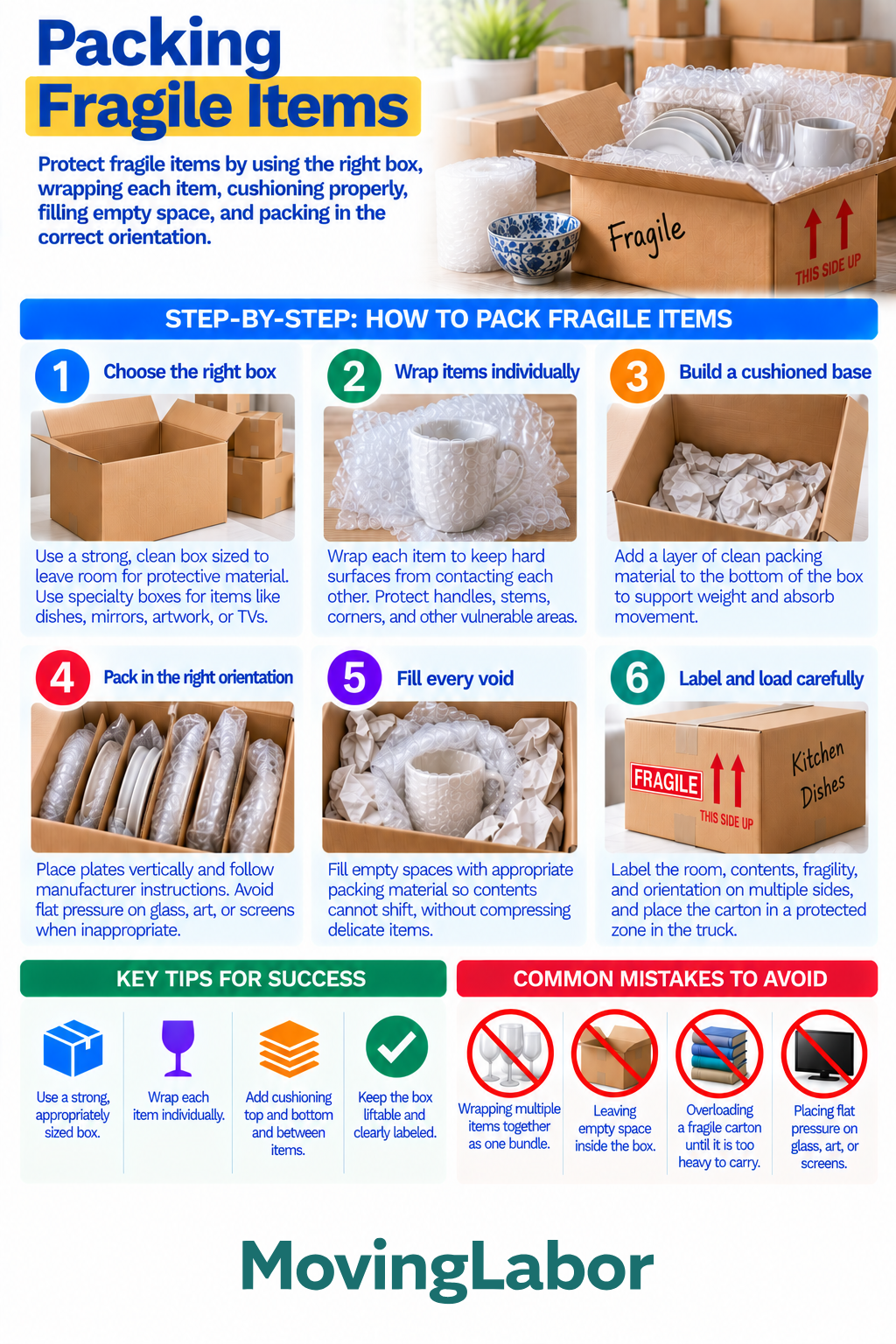
Fragile items need more than a FRAGILE label. Use a strong, appropriately sized box, wrap vulnerable items individually, cushion the bottom and top, prevent hard surfaces from touching, fill empty space, and pack each item in an appropriate orientation.
The goal is to prevent movement and direct contact without overpacking the carton or making it difficult to carry safely.
Quick Answer
For most fragile items, use this basic packing method:
- Choose a strong box with room for protective material.
- Cushion the bottom before adding items.
- Wrap fragile pieces individually.
- Separate hard or breakable surfaces from one another.
- Pack items in an appropriate orientation.
- Fill empty spaces so contents cannot shift excessively.
- Add cushioning above the contents before closing the box.
- Keep the carton reasonably liftable.
- Label the room, contents, fragility, and orientation where needed.
Different fragile items require different packing methods. Dishes, glassware, mirrors, artwork, electronics, and unusually shaped belongings should be packed according to their specific vulnerabilities.
Step-by-step plan
1. Choose the right box
Select the box before wrapping the item so you know how much space is available for cushioning.
Use a clean, dry, structurally sound carton that leaves enough room for protective material without creating excessive empty space.
Specialty boxes may be appropriate for items such as:
- Dishes and glassware
- Mirrors
- Artwork
- TVs and monitors
- Other unusually shaped or particularly vulnerable belongings
Do not use a damaged carton simply because the fragile item fits inside it.
2. Wrap fragile items individually
Protect individual pieces so hard surfaces do not strike or rub against one another.
Pay particular attention to vulnerable areas such as:
- Handles
- Stems
- Corners
- Rims
- Edges
- Protruding parts
- Finished surfaces
Avoid wrapping several breakable items together as one unprotected bundle.
When an item has detachable components, remove and pack them separately when appropriate and permitted by the manufacturer.
3. Build a cushioned base
Place suitable cushioning material across the bottom of the carton before adding fragile contents.
The base should help absorb movement and keep the lowest item from resting directly against the bottom of the box.
Use clean packing materials appropriate for the item being protected. Avoid materials that can scratch, stain, transfer ink, or otherwise affect vulnerable surfaces.
4. Pack items in the appropriate orientation
Orientation can make a significant difference with some fragile belongings.
For example, plates are generally better packed on edge rather than stacked flat. Mirrors, artwork, TVs, electronics, and other specialized items may have their own handling or orientation requirements.
Follow manufacturer instructions and orientation markings where applicable rather than assuming every fragile item should be packed the same way.
Avoid placing unnecessary pressure on glass, screens, artwork, or other vulnerable flat surfaces.
5. Fill empty spaces and cushion the top
After the items are positioned, fill open spaces with appropriate packing material so the contents cannot shift excessively during normal handling.
Do not force excessive material into the box if doing so places pressure on delicate contents.
Add protective material above the contents before closing the carton.
When finished, the box should close normally without bulging and the contents should remain securely positioned during gentle handling.
6. Label and load carefully
Clearly identify fragile cartons before they enter the loading area.
Include:
- Destination room
- Brief contents
- FRAGILE when appropriate
- THIS SIDE UP or other orientation instructions when required
Place important labels on the top and multiple sides so they remain visible when cartons are stacked.
During loading, keep fragile cartons away from locations where they could be crushed by furniture, heavy boxes, or shifting cargo. Do not rely on the FRAGILE label alone to protect the contents.
Decision checkpoints
- Before packing: Identify which belongings need ordinary fragile-item packing and which need specialty cartons or manufacturer-specific handling.
- Before placing items in the box: Check the carton and make sure the bottom is properly secured and cushioned.
- Before closing the box: Confirm that individual items are protected, separated, appropriately oriented, and unable to shift excessively.
- Before staging: Make sure the carton is reasonably liftable and clearly labeled.
- Before loading: Identify an appropriate protected position where the carton will not be crushed or exposed to unstable cargo.
Fragile-item packing checklist
- Strong, dry carton selected
- Specialty box used where appropriate
- Bottom securely closed
- Cushioned base added
- Fragile pieces wrapped individually
- Hard surfaces separated
- Handles, stems, corners, and edges protected
- Appropriate orientation maintained
- Empty spaces filled
- Top cushioning added
- Box closes without bulging
- Carton remains reasonably liftable
- Room and contents labeled
- FRAGILE marked where appropriate
- Orientation marked when necessary
- Protected loading position planned
Common mistakes to avoid
Wrapping several fragile items together
Breakable items can strike each other inside the bundle. Wrap and separate individual pieces so hard surfaces do not make direct contact.
Leaving empty space inside the box
A carton may look full while still allowing its contents to move. Fill appropriate gaps so fragile items remain securely positioned.
Packing fragile items too tightly
More packing material is not always better. Excessive compression can place pressure on glass, screens, delicate edges, or other vulnerable components.
Using the wrong orientation
Plates, mirrors, artwork, electronics, and other fragile belongings may require different orientations. Pack according to the item's needs and applicable manufacturer instructions.
Making fragile boxes too heavy
A carton that is difficult to carry level is harder to control. Divide dense or heavy fragile belongings among additional boxes when appropriate.
Relying on the FRAGILE label for protection
A label communicates handling needs but does not replace proper wrapping, cushioning, separation, stable loading, or protection from heavy cargo.
Where professional moving labor fits
Professional packing help can be useful for large quantities of dishes and glassware, artwork, mirrors, electronics, antiques, or other belongings that require more careful preparation.
Before booking, confirm which items the packing service will handle and whether boxes, specialty cartons, cushioning, and other packing materials are included.
For unusually valuable, delicate, or specialized belongings, confirm whether the provider offers the appropriate packing or crating service rather than assuming ordinary household packing is suitable.
Use Professional packing help or the Packing Materials Calculator to continue planning. For this guide, apply the result to the Choose the container first step and confirm the final scope, availability, minimums, and price in writing.