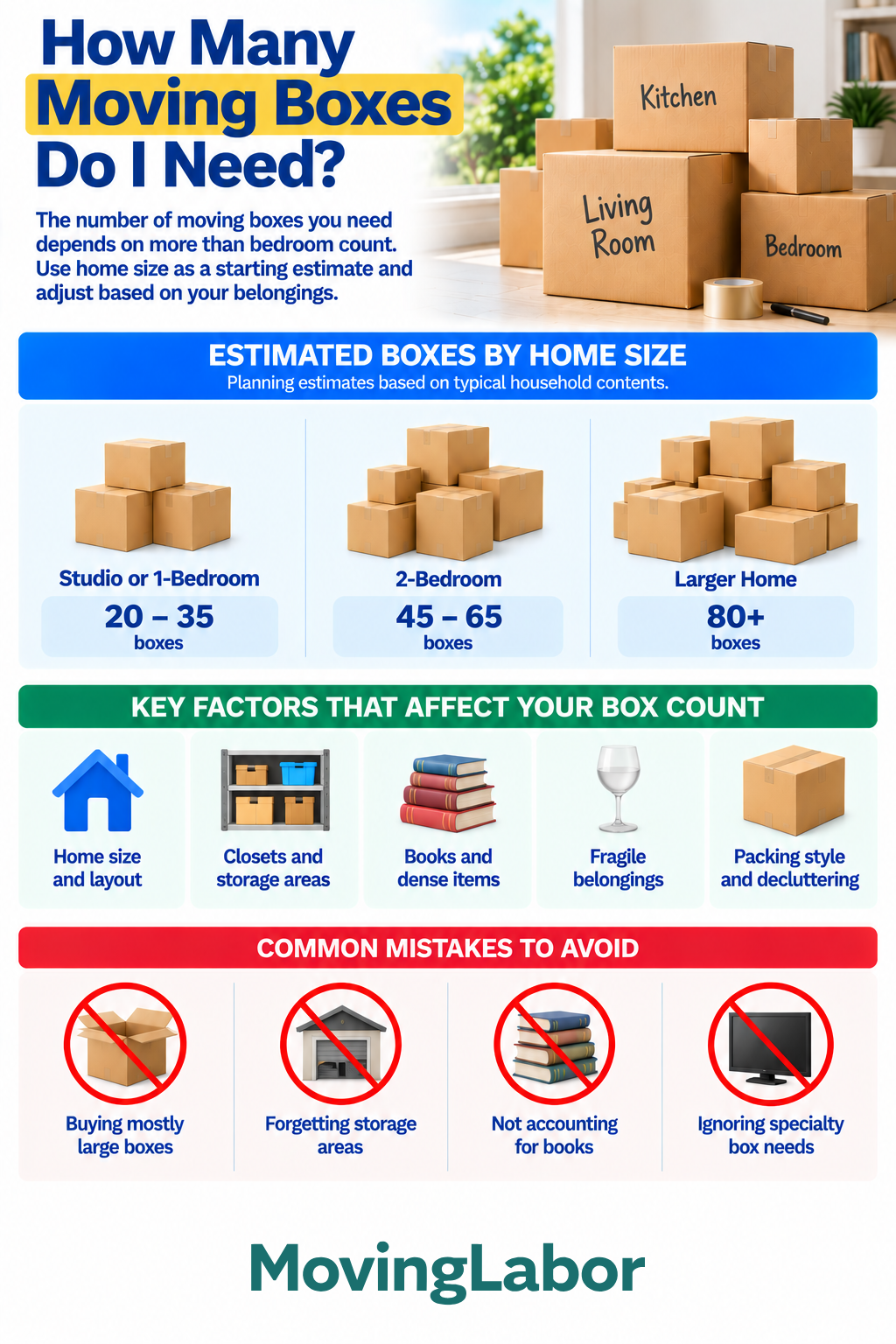
The number of moving boxes you need depends on more than bedroom count. Home size provides a useful starting estimate, but household density, closets, storage areas, books, fragile belongings, and how much you declutter can significantly change the final number.
Quick Answer
Use these as planning estimates, not guaranteed box counts:
- Studio or 1-bedroom: about 20–35 boxes
- 2-bedroom home: about 45–65 boxes
- Larger home: about 80+ boxes
These ranges come from MovingLabor.com's current packing-supply examples. Actual needs can be higher or lower depending on how much you own, storage areas, books, fragile belongings, clothing, electronics, and packing style.
Step-by-step plan
1. Inventory every space
Walk through the entire home before estimating boxes.
Include:
- Bedrooms and closets
- Kitchen and pantry
- Bathrooms
- Living and dining areas
- Home office
- Garage
- Basement or attic
- Shed
- Linen and utility closets
- Seasonal storage
A home with packed closets, bookshelves, garage storage, and seasonal belongings can require substantially more boxes than another home of the same size.
2. Sort before estimating
Separate belongings you plan to donate, sell, discard, or transport separately before finalizing your box count.
There is little benefit in buying boxes for belongings you ultimately will not move.
After decluttering, use the remaining inventory to refine your estimate.
3. Match box size to weight
Do not simply buy the largest boxes available.
Small boxes work well for books, pantry goods, small decor, and other dense belongings.
Medium boxes are versatile for kitchen items, toys, household goods, and many general belongings.
Large boxes are better for lightweight, bulky belongings such as linens, pillows, and lampshades.
4. Add specialty boxes where needed
General-purpose boxes do not cover every packing need.
Depending on your belongings, you may need:
- Wardrobe boxes
- Dish boxes
- TV or monitor boxes
- Mirror and artwork boxes
- File boxes
- Other specialty cartons
Count these separately rather than assuming every specialty item can go into your supply of general moving boxes.
5. Keep a modest box buffer
An estimate does not need to predict the final box count perfectly.
Keep a few additional sound boxes available for belongings you overlooked, boxes that become unusable, or rooms that require more cartons than expected.
Avoid buying a large surplus of random sizes simply to be safe.
6. Adjust after packing the first rooms
Your actual packing rate is one of the best ways to improve the estimate.
After packing a few representative rooms, compare the number and sizes of boxes used with what you expected.
If you are using boxes faster than planned, adjust the remaining estimate before packing becomes time-critical. If decluttering reduced the inventory substantially, you may need fewer boxes.
Decision checkpoints
- Before estimating: Inventory closets, garages, attics, basements, and other storage areas.
- After decluttering: Estimate boxes from the belongings that are actually moving.
- Before buying supplies: Separate general-purpose boxes from specialty-box needs.
- After packing the first rooms: Compare actual box use with your estimate and adjust the remaining quantity.
- Before buying additional boxes: Check which sizes you are actually running short on.
Moving box planning checklist
- Entire home inventoried
- Closets included
- Garage and storage areas included
- Donations and discarded items removed
- Books and dense belongings identified
- Fragile belongings identified
- Specialty boxes counted separately
- Small, medium, and large boxes planned
- Extra boxes kept to a reasonable amount
- Actual box use tracked while packing
Common mistakes to avoid
Treating bedroom count as an exact formula
Two 2-bedroom homes can have very different inventories. Use home size as a starting point and refine the estimate with the belongings actually being moved.
Buying mostly large boxes
Large boxes provide more volume but can become difficult to handle when filled with dense belongings. Use smaller boxes for books and other heavy contents.
Forgetting storage areas
Closets, garages, attics, basements, sheds, and seasonal storage can add substantially to the number of boxes required.
Ignoring specialty boxes
TVs, mirrors, artwork, hanging clothing, dishes, and other belongings may require different cartons or protection than ordinary household goods.
Buying the entire estimate before testing it
Start with a reasonable supply, pack several rooms, and use your actual box consumption to refine what remains.
Where professional packing help fits
Professional packing help can reduce the time required to box and prepare a household for moving.
Before booking, confirm whether the packing crew supplies boxes and packing materials or expects you to provide them. Also confirm which belongings are included, whether specialty packing is available, and how completed boxes will be labeled and staged.
Use Professional packing help or the Packing Materials Calculator to continue planning. For this guide, apply the result to the Inventory every space step and confirm the final scope, availability, minimums, and price in writing.