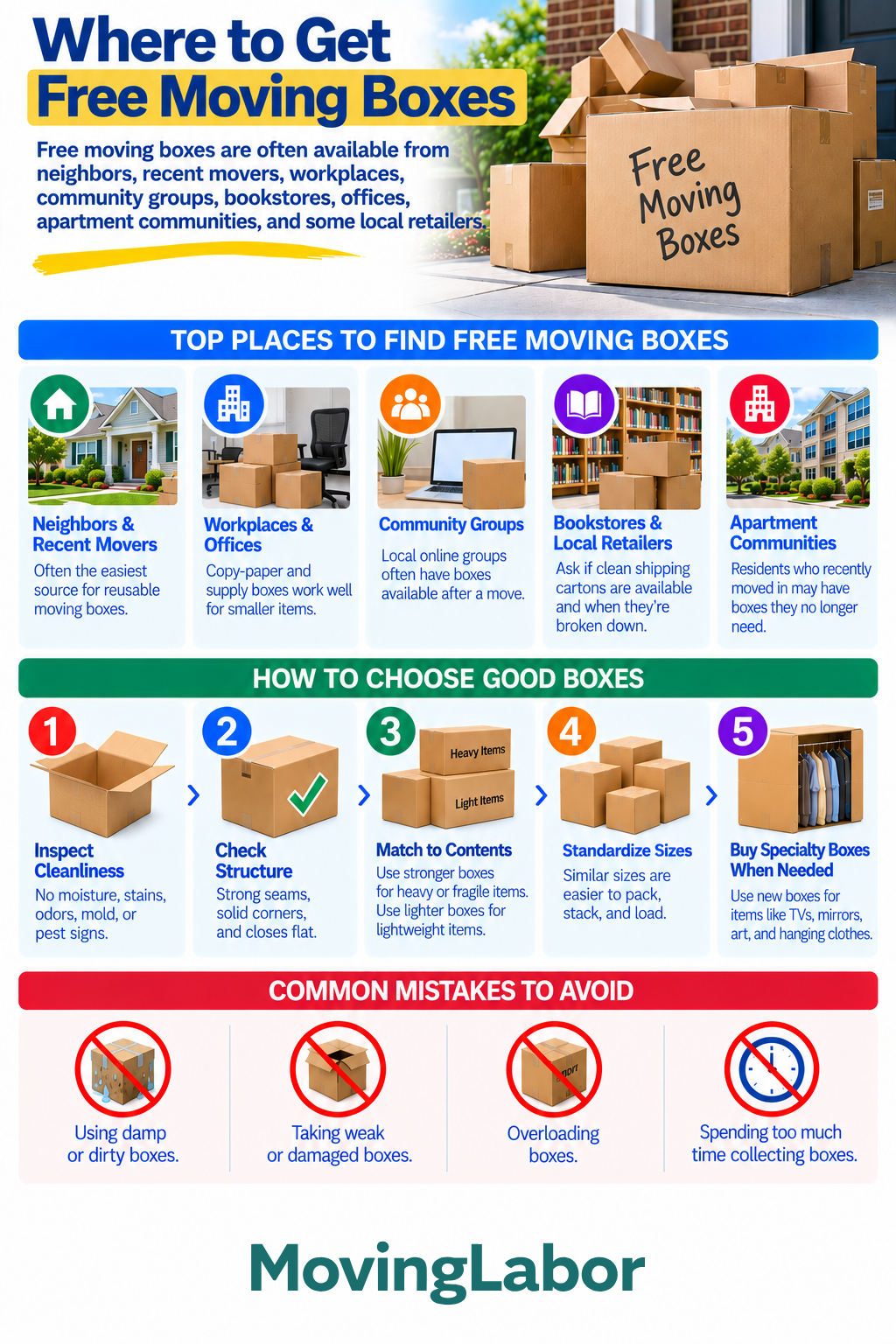
Free moving boxes are often available from neighbors and recent movers, workplaces, community groups, bookstores, offices, apartment communities, and some local retailers. Ask before taking boxes from a business or recycling area, and only use cartons that are clean, dry, odor-free, pest-free, and structurally sound.
Free boxes can reduce packing costs, but not every used carton is suitable for moving. Choose boxes that are strong enough for their contents, stable enough to stack, easy to close, clearly labeled, and reasonably liftable when packed.
Quick Answer
Good places to look for free moving boxes include:
- Neighbors and recent movers: Often a good source for reusable moving boxes in standard sizes.
- Workplaces and offices: Copy-paper and supply boxes can work well for smaller belongings.
- Community groups: Neighborhood groups and local online communities often have people giving away boxes after a move.
- Bookstores and local retailers: Ask whether clean shipping cartons are available and when boxes are normally broken down.
- Apartment communities: Residents who recently moved in may have boxes they no longer need.
Ask before taking boxes from private property, stores, dumpsters, or recycling areas.
Inspect every free box before bringing it home. Skip anything damp, stained, crushed, odorous, contaminated, or showing signs of pests.
Step-by-step plan
1. Ask early and be specific
Start collecting boxes before packing becomes urgent. Ask for clean, sturdy small and medium cartons rather than accepting every available box.
If possible, prioritize actual moving boxes, sturdy shipping cartons, copy-paper boxes, and similar sizes that are easier to pack and stack.
When getting boxes from a business, ask permission and find out when suitable cartons are normally available.
2. Inspect cleanliness
Reject boxes with moisture, grease, food residue, unusual odors, mold, pest evidence, or unknown contamination.
Check the inside, outside, seams, and bottom rather than judging the box only by its appearance from the top.
3. Inspect the structure
Check the bottom seams, corners, walls, closures, and previous tape areas.
Avoid boxes with crushed corners, torn hand holes, weakened bottoms, significant creases, water damage, or walls that no longer hold their shape.
The box should close properly and remain stable when packed.
4. Match the box to the contents
Use your strongest cartons for dense, fragile, or breakable belongings.
Lighter but structurally sound boxes can be used for lightweight belongings such as linens or other soft goods. Recycle boxes that are structurally questionable.
Avoid making any box so heavy that it becomes difficult to lift and control.
5. Standardize sizes when possible
A smaller selection of similar box sizes is usually easier to stack than a collection of irregular shipping cartons.
Standard sizes can also make it easier to build stable rows inside a moving truck or container.
You do not need every box to match, but avoid collecting awkward cartons simply because they are free.
6. Buy specialty boxes when needed
Free general-purpose boxes will not work well for every belonging.
Consider appropriate new or specialty cartons for items such as:
- Dishes and glassware
- TVs and monitors
- Mirrors and artwork
- Hanging clothes
- Files and documents
- Other fragile or unusually shaped belongings
Choose the box based on the protection and fit the item requires rather than trying to make an unsuitable free box work.
Decision checkpoints
- Before collecting boxes: Decide which sizes and approximate quantities you actually need.
- Before bringing used boxes home: Check for moisture, odors, residue, pests, and contamination.
- Before packing: Check seams, corners, walls, and closures for structural damage.
- Before loading: Make sure every packed box is closed securely, labeled, reasonably liftable, and strong enough to stack.
Moving box checklist
- Clean and dry
- No pest or mold signs
- No strong or unusual odors
- Bottom seams intact
- Corners not crushed
- Box closes properly
- Appropriate strength for contents
- Packed without excessive weight
- Securely taped where needed
- Labeled by room and contents
- Old shipping labels removed or covered
Common mistakes to avoid
Taking every free box available
Irregular, weak, or oversized cartons can be harder to pack and stack than a smaller collection of good boxes. Be selective.
Using food-stained or damp boxes
Food residue, moisture, odors, or pest evidence are reasons to leave a box behind.
Trusting a box because it looks good from the top
Check the bottom seam, corners, walls, and previous tape areas. Damage at the base becomes particularly important when the box is lifted or stacked.
Overloading used boxes
A previously used carton may not retain its original strength. Keep packed boxes reasonably liftable and use stronger cartons for dense belongings.
Spending too much time looking for free boxes
Free boxes save money only when collecting them remains practical. If you still lack suitable sizes close to packing day, buying the remaining boxes can be more efficient.
Where professional packing help fits
Professional packing help can be useful when you have limited time, a large amount to pack, or fragile and difficult belongings.
Before booking, confirm whether the packing crew supplies boxes and packing materials or expects you to provide them. Also confirm which belongings are included, whether furniture preparation or disassembly is part of the service, and how completed boxes will be labeled and staged.
If you collect free boxes before professional packers arrive, use clean, structurally sound cartons and avoid relying on irregular or damaged boxes for fragile belongings.
Use Professional packing help or the Packing Materials Calculator to continue planning. For this guide, apply the result to the Ask early and specifically step and confirm the final scope, availability, minimums, and price in writing.