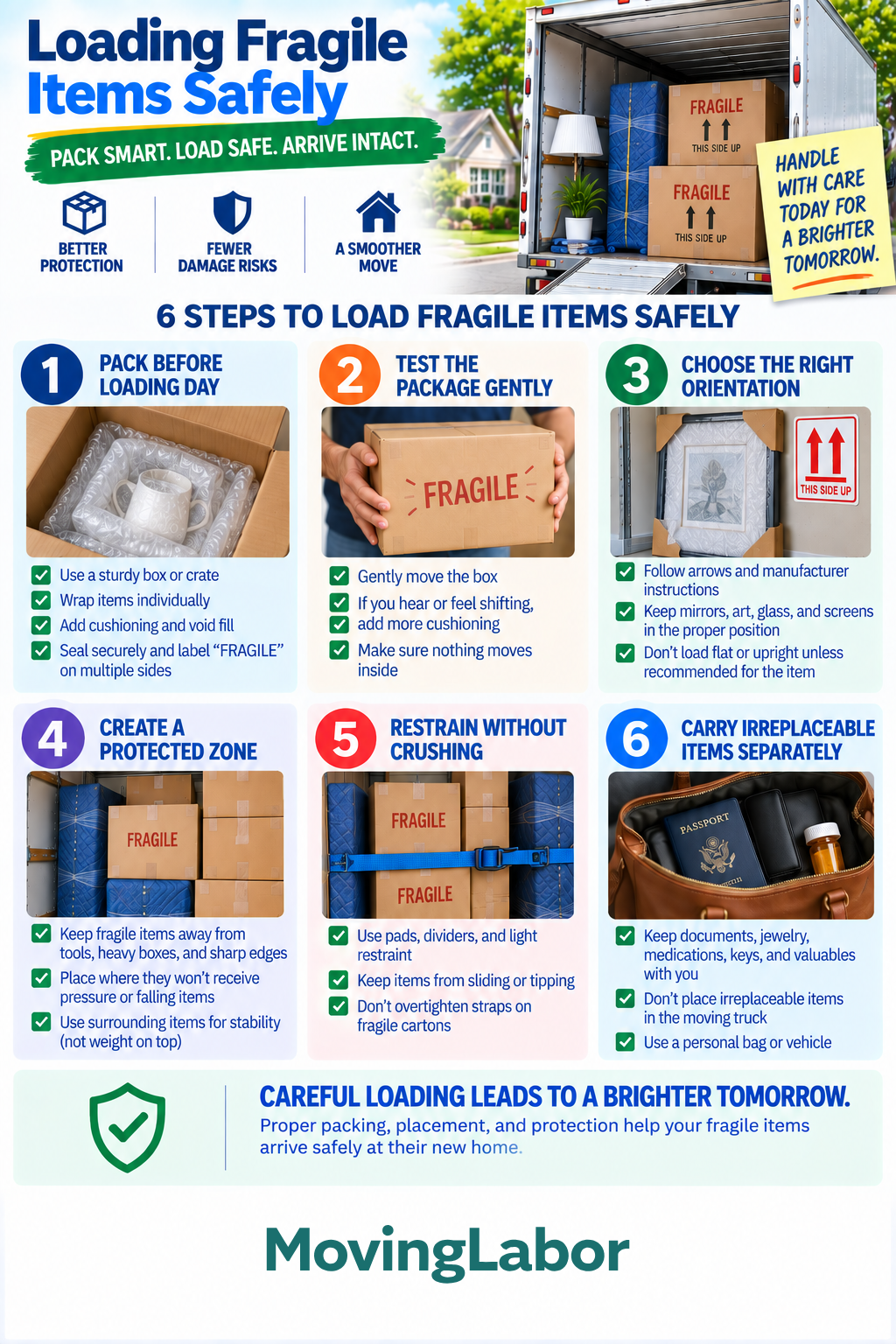
Fragile items need packaging that controls shock and pressure, a protected location in the load, no unsupported weight above them, clear labels on multiple sides, and restraint that prevents movement without crushing the package.
This guide connects four decisions in the Loading & Unloading plan: pack before loading day, test the package gently, choose the right orientation, and create a protected zone. Loading and unloading are safety-critical stages. The useful standard is not merely fitting everything inside; it is controlling each item through the route, distributing weight, protecting surfaces, and keeping the load stable during transit.
Quick Answer
Start with the Pack before loading day step, then complete Test the package gently, and verify Choose the right orientation before the move becomes time-critical.
Before the active move window, document what will happen for the Pack before loading day, Test the package gently, and Choose the right orientation steps. If one assumption changes, review the remaining steps instead of forcing the original estimate or schedule.
Step-by-step plan
1. Pack before loading day
Use a suitable carton or crate, individual wrapping, internal cushioning, void fill, and a strong closure.
Pack fragile items so they cannot move freely inside the container. Mark cartons FRAGILE on multiple visible sides and identify the correct orientation when needed.
2. Test the package gently
If contents shift when the box is moved carefully, add internal cushioning or support before loading.
Do not rely on a fragile label to compensate for an underpacked carton.
3. Choose the right orientation
Follow manufacturer guidance and package-orientation markings. Keep mirrors, framed art, glass, TVs, monitors, and other delicate items in an appropriate position for the specific item.
Avoid placing fragile pieces flat or upright simply because that orientation uses less space if the manufacturer or packaging instructions specify otherwise.
4. Create a protected zone
Keep fragile cartons away from loose metal, tools, sharp edges, heavy boxes, and areas likely to receive pressure.
Place them where surrounding belongings provide stability without putting damaging weight on the cartons. Avoid unstable stacks and locations where items could fall onto them during transit or when the cargo door is opened.
5. Restrain without crushing
Use surrounding stability, dividers, furniture pads, and light restraint rather than overtightened straps across delicate cartons.
Secure the surrounding load so fragile packages cannot slide, tip, or become trapped under shifting furniture or boxes.
6. Carry irreplaceable items separately
Keep critical documents, jewelry, medications, keys, and small sentimental or irreplaceable valuables with you when practical rather than placing them in the moving truck, trailer, or container.
Decision checkpoints
- Before booking — Test the package gently: Record who owns this step, its deadline, and the written or visible confirmation that it is complete.
- Before work begins — Create a protected zone: Record who owns this step, its deadline, and the written or visible confirmation that it is complete.
- Before closing out the job — Carry irreplaceable items separately: Record who owns this step, its deadline, and the written or visible confirmation that it is complete.
Move-day checklist
- Review the Pack before loading day decision
- Verify the Choose the right orientation details
- Complete the Restrain without crushing step
- Fragile cartons clearly labeled
- Fragile-item orientation checked
- Protected loading zone established
- No unsupported heavy items above fragile cartons
- Each load section restrained
- Final door area checked
Common mistakes to avoid
- Writing FRAGILE on an underpacked box. Revisit test the package gently and add cushioning or internal support before loading.
- Placing fragile cartons on top of a tall unsecured stack. Revisit create a protected zone and choose a stable location where the cartons cannot fall or receive damaging pressure.
- Using linens as the only protection for glass or electronics without adequate internal structure. Revisit pack before loading day and use packaging appropriate for the item rather than relying only on soft household materials.
Where professional moving labor fits
For Loading Fragile Items Safely, professional labor can provide the crew for planned loading or unloading work. Share the inventory, difficult-item photos, access conditions, equipment type, and deadline so the crew can evaluate the route and load rather than relying on a generic room count.
Tell the crew about fragile, high-value, glass, artwork, electronics, or unusually shaped items before work begins so they can account for them when planning the load.
Use Professional loading help or the Move Inventory Builder on MovingLabor.com to continue planning. For this guide, apply the result to the Pack before loading day step and confirm the final scope, availability, minimums, and price in writing.