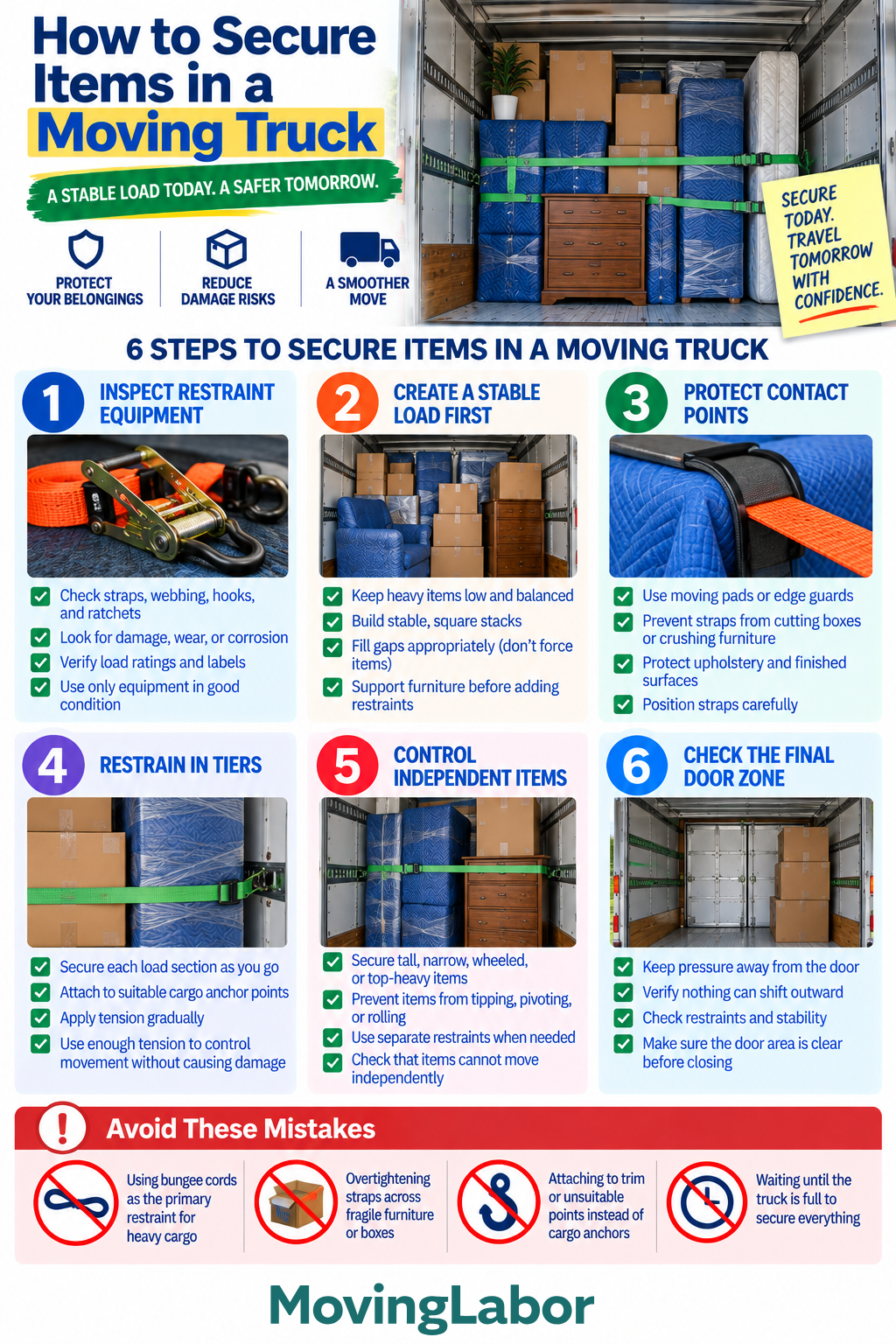
Secure a moving-truck load in stable sections using balanced stacking, suitable straps or tie-downs, protected contact points, and appropriate cargo anchor points. Restraints supplement good loading; they do not fix an unstable, top-heavy, or poorly balanced load.
This guide covers four important decisions in the Loading & Unloading plan: inspect restraint equipment, create a stable load first, protect contact points, and restrain in tiers. The goal is to distribute weight appropriately, prevent items from shifting or tipping, protect belongings from contact damage, and keep the load stable during transit.
Quick Answer
Start by inspecting straps, tie-downs, and cargo anchor points. Build a stable, balanced section of the load before adding restraints, and protect furniture or boxes anywhere straps could cause pressure or abrasion.
Secure sections as you load rather than waiting until the truck is full. Before closing the truck, check tall, narrow, wheeled, or top-heavy items separately and make sure nothing can shift toward or fall against the door.
Step-by-step plan
1. Inspect restraint equipment
Check straps, webbing, hooks, ratchets, rope, and cargo anchor points before loading.
Do not use equipment that is cut, frayed, excessively worn, corroded, jammed, missing required identification, or otherwise unsuitable for the load. Follow the equipment manufacturer's instructions and load ratings.
2. Create a stable load first
Build a stable load before relying on restraints.
Keep dense weight appropriately positioned, build stable box stacks, support furniture, and control open spaces where cargo could shift. Avoid unstable or top-heavy stacks.
3. Protect contact points
Use moving pads, edge guards, or other appropriate protection where restraints contact vulnerable surfaces.
Position straps so they do not cut into cartons, crush upholstery, damage furniture edges, or mark finished surfaces.
4. Restrain in tiers
Secure completed sections as the truck is loaded instead of relying on one restraint across the entire load at the end.
Attach restraints only to suitable cargo anchor points and apply tension gradually. Use enough tension to control movement without damaging the cargo, restraint, or anchor.
5. Control independent items
Secure tall, narrow, wheeled, or top-heavy pieces so they cannot independently tip, pivot, or roll during transit.
Pay particular attention to items that could move even when the surrounding load appears stable.
Check the final door zone
Inspect the final section before closing the moving truck.
Keep unstable cargo and excessive pressure away from the door. Make sure nothing can shift against the door or fall outward when it is opened at the destination.
Decision checkpoints
- Before loading: Inspect restraint equipment and available cargo anchor points.
- As each section is built: Check stability, protect contact points, and add appropriate restraints.
- Before closing the truck: Check independent items, restraints, load stability, and the final door zone.
Move-day checklist
- Inspect straps, hooks, ratchets, and webbing
- Check suitable cargo anchor points
- Build stable stacks before adding restraints
- Keep dense weight appropriately positioned
- Protect strap contact points
- Control gaps that could allow cargo to shift
- Secure completed sections as loading progresses
- Restrain tall, narrow, wheeled, or top-heavy items
- Check restraint tension without crushing belongings
- Inspect the final door area before closing
Common mistakes to avoid
Using bungee cords as the primary restraint for heavy cargo
Bungee cords stretch and generally should not be relied on as the primary restraint for heavy cargo. Use equipment intended and appropriately rated for securing the load.
Overtightening straps across fragile furniture
Excessive tension can deform cartons, crush upholstery, damage furniture, or stress attachment points. Protect contact areas and apply tension gradually.
Attaching restraints to trim or unsuitable points
Decorative trim and other nonstructural components may not be designed to withstand restraint forces. Use suitable cargo anchor points intended for securing the load.
Waiting until the truck is full to secure everything
A single restraint across the final load may not adequately control individual sections. Build stable sections and secure them progressively as loading continues.
Where professional moving labor fits
Professional moving labor can provide the crew for planned truck loading or unloading, particularly when a load includes heavy, bulky, or difficult items.
Share the inventory, difficult-item photos, access conditions, moving-truck size, available cargo anchor points, and relevant equipment information before the job. This helps the crew understand the loading and securement needs rather than relying only on a general room count.
Use Professional loading help or the Truck and Container Calculator to continue planning. For this guide, apply the result to the Inspect restraint equipment step and confirm the final scope, availability, minimums, and price in writing.