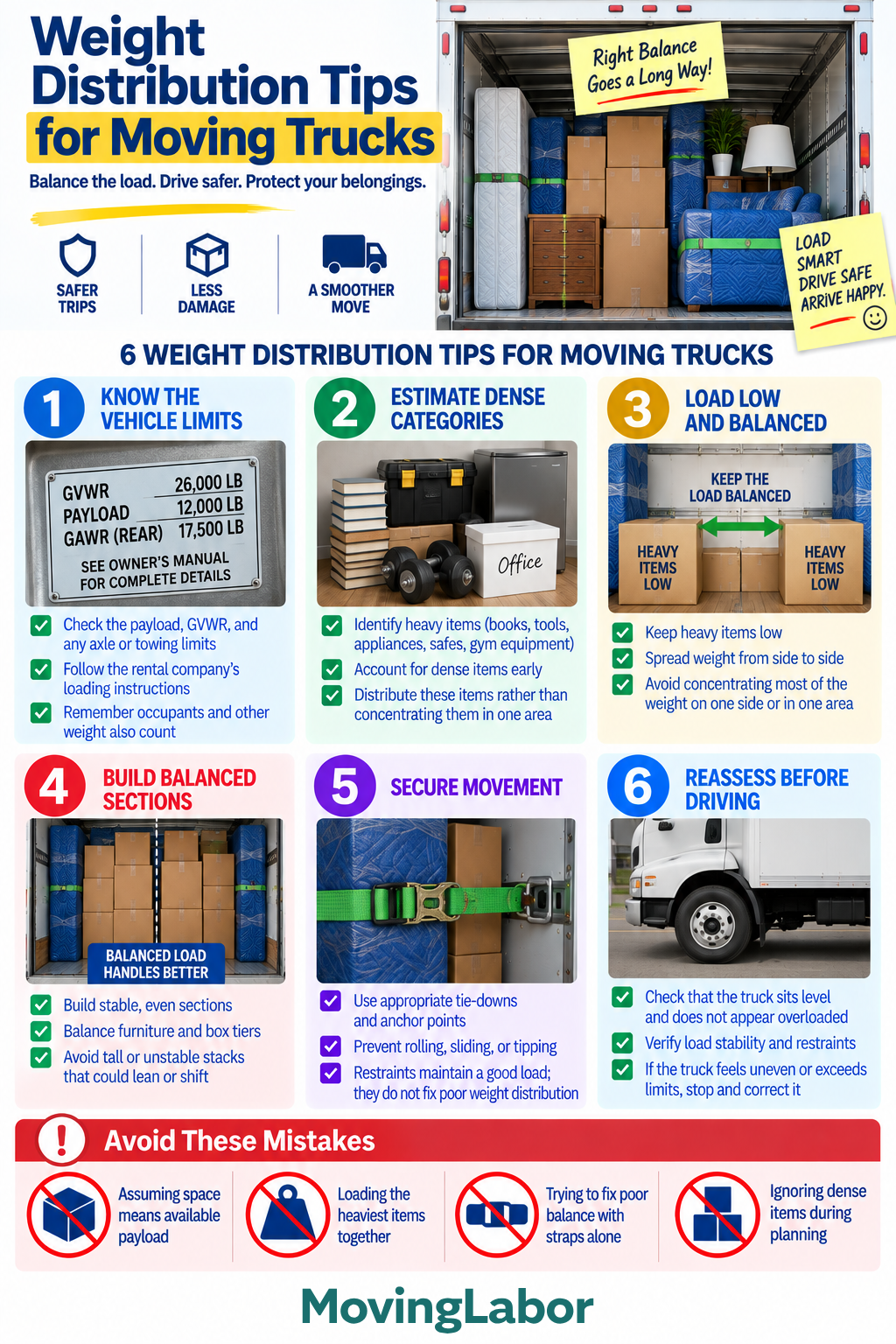
A properly loaded moving truck keeps dense items low, distributes weight from side to side, avoids excessive weight concentrated in one area, and stays within the vehicle's applicable weight limits. Follow the rental company or vehicle manufacturer's loading instructions for the specific truck.
This guide covers four important decisions in the Loading & Unloading plan: know the vehicle limits, estimate dense categories, load low and balanced, and build balanced sections. The goal is to distribute weight appropriately, keep the load stable, and prevent cargo from shifting during transit.
Quick Answer
Start by checking the weight limits and loading instructions for the specific moving truck. Identify unusually dense belongings before loading so their weight can be distributed rather than concentrated in one area.
Keep heavy items low, balance the load from side to side, and secure each section against movement. Before driving, inspect the completed load and confirm that the truck is not overloaded or visibly uneven.
Step-by-step plan
1. Know the vehicle limits
Check the documentation for the specific truck, including its payload capacity, gross vehicle weight rating (GVWR), and any axle or towing limits provided.
Remember that the allowable load is not determined by cargo space alone. Occupants and other weight carried by the vehicle can also count toward its limits.
2. Estimate dense categories
Identify belongings that concentrate substantial weight in relatively little space.
Books, tools, appliances, safes, gym equipment, and boxed files can add weight much faster than their size suggests. Account for these items when planning the load.
3. Load low and balanced
Keep heavy items low and distribute weight across the truck according to the vehicle or rental company's loading guidance.
Avoid concentrating most of the heavy cargo on one side or in one small area of the truck.
4. Build balanced sections
Build stable sections without allowing one side of the load to become substantially heavier or less supported than the other.
Balance furniture and box tiers where practical, and avoid tall or unstable stacks that could lean or shift.
5. Secure movement
Prevent cargo from rolling, sliding, tipping, or shifting during transit.
Build stable sections first, then use suitable restraints and cargo anchor points where appropriate. Restraints help maintain a properly distributed load; they do not correct poor weight distribution.
6. Reassess before driving
Inspect the completed load before operating the truck.
If the vehicle appears overloaded or uneven, or the load does not match the vehicle provider's instructions, stop and correct the problem before driving. Do not rely on additional strap tension to compensate for poor weight distribution.
Decision checkpoints
- Before loading: Check the specific truck's weight limits and identify unusually dense items.
- As the load is built: Keep heavy items low and monitor side-to-side weight distribution.
- Before driving: Check load stability, restraints, weight distribution, and the final door area.
Move-day checklist
- Check the truck's stated weight limits
- Review the vehicle provider's loading instructions
- Identify unusually dense belongings
- Keep heavy items low
- Avoid concentrating weight on one side
- Build stable, balanced load sections
- Prevent items from rolling, sliding, or tipping
- Secure completed sections appropriately
- Check the final door area
- Reassess the completed load before driving
Common mistakes to avoid
Assuming available space means available payload
Cargo volume and weight capacity are different limits. Dense belongings can use up the truck's available payload even when substantial cargo space remains.
Grouping the heaviest items together for convenience
Concentrating dense belongings in one area can create poor weight distribution. Plan their placement throughout the load according to the truck provider's guidance.
Trying to correct poor balance with straps
Tie-downs help prevent cargo from moving, but they do not redistribute its weight. Correct the placement of the load itself before adding or tightening restraints.
Ignoring unusually dense items during planning
Books, tools, safes, gym equipment, and similar belongings can add significant weight without taking up much space. Identify them before loading rather than discovering the problem after the truck is nearly full.
Where professional moving labor fits
Professional moving labor can provide the crew for planned truck loading or unloading and help build stable, balanced load sections.
Share the inventory, unusually heavy items, difficult-item photos, access conditions, moving-truck size, and relevant equipment information before the job. This helps the crew understand the loading requirements rather than relying only on a general room count.
Use Professional loading help or the Truck / Container Calculator to continue planning. For this guide, apply the result to the Know the vehicle limits step and confirm the final scope, availability, minimums, and price in writing.