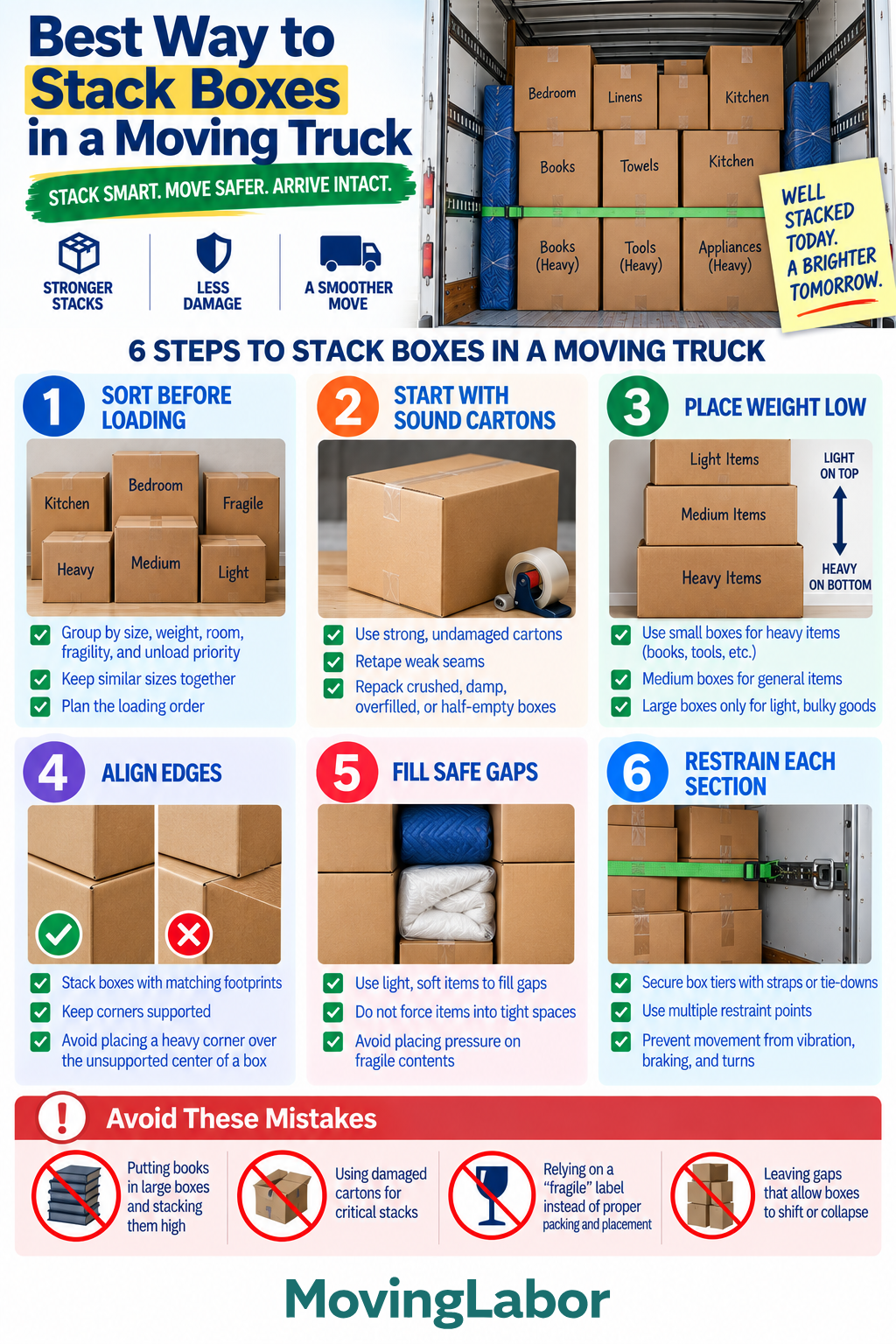
Stack moving boxes with strong, dense cartons low in the load and lighter cartons above. Keep box corners supported, control gaps that could allow shifting, and build stable, supported sections rather than one tall, unstable wall.
This guide covers four important decisions in the Loading & Unloading plan: sort before loading, start with sound cartons, place weight low, and align edges. The goal is to distribute weight appropriately, prevent cartons from crushing or shifting, and keep each section stable during transit.
Quick Answer
Sort boxes by weight, strength, size, fragility, and unloading priority before they enter the truck. Use sound, properly packed cartons and place heavier, stronger boxes below lighter ones.
Align compatible box footprints so corners remain supported, control gaps with appropriate light or soft items, and secure completed sections as loading progresses.
Step-by-step plan
1. Sort before loading
Group boxes by size, strength, weight, room, fragility, and unloading priority.
Plan the loading order so stronger, heavier cartons are available when building the lower portions of each stack.
2. Start with sound cartons
Inspect cartons before loading.
Retape weak seams and repack boxes that are crushed, damp, torn, overfilled, or too loosely packed to maintain their shape. A damaged carton can weaken the boxes stacked above it.
3. Place weight low
Keep heavier, stronger cartons toward the bottom and lighter cartons above them.
Small boxes are often useful for dense contents such as books and tools, while larger boxes are generally better for lighter, bulkier belongings. Regardless of size, consider both the contents and the strength of the carton before stacking on it.
4. Align edges
Stack compatible box footprints so the corners and edges of upper cartons are supported by the cartons below.
Avoid placing a heavy corner or edge over the unsupported center of a box underneath it.
5. Fill safe gaps
Control spaces that could allow boxes to shift during transit.
Use suitable light or soft items where appropriate, but do not force belongings into tight spaces or place pressure against fragile contents. Gap filling should improve stability rather than hide an unstable stack.
6. Restrain each section
Secure stable sections as the truck is loaded instead of waiting until the entire load is complete.
Use appropriate restraints and suitable cargo anchor points to prevent box tiers from shifting due to vibration, braking, and turns. Protect cartons where restraints could crush or damage them.
Decision checkpoints
- Before loading: Sort boxes and identify damaged or poorly packed cartons.
- As each stack is built: Keep heavier cartons low and check that corners and edges remain supported.
- Before moving to the next section: Control gaps and secure the completed section as appropriate.
Move-day checklist
- Sort boxes by weight, strength, size, and fragility
- Repack damaged or unstable cartons
- Keep heavier and stronger boxes low
- Place lighter cartons above heavier ones
- Support box corners and edges
- Avoid excessively tall or unstable stacks
- Control gaps that could allow shifting
- Protect fragile cartons from pressure
- Secure completed load sections
- Check the final door area before closing
Common mistakes to avoid
Putting books in large boxes and stacking them high
Dense contents can make large cartons difficult to handle and place excessive weight high in the stack. Use appropriately sized, strong boxes and keep dense loads lower.
Using damaged cartons as structural bases
Crushed, damp, torn, or weakened boxes may collapse under additional weight. Repack them before loading.
Treating a fragile label as protection
A “fragile” label helps identify a box, but it does not replace proper packing, placement, support, and protection from pressure.
Leaving gaps that allow boxes to shift
Uncontrolled spaces can let cartons move, lean, or collapse into one another during transit. Control gaps without forcing items together or putting pressure on fragile belongings.
Where professional moving labor fits
Professional moving labor can provide the crew for planned truck loading or unloading and help build stable load sections.
Share the inventory, approximate number and types of boxes, heavy or fragile items, access conditions, truck size, and relevant equipment information before the job. This helps the crew understand the loading requirements rather than relying only on a general room count.
Use Professional packing help or the Packing Materials Calculator to continue planning. For this guide, apply the result to the Sort before loading step and confirm the final scope, availability, minimums, and price in writing.