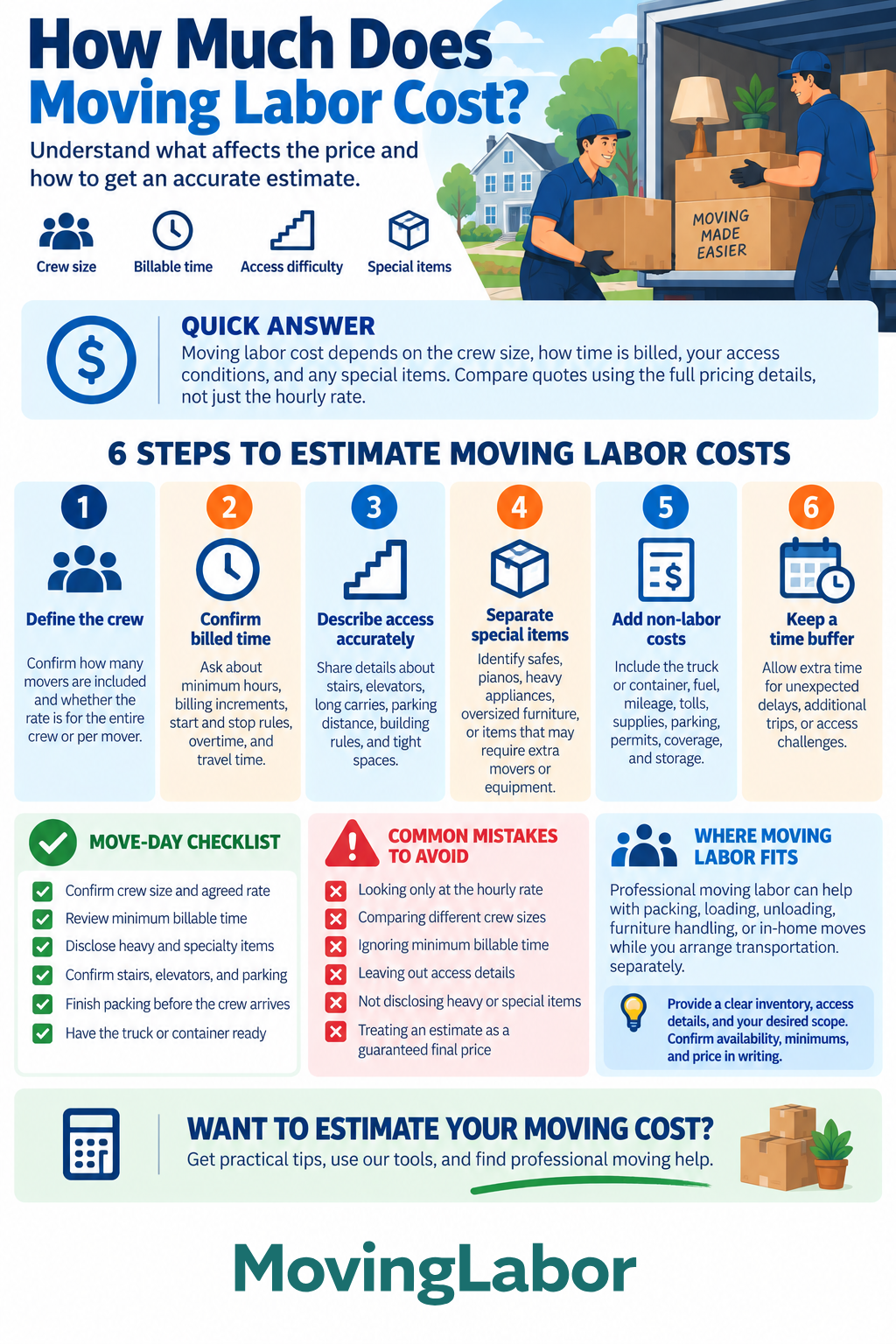
Moving labor cost is usually influenced by crew size, billable time, local rates, minimum hours, access difficulty, heavy or specialty items, travel or service fees, and the services requested. A useful estimate breaks down these variables instead of relying on a single national average.
This guide focuses on four important cost decisions: define the crew, confirm billed time, describe access accurately, and separate special items. With labor-only moving, transportation and physical moving labor are typically arranged separately. A clear inventory, accurate access description, and written scope make it easier to compare quotes and understand what may affect the final cost.
Quick Answer
To estimate moving labor cost, start by confirming the crew size and whether the quoted rate applies to the entire crew or each mover. Then determine the minimum billable time and how additional time is charged.
Before booking, provide accurate information about stairs, elevators, parking distance, long carries, heavy items, furniture disassembly, and other conditions that could increase the time or resources required. Compare quotes based on the complete pricing structure, not just the advertised hourly rate.
Step-by-Step Plan
1. Define the Crew
Confirm how many movers are included in the quote and whether the stated rate applies to the entire crew or each mover. Compare quotes using similar crew sizes whenever possible.
2. Confirm Billed Time
Ask about minimum hours, billing increments, when billable time begins and ends, waiting time, overtime, and whether travel time is charged.
3. Describe Access Accurately
Disclose stairs, elevators, long carries, parking distance, building restrictions, tight spaces, and furniture that may require disassembly. These conditions can increase the amount of labor time required.
4. Separate Special Items
Identify safes, pianos, unusually heavy appliances, oversized furniture, and other specialty items before booking. Depending on the item and provider, additional movers, equipment, or specialized services may be required.
5. Add Non-Labor Costs
When estimating the total move budget, account for expenses that may be separate from moving labor. These can include a rental truck or moving container, fuel, mileage, tolls, moving supplies, parking, permits, applicable coverage, and storage.
6. Keep a Time Buffer
Allow some flexibility in the budget and schedule. Extra trips between the home and truck, difficult furniture, elevator delays, parking issues, or other unexpected conditions can increase the time required.
Decision Checkpoints
- Before comparing quotes: Confirm the crew size and determine whether each quote uses the same or a similar service scope.
- Before booking: Review minimum hours, billing increments, travel or service fees, overtime terms, and other disclosed charges.
- Before work begins: Make sure stairs, elevators, parking distance, heavy items, and other access conditions have been disclosed.
- Before payment: Review the completed billable time and applicable charges against the agreed pricing structure.
Move-Day Checklist
- Confirm crew size and agreed rate
- Review minimum billable time
- Keep the written scope and pricing terms available
- Make sure heavy and specialty items were disclosed
- Confirm stairs, elevators, and parking access
- Finish packing before the crew arrives
- Clear pathways between the home and loading area
- Have the truck or container ready
- Keep important inventory details available
- Allow reasonable time for unexpected delays
Common Mistakes to Avoid
- Looking only at the hourly rate. A lower hourly rate may not mean a lower total cost if crew size, minimum hours, fees, or included services differ.
- Comparing different crew sizes as if they were identical. Confirm how many movers are included in each quote before comparing prices.
- Ignoring minimum billable time. A short job may still be subject to a provider's minimum booking requirement.
- Leaving out difficult access conditions. Stairs, elevators, long carries, parking distance, and building restrictions can affect the time required.
- Not disclosing heavy or specialty items. Certain items may require additional labor, equipment, or specialized handling.
- Treating an estimate as a guaranteed final price. Changes to the inventory, scope, access conditions, or actual work time may affect the final charge depending on the agreed pricing terms.
Where Professional Moving Labor Fits
Professional moving labor can handle agreed physical work such as packing, loading, unloading, furniture handling, or in-home moving while the customer remains responsible for separately arranged transportation when booking labor-only service.
For an accurate quote, provide the crew with a detailed inventory, service locations, access conditions, heavy or specialty items, and the work you want completed. Confirm the final scope, crew size, minimums, billing terms, availability, and pricing in writing before the scheduled work.
Use Moving labor cost or the DIY vs Movers Calculator to continue planning.