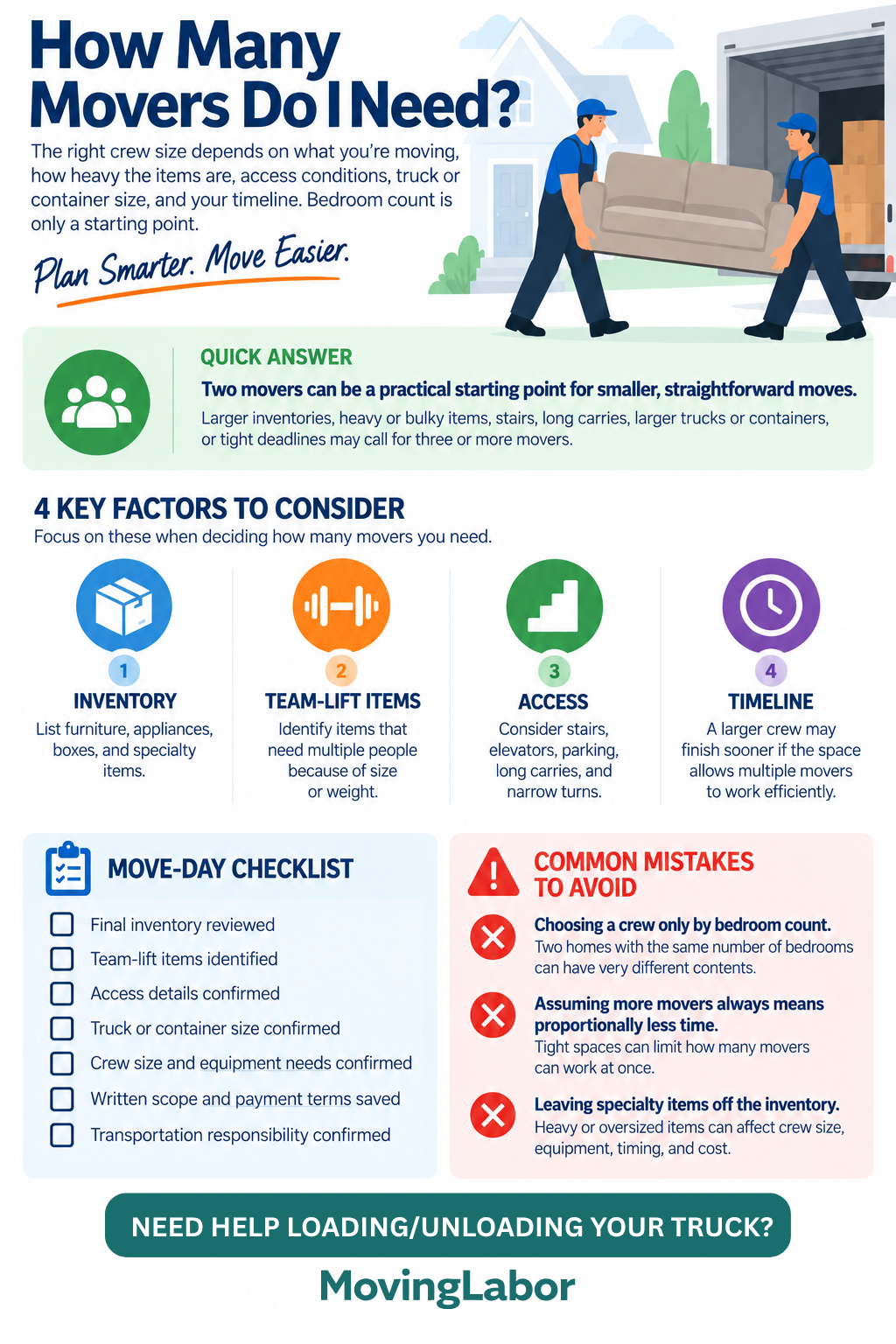
The right crew size depends on inventory, item weight, stairs, walking distance, truck or container size, loading complexity, and the deadline. Bedroom count is only a starting point; a detailed inventory produces a better recommendation.
To choose the right crew size, focus on four things: count the inventory, flag team-lift items, score the access, and set a realistic deadline. Labor-only moving works best when transportation and physical work are treated as separate responsibilities. A clear inventory, honest access description, and written scope help the crew estimate time and arrive with the right plan.
Quick Answer
Two movers can be a practical starting point for smaller, straightforward moves. Larger inventories, heavy or bulky items, stairs, long carries, larger trucks or containers, or tight deadlines may justify three or more movers.
Before booking, count the inventory, flag items that require multiple people, and review the access conditions. If the inventory, access, or schedule changes, update the crew estimate rather than relying on the original plan.
Quick answer
Two movers can be a practical starting point for smaller, straightforward moves. Larger inventories, heavy or bulky items, stairs, long carries, larger trucks or containers, or tight deadlines may justify three or more movers.
Before booking, count the inventory, flag items that require multiple people, and review the access conditions. If the inventory, access, or schedule changes, update the crew estimate rather than relying on the original plan.
Step-by-step plan
1. Count the inventory
List furniture, appliances, boxes, outdoor items, garage contents, and specialty pieces room by room.
2. Flag team-lift items
Identify pieces that cannot be safely controlled by one person and items that need more hands because of size, not just weight.
3. Score the access
Add time for stairs, elevators, long hallways, limited parking, narrow turns, steep ramps, and multiple pickup points.
Set a realistic deadline
A larger crew may finish sooner, but only if the space supports multiple movers working efficiently without congestion.
5. Match the crew to equipment
Confirm enough dollies, straps, blankets, tools, and ramp access for the number of movers booked. More movers may provide limited benefit if equipment or workspace prevents them from working efficiently.
6. Reconfirm after changes
Update the crew if the inventory grows, packing is incomplete, access changes, or a second location is added.
Decision checkpoints
- Before booking: Identify heavy, bulky, oversized, or awkward items that may require multiple movers.
- Before work begins: Confirm stairs, elevators, parking, walking distance, truck or container placement, and the expected completion window.
- After anything changes: Update the moving labor provider if the inventory, access, locations, or timing changes.
Move-day checklist
- Final inventory reviewed
- Team-lift items identified
- Stairs, elevators, parking, and long carries confirmed
- Truck or container size confirmed
- Crew size and equipment needs confirmed
- Written scope and payment terms saved
- Transportation responsibility confirmed
Common mistakes to avoid
- Choosing a crew only by bedroom count. Review the actual inventory and team-lift items before deciding how many movers to book.
- Assuming more movers always means proportionally less time in tight spaces. Stairs, elevators, narrow hallways, and limited loading space can prevent a larger crew from working efficiently.
- Leaving specialty items off the inventory until move day. Heavy, oversized, or unusually shaped items can affect crew size, equipment, timing, and cost.
Where professional moving labor fits
For How Many Movers Do I Need?, a professional moving labor provider can use your inventory, team-lift items, access conditions, truck or container size, and completion window to help determine an appropriate crew size.
With labor-only moving, the customer arranges transportation separately while the crew handles the physical work included in the booking.
Use the Crew Size & Time Estimator or Moving truck loading help to continue planning. Confirm the final scope, availability, minimums, and price in writing before booking.