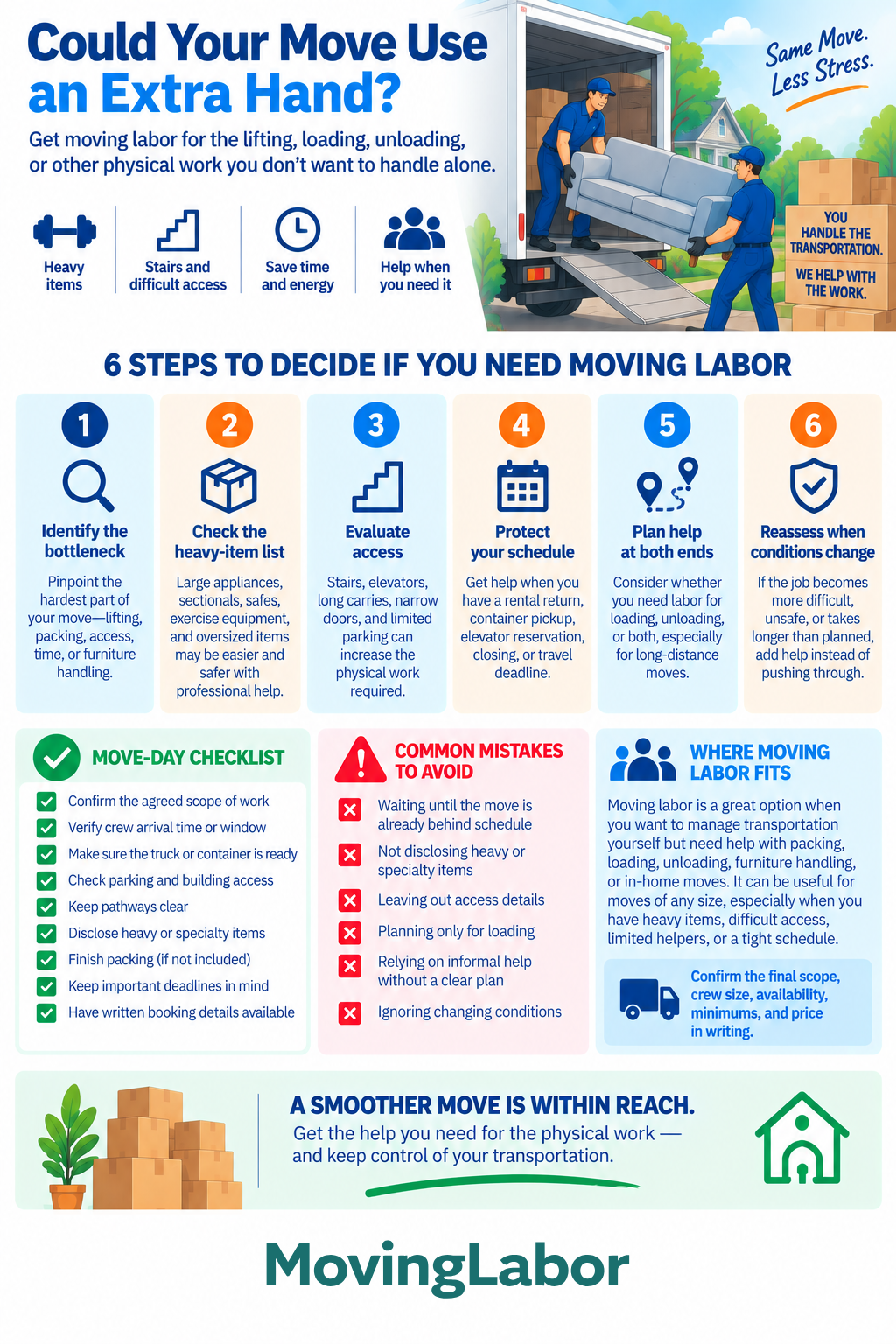
Consider hiring moving labor when you can arrange the truck, portable moving container, or other transportation but need professional help with the physical work. Loading, unloading, packing, stairs, heavy furniture, difficult access, or a tight schedule can all make moving labor useful.
This guide focuses on four important decisions: identify the bottleneck, check the heavy-item list, evaluate access, and protect your schedule. With labor-only moving, transportation and physical moving labor are typically arranged separately. A clear inventory, accurate access details, and written scope help the provider understand the work before move day.
Quick Answer
Moving labor can make sense when the physical work, difficult access, or available time is the hardest part of your move.
Consider professional help when you have heavy or bulky belongings, stairs or long carries, limited helpers, a strict loading or unloading window, or simply do not want to handle all of the lifting yourself. Before booking, identify exactly where help will have the greatest value and provide the crew with accurate inventory and access information.
Step-by-Step Plan
1. Identify the Bottleneck
Determine which part of the move will be hardest to manage yourself. It might be loading, unloading, packing, heavy lifting, limited time, difficult access, or furniture handling.
Moving labor allows you to hire help for specific physical tasks while keeping responsibility for separately arranged transportation.
2. Check the Heavy-Item List
Identify large, bulky, or unusually heavy belongings before deciding how much help you need.
Items such as large appliances, sectionals, exercise equipment, oversized furniture, and some specialty items may require additional people, equipment, or provider review. Disclose these items before booking rather than waiting until move day.
3. Evaluate Access
Consider the entire route between the home and the truck or container.
Stairs, elevators, long hallways, long carries, steep driveways, limited parking, narrow doorways, and difficult turns can increase the time and physical effort required.
Provide these details when requesting moving labor so the provider can evaluate the job accurately.
4. Protect Your Schedule
Moving labor may be especially useful when the move has a firm time constraint.
Rental truck return times, portable container pickup windows, elevator reservations, building move hours, storage facility access, travel plans, or other deadlines can leave less flexibility for a slower DIY move.
Schedule enough time for the expected work and allow for reasonable delays.
5. Plan Help at Both Ends
Think about loading and unloading as separate jobs.
If you are moving between different locations, decide whether you need professional labor at the origin, destination, or both. For a long-distance DIY move, separate crews may be booked for loading and unloading when service is available in both locations.
6. Reassess When Conditions Change
Do not continue with the original plan when the work becomes materially different from what you prepared for.
Unexpected heavy items, difficult access, weather conditions, insufficient equipment, or other changes may require additional time, equipment, or professional assistance.
Decision Checkpoints
- Before deciding to DIY: Identify the tasks, belongings, or access conditions that will require the most physical effort.
- Before requesting a quote: List heavy and specialty items and document stairs, elevators, long carries, parking, and other access conditions.
- Before booking: Decide whether you need help loading, unloading, or both, and confirm transportation and important deadlines.
- Before move day: Verify the crew, scope, arrival window, access, transportation, minimums, and pricing.
Move-Day Checklist
- Confirm the agreed scope of work
- Verify crew arrival time or window
- Make sure the truck or container is ready
- Confirm parking and building access
- Keep pathways clear
- Disclose heavy or specialty items
- Review stairs, elevators, and long carries
- Finish packing unless packing is included
- Keep important deadlines in mind
- Have written booking and pricing details available
Common Mistakes to Avoid
- Waiting until the move is already behind schedule to seek help. Identify difficult tasks and time constraints during planning rather than after they become problems.
- Failing to disclose the hardest items. Heavy, oversized, or specialty belongings may affect crew, equipment, time, or whether the provider accepts the work.
- Leaving out difficult access. Stairs, elevators, long carries, parking distance, and narrow pathways can significantly affect the physical work required.
- Planning only for loading. If you are handling transportation yourself, remember that the belongings will also need to be unloaded at the destination.
- Relying on informal help without a clear plan. Make sure everyone understands the tasks and that appropriate equipment and enough help are available.
- Ignoring changing conditions. If the job differs materially from the plan, reassess the work instead of forcing the original schedule or approach.
Where Professional Moving Labor Fits
Professional moving labor can be useful when you want to manage transportation yourself but need help with some or all of the physical moving work.
Depending on the provider and agreed scope, moving labor may help with packing, loading a rental truck or portable moving container, unloading, furniture handling, or moving belongings within the same home.
You do not necessarily need a large household move to benefit from moving labor. A smaller move with difficult stairs, bulky furniture, limited helpers, or a strict time window may also be a good use case.
Use Moving labor cost or the Crew Size and Time Estimator to continue planning.
Before booking, confirm the final scope, crew size, availability, minimums, arrival window, and price in writing.