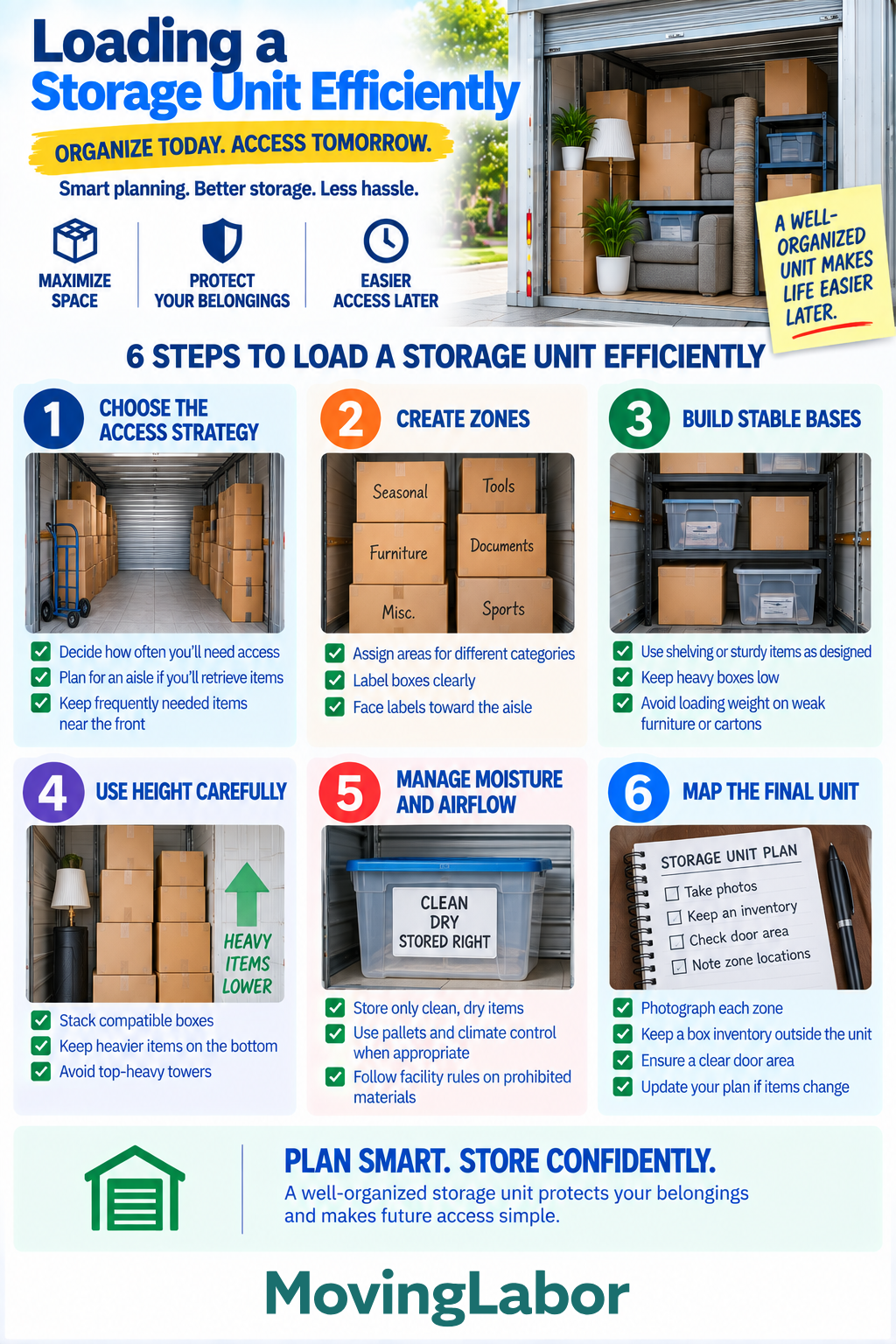
Efficient storage-unit loading balances density with access. Use a floor plan, stable heavy bases, labeled zones, vertical space, a retrieval aisle when needed, moisture-aware protection, and a safe door buffer.
This guide connects four decisions in the Loading & Unloading plan: choose the access strategy, create zones, build stable bases, and use height carefully. Loading and unloading are safety-critical stages. The useful standard is not merely fitting everything inside; it is controlling each item through the route, distributing weight, protecting surfaces, and keeping the stored load stable.
Quick Answer
Start with the Choose the access strategy step, then complete Create zones, and verify Build stable bases before the move becomes time-critical.
Before the active move window, document what will happen for the Choose the access strategy, Create zones, and Build stable bases steps. If one assumption changes, review the remaining steps instead of forcing the original estimate or schedule.
Step-by-step plan
1. Choose the access strategy
Decide whether the unit will remain closed, be visited occasionally, or support frequent retrieval.
If you expect to retrieve belongings regularly, plan an aisle and keep frequently needed items near the front. Current Public Storage guidance similarly recommends creating an aisle and strategically positioning frequently used belongings for easier access.
2. Create zones
Assign areas for furniture, boxes, seasonal items, business records, tools, and near-term retrieval.
Clearly label boxes and face labels toward the aisle when practical so you can identify belongings without moving unnecessary items.
3. Build stable bases
Use shelving or sturdy items as designed, keep dense boxes low, and avoid loading weight on weak furniture panels, upholstered furniture, or damaged cartons.
Check the facility's rules before bringing in freestanding shelving, pallets, or other storage equipment.
4. Use height carefully
Stack compatible boxes and protected furniture vertically without creating top-heavy towers.
Keep heavier boxes lower and lighter belongings higher. Public Storage likewise recommends using vertical space with heavier boxes at the bottom.
5. Manage moisture and airflow
Store only clean, completely dry belongings and follow facility guidance on pallets, climate control, airflow, and prohibited materials.
Climate-controlled storage may be worth considering for belongings sensitive to temperature or humidity, including some wood furniture, electronics, photographs, documents, and artwork. Climate control provides a more consistent environment but does not eliminate the need to store belongings clean and dry.
Avoid tightly wrapping moisture-sensitive furniture in plastic for long-term storage when doing so could trap moisture. Use material-appropriate protection and follow the item's care requirements.
6. Map the final unit
Photograph each zone and keep a box inventory outside the unit.
Before closing the unit, make sure belongings are stable and nothing interferes with the door. Keep frequently needed items accessible and update your inventory if items are added or removed.
Decision Checkpoints
- Before booking - Create zones: Record who owns this step, its deadline, and the written or visible confirmation that it is complete.
- Before work begins - Use height carefully: Record who owns this step, its deadline, and the written or visible confirmation that it is complete.
- Before closing out the job - Map the final unit: Record who owns this step, its deadline, and the written or visible confirmation that it is complete.
Move-day checklist
- Review the Choose the access strategy decision
- Verify the Build stable bases details
- Complete the Manage moisture and airflow step
- Furniture and belongings protected
- Dense weight kept low
- Stable vertical stacks created
- Retrieval aisle maintained if needed
- Frequently needed items accessible
- Door area kept clear
- Final unit photographed and mapped
Common mistakes to avoid
- Blocking the only path to items you expect to retrieve. Revisit create zones and maintain an aisle or accessible area when regular retrieval is expected.
- Using upholstered furniture or weak cartons as structural supports. Revisit build stable bases and use stable, load-bearing surfaces appropriately.
- Storing damp, perishable, combustible, hazardous, or other prohibited materials. Revisit manage moisture and airflow, make sure belongings are dry, and check the facility's current rental agreement and prohibited-items policy before storing questionable items.
Facility restrictions vary, but major U.S. storage providers prohibit categories such as hazardous/flammable materials and perishables, making it important to check the specific facility's rules.
Where professional moving labor fits
For Loading a Storage Unit Efficiently, professional labor can provide the crew for planned loading or unloading work. Share the inventory, difficult-item photos, storage-unit size, access conditions, and deadline so the crew can evaluate the route and storage plan rather than relying on a generic room count.
Use Storage moving help or the Move Inventory Builder on MovingLabor.com to continue planning. For this guide, apply the result to the Choose the access strategy step and confirm the final scope, availability, minimums, and price in writing.