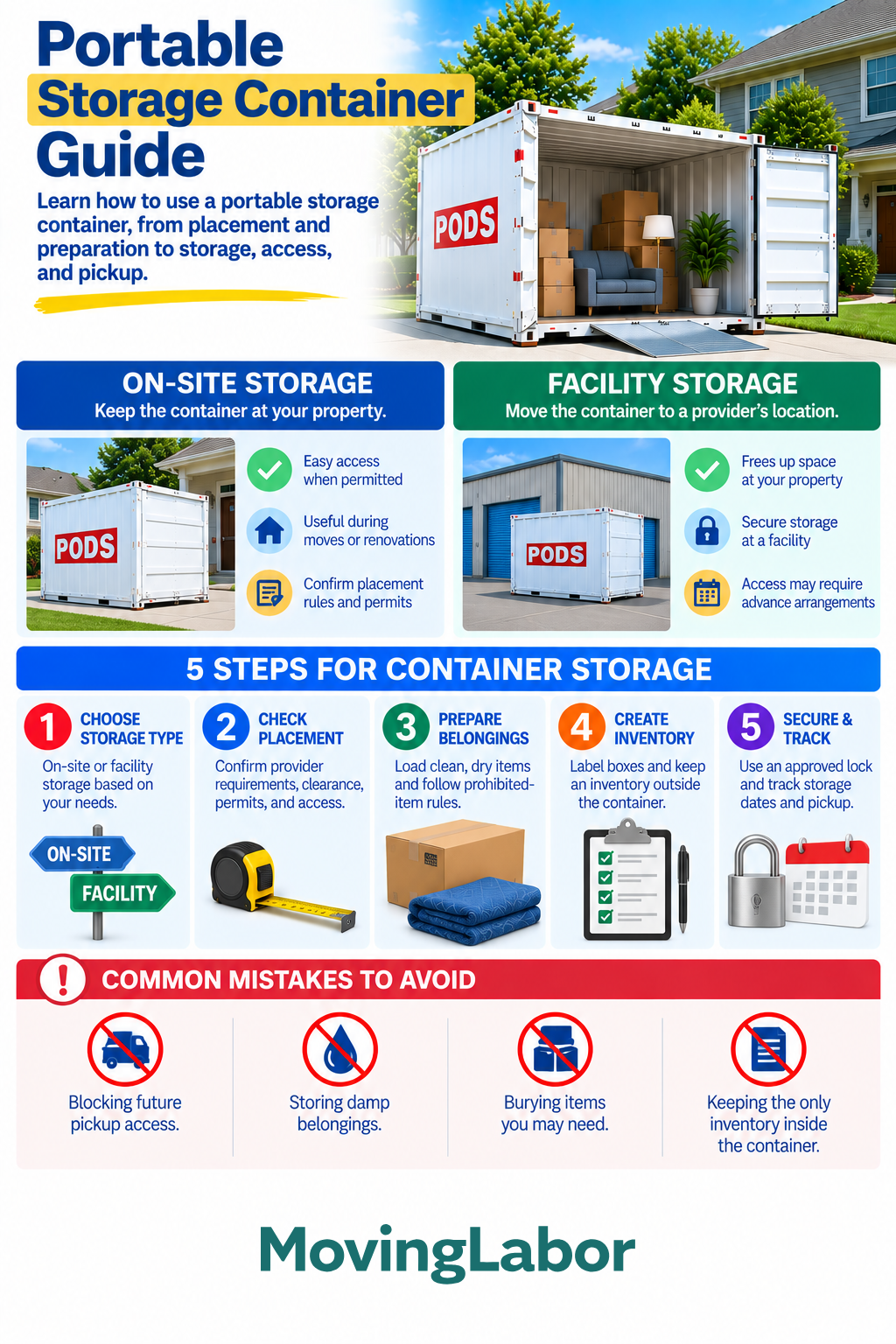
Portable storage containers let you load belongings at your property and keep the loaded container on-site or, when offered, have it transported to a storage facility. They can be useful during a move, renovation, temporary housing period, or when move-out and move-in dates do not align.
Before delivery, decide where the container will be stored, how often you may need access, what belongings are suitable for storage, and how the container will be placed, loaded, secured, and eventually picked up.
Quick Answer
Start by deciding between on-site storage and facility storage.
On-site storage can make belongings easier to access, but the property must accommodate the container and continued placement must be permitted. Facility storage removes the container from the property, but access may require advance arrangements and additional handling.
For either option, confirm placement requirements, storage conditions, prohibited items, access rules, billing periods, and pickup procedures before loading.
Step-by-step plan
1. Choose on-site or facility storage
Decide how and where the loaded container will be stored.
On-site storage keeps the container at your property where permitted, which can be useful when you expect to retrieve belongings during a renovation or extended move.
Facility storage moves the loaded container to the provider's storage location. This can free up space at the property, but access procedures vary.
Before choosing, compare:
- How often you need access
- Storage duration
- Property restrictions
- Access procedures
- Redelivery requirements
- Storage and handling charges
2. Prepare the placement area
Confirm the placement location before the container arrives.
Check the provider's requirements for surface conditions, slope, delivery clearance, overhead obstacles, door orientation, and space needed for later pickup.
Also check applicable parking restrictions, permits, HOA requirements, apartment or building rules, and other property restrictions.
Remember that the delivery equipment will eventually need to retrieve the container, so keep future pickup access in mind.
3. Prepare belongings for storage
Only load belongings that are clean and dry.
Use protection appropriate for the material being stored, and protect furniture from rubbing against boxes, other furniture, or the container.
Consider how storage duration, temperature changes, and humidity could affect:
- Wood furniture
- Upholstered furniture
- Mattresses
- Electronics
- Documents and photographs
- Artwork
- Clothing and textiles
Keep prohibited items out of the container and consider storing valuable, irreplaceable, highly temperature-sensitive, or frequently needed belongings elsewhere.
4. Create an inventory
Make it possible to find belongings without relying on memory.
Number or label boxes and record which belongings are stored in the container. If using multiple containers, maintain a separate inventory for each one.
Photographing completed loading sections can also help document where larger belongings were placed.
Keep the inventory somewhere accessible rather than inside the locked container.
5. Secure the load and container
A locked container protects access to the unit, but it does not prevent belongings inside from shifting.
Build stable sections, keep heavier belongings low, control gaps, and use suitable restraints with appropriate anchor points where available.
Keep the door area clear so belongings cannot shift against the doors.
After loading, close and lock the container according to the provider's requirements.
6. Track storage time and pickup
Understand how storage is billed before the container is loaded.
Confirm the billing period, renewal date, extension terms, access procedures, pickup notice requirements, redelivery charges, and final removal process.
If your move-in date is uncertain, understand what another storage period would cost before assuming a short extension will have little effect.
Decision checkpoints
- Before booking: Decide whether on-site or facility storage better matches your access and property needs.
- Before delivery: Confirm placement, clearance, property restrictions, and future pickup access.
- Before loading: Review prohibited items and determine which belongings are appropriate for the expected storage conditions.
- Before pickup or transfer to storage: Check load stability, restraints, door clearance, lock requirements, and your external inventory.
Storage checklist
- Confirm on-site or facility storage
- Verify placement requirements
- Check applicable permits or property rules
- Confirm future pickup access
- Inspect the container before loading
- Review prohibited-item rules
- Load only clean, dry belongings
- Protect moisture-sensitive belongings appropriately
- Keep heavy belongings low
- Secure the load against shifting
- Label boxes and maintain an inventory
- Keep frequently needed items accessible
- Keep the door area clear
- Confirm lock requirements
- Record storage and billing dates
Common mistakes to avoid
Forgetting about pickup access
A container that can be delivered to a location must also be retrievable. Avoid blocking the pickup area with vehicles, construction materials, landscaping changes, or other obstacles.
Loading damp belongings
Wet furniture, textiles, boxes, or other materials can introduce moisture into the stored load. Make sure belongings are clean and dry before loading.
Burying belongings you may need
If you expect to access the container, keep likely retrieval items closer to the door and record their location.
Keeping the inventory inside the container
Maintain your inventory outside the locked unit so you can determine what is stored without opening or accessing the container.
Ignoring storage billing dates
An extended storage period may trigger another charge. Know the billing cycle, pickup notice requirements, and extension terms.
Where professional moving labor fits
Professional moving labor can load or unload a customer-arranged portable storage container.
When booking labor, provide the container type and size, inventory, heavy or difficult items, stairs, walking distance, and property-access conditions. Let the crew know if certain belongings need to remain near the door for later access.
Use Storage moving help or the Truck and Container Calculator to continue planning. For this guide, apply the result to the Choose on-site or facility storage step and confirm the final scope, availability, minimums, and price in writing.