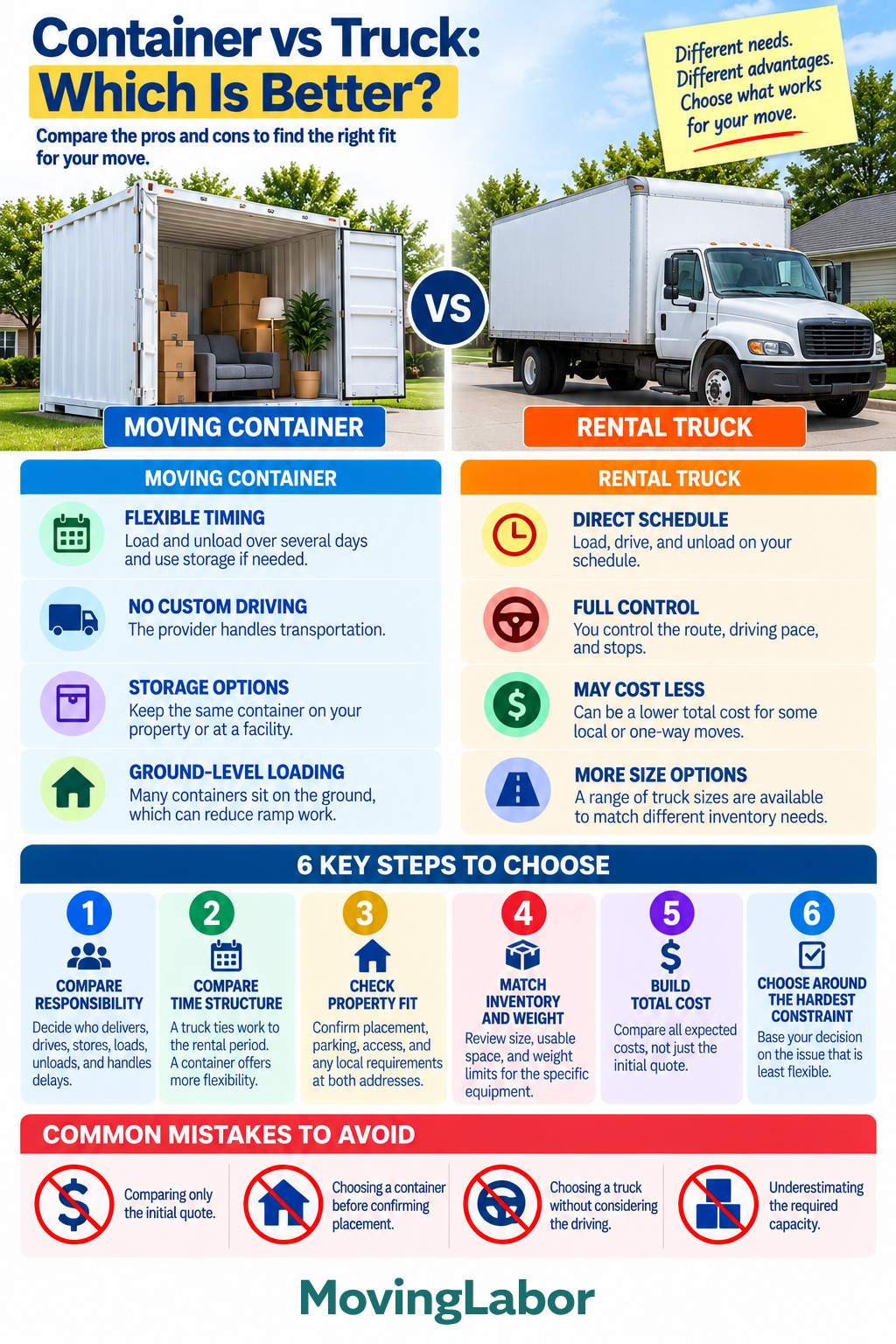
A moving container favors flexible loading, storage, and not having to drive the equipment yourself, while a rental truck provides direct control over transportation and scheduling. The better option depends on property access, inventory, route, driver comfort, timing, storage needs, and total cost.
This guide compares four important decisions in the Containers plan: compare responsibility, compare time structure, check property fit, and match inventory and weight. Equipment, availability, dimensions, weight limits, loading rules, and pricing vary. Confirm the specific equipment and reservation terms before relying on capacity, access, or timing.
Quick Answer
Choose based on the requirements of the move rather than the advertised rate alone.
A moving container may fit better when you want flexible loading or unloading time, need storage between homes, or do not want to drive a moving truck. A rental truck may fit better when you want direct control over transportation and can comfortably handle the driving, parking, fuel stops, and schedule.
Step-by-step plan
1. Compare responsibility
Determine who is responsible for each part of the move.
With a rental truck, the customer generally controls the driving and transportation schedule. With a moving container, the provider handles transportation while the customer coordinates delivery, loading, pickup, and destination access.
With either option, loading and unloading can be handled yourself or by hired moving labor.
2. Compare time structure
Consider how much time you need to load and unload.
A rental truck typically ties loading, transportation, and unloading to the rental period. A moving container can provide more flexibility when loading or unloading needs to occur over several days or when storage is needed between homes.
Confirm the actual rental period, container pickup schedule, transit timing, and applicable extension or storage charges.
3. Check property fit
Make sure the equipment can be accommodated at both addresses.
Containers need suitable placement space, delivery and pickup clearance, and any required property or local approvals. Rental trucks need appropriate parking and loading access, plus a route the driver is comfortable operating.
Consider driveways, apartment complexes, HOAs, street parking, overhead clearance, narrow streets, and loading distance.
4. Match inventory and weight
Compare the specific equipment with the belongings being moved.
For containers, review usable interior dimensions, door opening, allowable load, and the possibility of needing another container. For rental trucks, review cargo dimensions and applicable payload or vehicle weight limits.
Pay particular attention to unusually large or dense belongings.
5. Build the total cost
Compare the expected all-in cost, not just the initial transportation or rental quote.
For a rental truck, consider the rental charge, mileage where applicable, fuel, tolls, parking, lodging for longer trips, coverage, equipment, supplies, and labor.
For a moving container, consider container rental, delivery and pickup, transportation, storage, coverage, permits where applicable, locks, supplies, and labor.
Also consider the cost of extending either option when the move does not stay on schedule.
6. Choose around the hardest constraint
Identify the issue that is least flexible.
That may be:
- Comfort driving a moving truck
- Need for temporary storage
- Container placement restrictions
- Truck parking
- A narrow move-in or move-out window
- Equipment capacity
- Long-distance transportation timing
The option that works with the move's most difficult constraint may be more practical even when its initial quote is higher.
Decision checkpoints
- Before requesting quotes: Determine whether driving, storage, scheduling, or property access creates a major constraint.
- Before booking: Compare equipment capacity, weight limits, placement or parking requirements, and total expected cost.
- Before move day: Confirm equipment timing, access, loading and unloading labor, and any applicable placement or parking requirements.
Move-day checklist
- Confirm the specific equipment reserved
- Inspect the truck or container before loading
- Review applicable weight limits
- Review prohibited-item rules
- Confirm parking or container placement
- Keep the loading route accessible
- Coordinate loading and unloading labor
- Secure belongings appropriately
- Confirm pickup, return, or transportation timing
Common mistakes to avoid
Comparing only the initial quote
A truck's advertised rental rate does not include every potential driving expense, while a container quote may change with transportation, storage, delivery events, and other services. Compare
Choosing a container before confirming placement
Verify that the container can be legally and practically placed at the property and that the provider has sufficient delivery and pickup access.
Choosing a truck without considering the driving
Consider the size of the vehicle, distance, parking, road conditions, fuel stops, and the available driver's comfort operating it.
Underestimating the required capacity
Compare actual inventory against usable equipment dimensions and weight limits. Needing another container or an additional truck trip can significantly change the original plan and cost.
Where professional moving labor fits
Professional moving labor can load or unload either a customer-arranged rental truck or portable moving container.
For a truck move, coordinate the crew with the rental pickup and return schedule. For a container move, coordinate labor with confirmed container delivery, pickup, and destination availability.
Use moving storage or the Truck and Container Calculator to continue planning. For this guide, apply the result to the Compare responsibility step and confirm the final scope, availability, minimums, and price in writing.