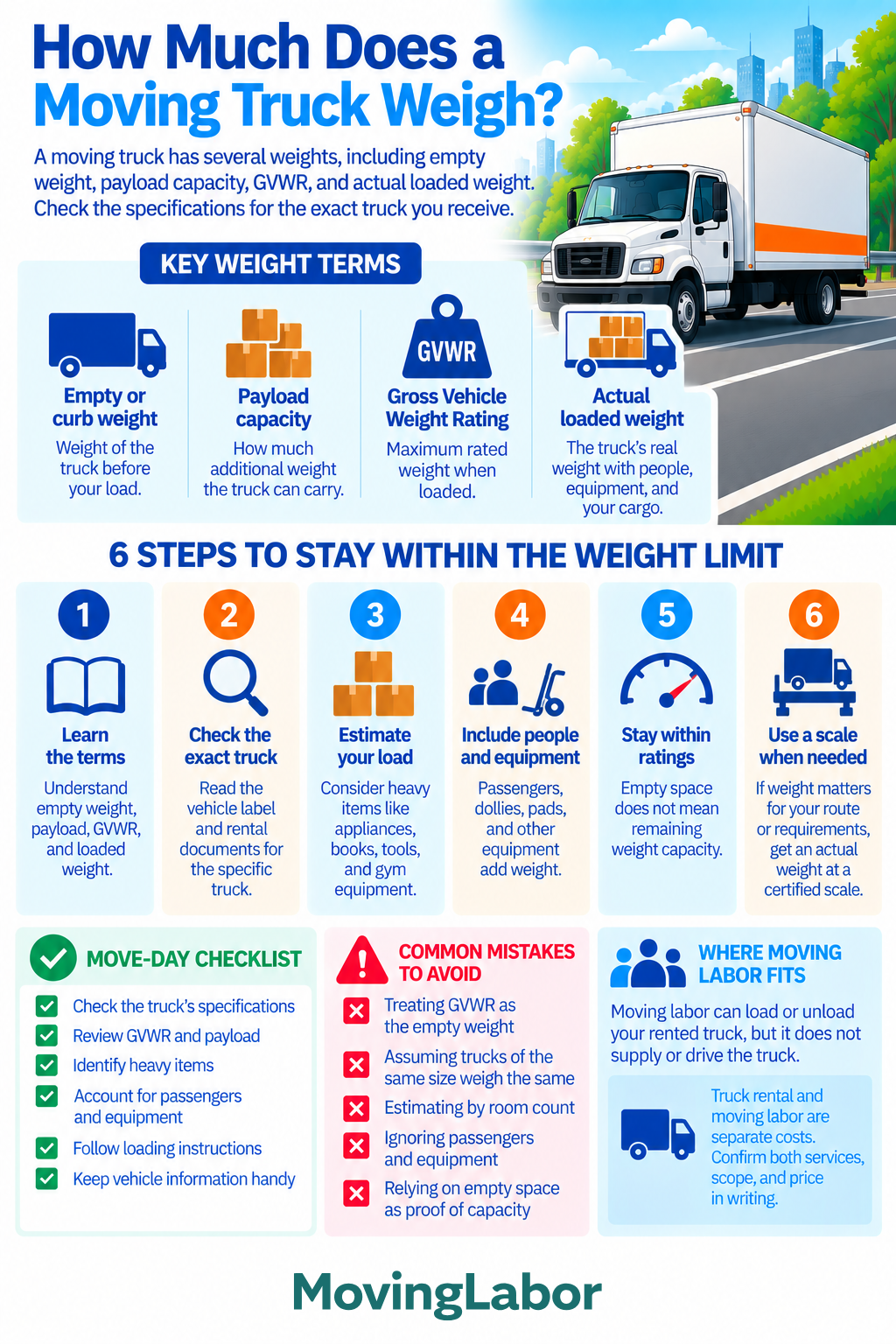
There is no single weight for a moving truck. The actual weight depends on the truck's chassis, body, equipment, fuel, passengers, cargo, and other items being carried or towed.
When planning a rental-truck move, understand the difference between the truck's empty or curb weight, payload capacity, Gross Vehicle Weight Rating (GVWR), and actual loaded weight. Do not rely on the advertised truck length alone to determine how much the vehicle weighs or can carry.
For important weight decisions, use the information provided for the exact truck you receive, including its vehicle labels, rental documents, and rental-company guidance.
Quick Answer
A moving truck's advertised size, such as 16, 20, or 26 feet—does not tell you its exact weight.
The numbers that matter include:
- Empty or curb weight: The vehicle's weight before your moving load is added, as defined by the applicable specification
- Payload capacity: How much additional weight the vehicle is rated to carry under the applicable specifications
- GVWR: The manufacturer's maximum rated weight for the vehicle when loaded
- Actual loaded weight: What the truck actually weighs with its current load
Always verify the specifications for the actual rental truck rather than relying on a generic estimate for its size class.
Step-by-Step Plan
1. Understand the Weight Terms
Start by separating the different measurements.
Empty or curb weight describes the vehicle's weight before your moving load is added, although the precise definition used in specifications can vary.
Payload capacity refers to the amount of additional weight the vehicle is rated to carry under the applicable specifications.
Gross Vehicle Weight Rating (GVWR) is the manufacturer's maximum rated weight for the vehicle when loaded.
Actual loaded weight is the vehicle's real weight under its current loading conditions.
Do not confuse GVWR with what the empty truck actually weighs.
2. Check the Exact Truck
Specifications can vary even between rental trucks advertised as the same size.
At pickup, review the information available for the vehicle you actually receive. Depending on the truck, useful information may be found on:
- Vehicle certification labels
- Rental documents
- Rental-company specifications
- Other vehicle information supplied by the provider
If a weight rating or specification is unclear, ask the rental company rather than estimating it from the truck's advertised length.
3. Estimate What You Are Loading
Think about the weight of the actual inventory rather than relying only on the number of rooms in the home.
Pay particular attention to dense or unusually heavy items such as:
- Books and files
- Tools
- Appliances
- Safes
- Exercise equipment
- Shop equipment
- Dense furniture
- Other unusually heavy items
A truck can still have available cargo space without necessarily having sufficient remaining weight capacity.
4. Account for People and Equipment
Your household goods are not the only weight associated with an operating moving truck.
Depending on the vehicle and setup, the total load can also involve:
- Driver and passengers
- Dollies and hand trucks
- Moving pads and equipment
- Personal belongings in the cab
- Additional rented equipment
- Towing-related equipment
If towing, follow the rental company's requirements and the applicable ratings for the exact truck and towing setup.
5. Stay Within the Vehicle's Ratings
Do not use the amount of empty cargo space as a substitute for weight capacity.
A truck that still has room inside can still be too heavily loaded. Likewise, the way a truck looks or sits on its suspension is not a reliable method for determining whether it is within its ratings.
Follow the applicable ratings and loading instructions for the exact vehicle.
6. Verify Actual Weight When Necessary
An estimate cannot tell you the truck's exact loaded weight.
When an actual weight is necessary, use an appropriate scale and follow the rental company's guidance and any applicable requirements.
This may be particularly important when weight affects your route, towing setup, or another requirement associated with the trip.
Decision Checkpoints
- Before choosing a truck: Consider both the amount of cargo space and the weight of your inventory.
- At pickup: Review the weight information and ratings for the actual vehicle.
- Before loading: Identify unusually heavy or dense items and any additional equipment.
- After loading: Do not assume remaining cargo space means remaining payload capacity.
- When actual weight matters: Follow provider guidance and use an appropriate scale rather than relying on an estimate.
Move-Day Checklist
- Check the exact truck's specifications
- Review the GVWR
- Review available payload information
- Identify unusually heavy items
- Account for passengers and equipment
- Follow loading instructions
- Consider towing equipment separately
- Do not judge capacity by empty space
- Keep vehicle information accessible
- Verify actual weight when required
Common Mistakes to Avoid
- Treating GVWR as the truck's empty weight. GVWR is a maximum rated loaded vehicle weight, not simply what the truck weighs when empty.
- Assuming trucks of the same advertised length weigh the same. Chassis, body, equipment, and configuration can vary.
- Choosing a truck only by room count. Dense or unusually heavy belongings can affect weight even when the move does not require much cargo volume.
- Assuming empty space means available payload. Cargo volume and weight capacity are different limits.
- Forgetting passengers and equipment. Consider the complete vehicle setup rather than household goods alone.
- Guessing actual loaded weight. Use an appropriate scale when an actual weight measurement is needed.
Where Professional Moving Labor Fits
Professional moving labor can load or unload a customer-rented truck, but the customer typically remains responsible for selecting, renting, and driving the vehicle.
Give the moving labor provider an accurate inventory and disclose unusually heavy or specialty items before move day. This helps the crew plan the physical loading work and identify items that may require special handling.
The rental truck's weight ratings and operating requirements remain separate from the moving labor booking. Do not assume that hiring a loading crew transfers responsibility for choosing an appropriate rental vehicle or complying with its weight limitations.
Use Truck loading and unloading help or the Truck and Container Calculator to continue planning.
Confirm the truck separately, and confirm the moving labor scope, crew size, heavy-item requirements, minimums, availability, arrival window, and price in writing.