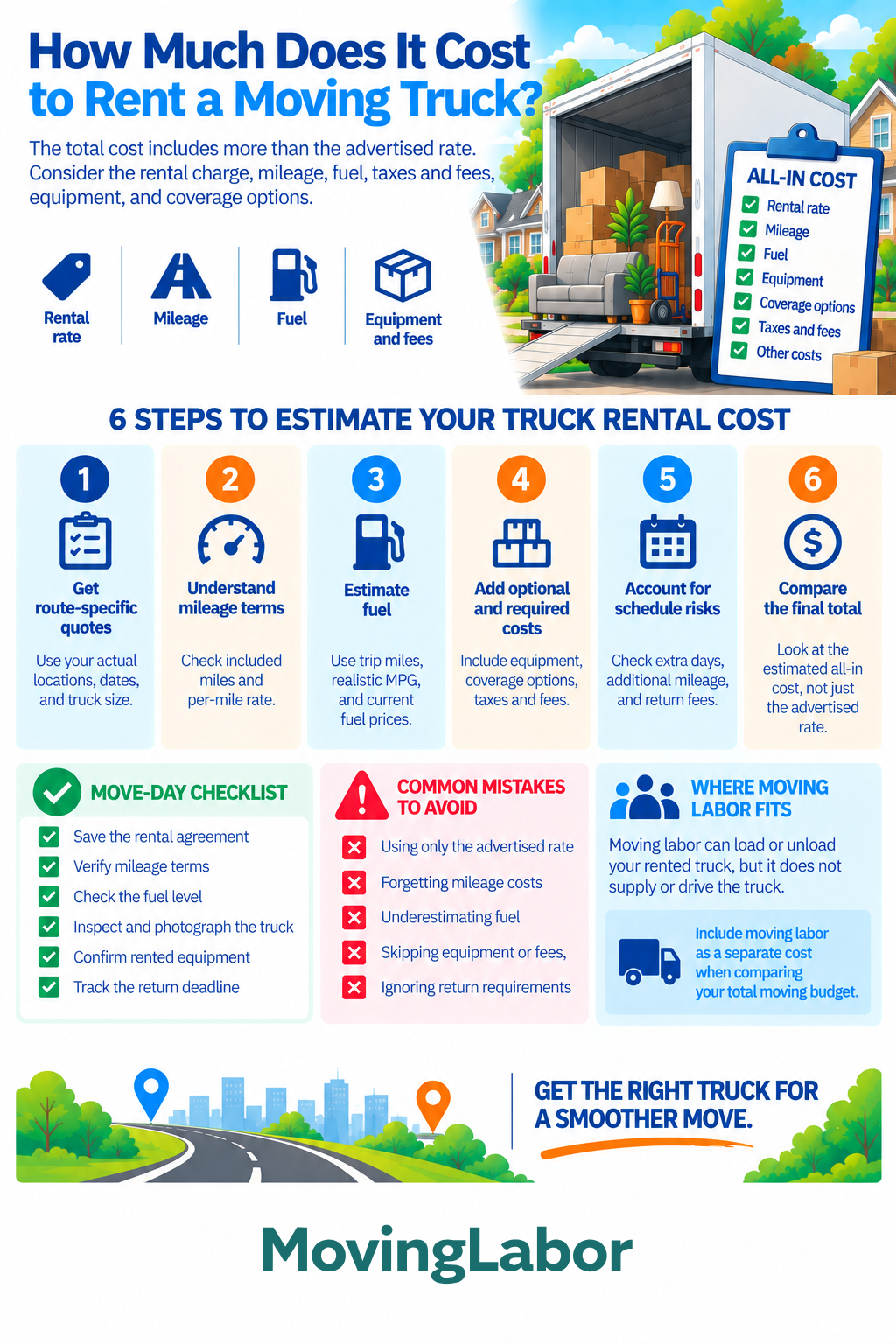
The cost to rent a moving truck includes more than the advertised rental rate. Your actual cost can include the truck rental, mileage, fuel, taxes and fees, equipment, optional protection products, extra rental time, tolls, parking, and other trip-specific expenses.
Local and one-way rentals may also use different pricing structures. The most reliable way to estimate your cost is to get quotes using your actual pickup location, destination or return location, dates, and truck size, then calculate the expected all-in trip cost.
This guide focuses on four important decisions: get route-specific quotes, understand the mileage terms, estimate fuel, and include optional and required costs. Rates, availability, rental terms, and protection products can change, so verify the current quote and rental agreement before booking.
Quick Answer
Start with a quote for your actual route, dates, and truck size. Then add the costs that may not be obvious from the advertised rental rate.
Depending on the rental, your total may include:
- Base rental charge
- Mileage charges
- Fuel
- Taxes and fees
- Equipment rentals
- Optional protection products
- Tolls and parking
- Extra days or mileage
- Other charges under the rental agreement
Compare rental companies using the estimated all-in cost, not just the advertised starting rate.
Step-by-Step Plan
1. Get Route-Specific Quotes
Use your actual pickup location, return location or destination, rental dates, and required truck size when requesting quotes.
Truck rental prices can vary by location, date, availability, truck size, and whether the rental is local or one-way.
For a fair comparison, enter the same move details with each rental company.
2. Understand the Mileage Terms
Determine how mileage is priced before booking.
Depending on the rental, mileage may be charged separately or an allowance may be included in the quote.
Review:
- Included mileage, if any
- Additional mileage rate
- Expected driving distance
- Local errands or extra stops
- Detours
- Pickup and return driving
- Return-location requirements
Allow some room in your estimate for reasonable additional driving rather than budgeting only for the shortest mapped route.
3. Estimate Fuel
Fuel can be a significant part of the total rental-truck cost, particularly on longer trips.
A simple planning formula is:
Estimated fuel cost = Trip miles ÷ estimated MPG × expected fuel price
Use a realistic fuel-economy assumption for the specific truck rather than the MPG of your passenger vehicle. Actual fuel use can vary with truck size, load, speed, traffic, terrain, weather, and driving conditions.
Also check the rental agreement for the required fuel level at return.
4. Add Optional and Required Costs
Review the quote for additional products or charges that apply to your move.
Depending on the company and rental, these may include:
- Dollies or hand trucks
- Furniture pads or moving blankets
- Towing equipment
- Optional protection or coverage products
- Additional drivers
- Taxes and fees
- Parking
- Tolls
- Other rental-specific charges
Some items are optional, while others may apply automatically to the transaction or trip. Review the checkout details before booking.
5. Account for Schedule and Return Costs
Understand what can happen if the rental does not go according to plan.
Review the agreement for possible charges related to:
- Extra rental days
- Additional mileage
- Late returns
- Fuel or refueling
- Cleaning
- Damage
- Equipment
- Returning to an incorrect location
Knowing the return requirements before the move can help prevent avoidable charges.
6. Compare the Final Estimated Total
Compare the expected total cost of each rental rather than focusing on the headline rate.
A useful comparison is:
Truck rental + mileage + fuel + equipment + protection options + taxes/fees + tolls/parking + expected extras = estimated trip cost
Use the same assumptions for each company so you are comparing similar rentals.
Decision Checkpoints
- Before requesting quotes: Determine the route, dates, truck size, estimated mileage, and rental type.
- Before comparing quotes: Make sure each estimate uses similar mileage, equipment, protection options, and rental duration.
- Before booking: Review the estimated checkout total, mileage terms, fuel requirements, return rules, and possible additional charges.
- Before pickup: Reconfirm the reservation, truck details, pickup instructions, rental period, and return requirements.
Move-Day Checklist
- Save the rental agreement
- Confirm the rental period
- Verify mileage terms
- Check the fuel level at pickup
- Inspect and photograph the truck
- Confirm rented equipment
- Keep fuel receipts if appropriate
- Follow the planned truck-safe route
- Track the return deadline
- Verify the required return location
- Confirm the required return fuel level
Common Mistakes to Avoid
- Treating the advertised rate as the total cost. Include mileage, fuel, equipment, protection options, taxes, fees, and other expected trip expenses.
- Comparing quotes with different assumptions. Use the same dates, route, truck requirements, mileage, and optional products when comparing companies.
- Forgetting mileage costs. Understand whether mileage is included or charged separately and account for additional driving.
- Underestimating fuel. A loaded moving truck should not be budgeted using your passenger vehicle's fuel economy.
- Ignoring return requirements. Extra time, mileage, fuel, or an incorrect return location may result in additional charges under the rental agreement.
- Adding equipment without checking the final total. Dollies, pads, towing equipment, and other add-ons can change the overall cost.
Where Professional Moving Labor Fits
Moving labor can load or unload a customer-rented moving truck while you remain responsible for arranging and driving the rental vehicle.
When estimating the total cost of a DIY truck move, consider the truck rental and moving labor as separate expenses. Professional loading or unloading help can reduce the amount of physical work you handle yourself, but it should be included when comparing the overall cost of different moving options.
Use Truck loading and unloading help or the Truck and Container Calculator to continue planning.
Confirm the truck rental separately, and confirm the moving labor scope, crew size, minimums, availability, arrival window, and price in writing.