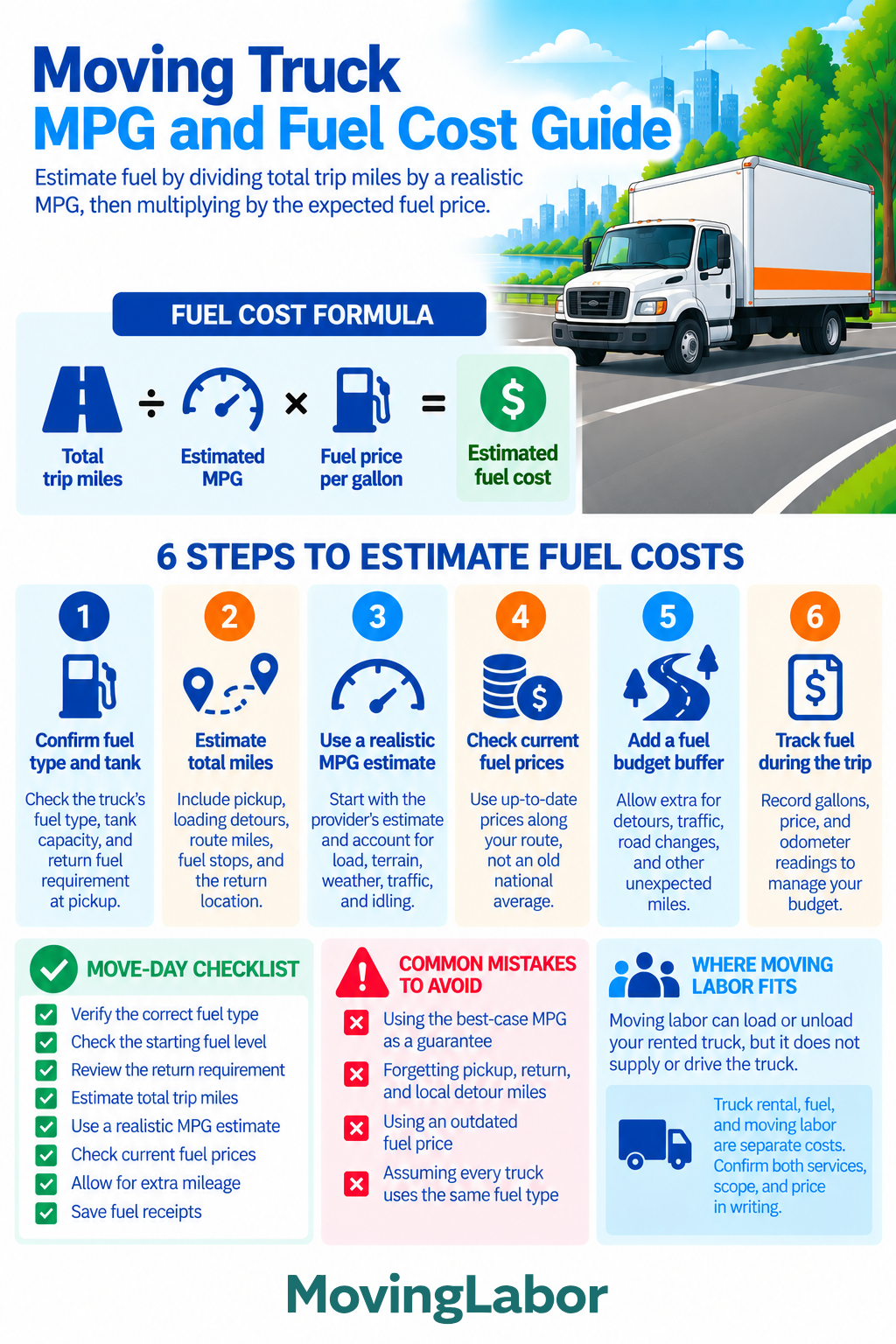
Fuel can be a significant part of the cost of renting a moving truck, especially for a long-distance move. A simple estimate starts with your expected trip mileage, the truck's estimated miles per gallon (MPG), and the expected fuel price along your route.
Use this formula:
Estimated fuel cost = Total trip miles ÷ Estimated MPG × Fuel price per gallon
Treat the result as a planning estimate. Actual fuel use can change with truck size, cargo weight, towing, speed, traffic, terrain, weather, idling, and driving conditions.
This guide focuses on four important steps: confirm the fuel requirements, estimate total mileage, use a realistic MPG assumption, and check current fuel prices. Verify the exact truck and rental agreement at pickup rather than relying solely on specifications for the reserved truck class.
Quick Answer
Estimate fuel by dividing your expected total mileage by a realistic MPG for the rental truck, then multiply the gallons by the expected price per gallon.
For example:
500 miles ÷ 10 MPG = 50 gallons
50 gallons × $3.50 = $175 estimated fuel cost
This is only a planning example—not a current fuel price or a guaranteed MPG. Add room in your budget for detours, traffic, idling, terrain, and other conditions that can increase fuel use.
Step-by-Step Plan
1. Confirm the Fuel Requirements
At pickup, verify the fuel type required by the actual truck you receive.
Also review:
- Fuel gauge at pickup
- Required return fuel level
- Refueling terms
- Approximate tank capacity, if needed for trip planning
Do not assume every rental truck uses the same fuel type or has the same tank size.
Follow the fuel information provided for the specific vehicle.
2. Estimate Total Trip Miles
Start with the main driving route, then include additional mileage associated with the rental.
Your estimate may need to include:
- Driving from the rental location
- Travel to the loading location
- Main route mileage
- Fuel and meal stops
- Hotel access
- Detours
- Destination errands
- Driving to the approved return location
For a local or round-trip rental, remember to include the mileage required to return the truck to its original location.
3. Use a Realistic MPG Estimate
Use fuel-economy information for the type of truck you are renting when available, but treat published MPG figures as estimates rather than guarantees.
Actual MPG can be affected by:
- Cargo weight
- Truck size
- Towing
- Driving speed
- Hills and mountain grades
- Stop-and-go traffic
- Wind
- Weather
- Idling
- Driving style
For budgeting, avoid assuming that you will achieve the most favorable published MPG throughout the entire trip.
4. Check Current Fuel Prices
Fuel prices vary by location and can change before your move.
Check current prices close to the travel date, paying attention to the areas along your actual route rather than relying only on an older national average.
For a long-distance move, fuel prices may differ substantially between parts of the route.
If the trip crosses several regions, using a reasonable route-based average can produce a more useful estimate.
5. Add a Fuel Budget Buffer
The shortest mapped route may not equal the number of miles you actually drive.
Traffic, road closures, missed turns, fuel stops, lodging, destination errands, and other changes can add mileage or increase fuel consumption.
Include a reasonable buffer rather than budgeting to the exact dollar produced by the formula.
A buffer is particularly useful for longer trips, unfamiliar routes, mountain driving, or moves involving towing.
6. Track Fuel During the Trip
Keep track of actual fuel use as you travel.
Useful information includes:
- Odometer or trip mileage
- Gallons purchased
- Price per gallon
- Fuel receipts
- Current fuel level
- Required return fuel level
Tracking actual fuel use can help you adjust the remaining trip budget and avoid surprises when returning the truck.
Decision Checkpoints
- Before estimating fuel: Determine the expected route and total trip mileage.
- Before booking: Review available fuel-economy information for the truck size you are considering.
- At pickup: Confirm the actual truck's fuel type, fuel level, and return requirements.
- Before a long drive: Check current fuel prices and identify reasonable fueling opportunities along the route.
- Before returning the truck: Review the rental agreement and make sure the fuel level meets the required return terms.
Move-Day Checklist
- Confirm the correct fuel type
- Check the starting fuel level
- Review the return fuel requirement
- Verify expected trip mileage
- Use a realistic MPG estimate
- Check current route fuel prices
- Plan reasonable fuel stops
- Allow for extra mileage
- Save fuel receipts
- Monitor fuel during the trip
- Refuel as required before return
Common Mistakes to Avoid
- Treating published MPG as guaranteed. Actual fuel economy depends on the truck, load, route, traffic, weather, and driving conditions.
- Using passenger-car MPG. Estimate fuel using information appropriate for the moving truck you will actually drive.
- Counting only highway route miles. Include pickup, return, detours, lodging, fuel stops, and other expected driving.
- Using an outdated fuel price. Check current prices close to your move date and along the route.
- Assuming every rental truck uses the same fuel. Verify the fuel type for the actual vehicle at pickup.
- Forgetting the return fuel requirement. Check the rental agreement so you know how much fuel the truck should have when returned.
Where Professional Moving Labor Fits
Moving labor can help load or unload a customer-rented moving truck, but the customer typically remains responsible for renting, fueling, and driving the vehicle.
When estimating the complete cost of a DIY truck move, treat truck rental, fuel, and moving labor as separate expenses.
Professional loading can also help you use the available cargo space effectively, but do not assume it will produce a particular fuel economy. Actual MPG still depends on the truck, total load, route, driving, and other conditions.
Use Truck loading and unloading help or the Truck and Container Calculator to continue planning.
Confirm the truck separately, and confirm the moving labor scope, crew size, minimums, availability, arrival window, and price in writing.