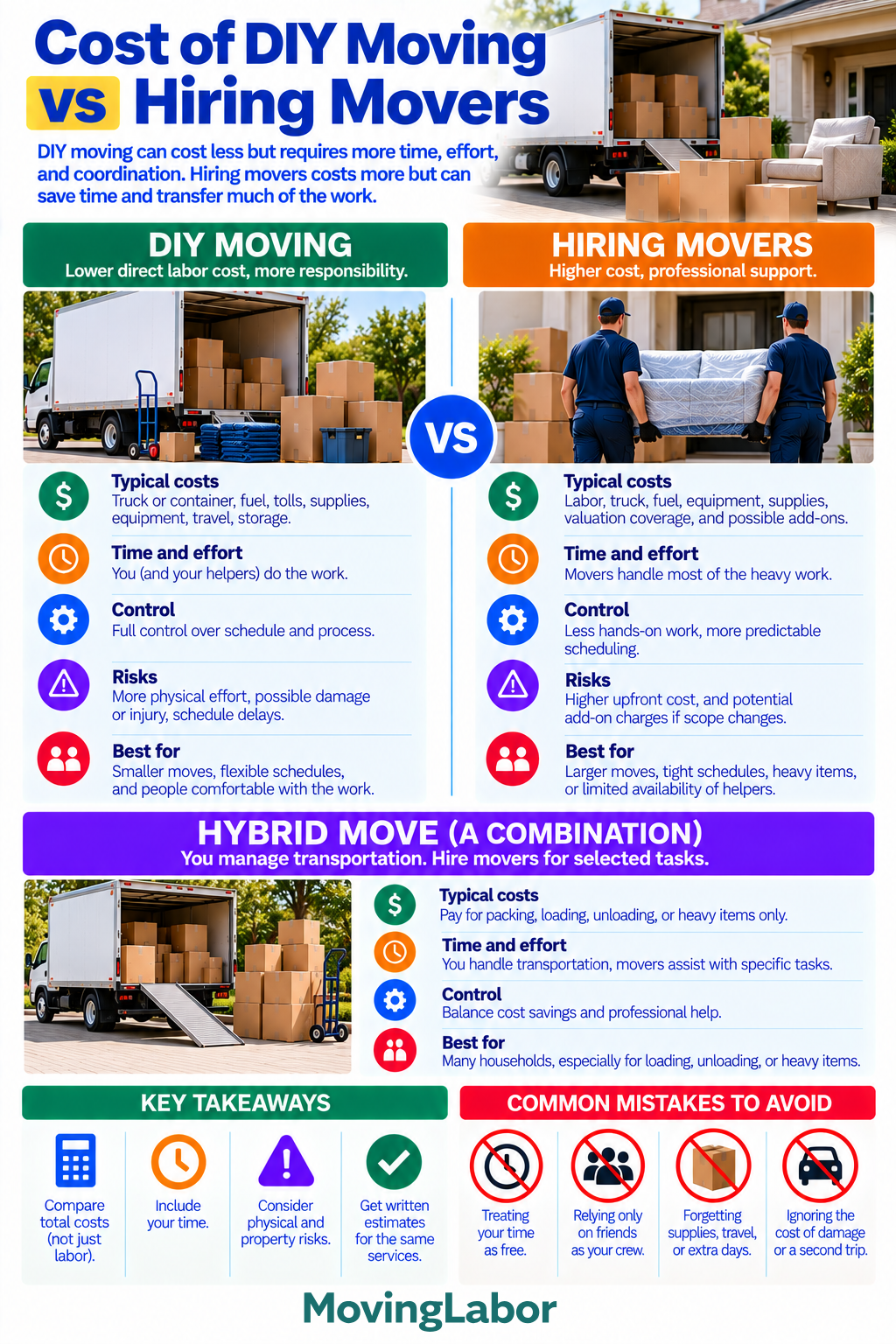
DIY moving, hiring professional movers, and combining both approaches come with different costs and responsibilities. DIY moving gives you more control over transportation and labor, while professional movers handle the services included in your booking.
The best choice depends on your total moving cost, available time, physical demands, property access, and schedule. Compare all three options using the same inventory and moving requirements.
Quick Answer
There are three main approaches to compare:
- DIY moving: You arrange transportation, packing, loading, driving, and unloading. You pay for equipment, fuel, supplies, and other expenses while doing most of the work yourself.
- Hiring movers: A moving company handles transportation and the services included in your agreement. Costs depend on the move, service scope, and applicable charges.
- Hybrid moving: You rent a truck or moving container and hire professional moving labor for selected tasks, such as loading, unloading, or heavy furniture.
DIY moving may reduce direct labor expenses, but the lowest advertised price is not necessarily the lowest total cost.
Compare complete estimates and consider the time, effort, and responsibilities involved.
DIY Moving vs. Hiring Movers vs. Hybrid Moving
| Factor |
DIY moving |
Hiring movers |
Hybrid moving |
| Transportation |
You arrange and manage it |
Included when booked |
You arrange it |
| Packing |
You handle it |
Depends on service |
DIY or hired help |
| Loading and unloading |
You and your helpers |
Included as agreed |
Hired labor for selected tasks |
| Driving |
You or an authorized driver |
Moving company |
Depends on transportation method |
| Equipment |
You arrange needed equipment |
Depends on service |
Shared responsibilities |
| Scheduling |
You coordinate the move |
Based on service agreement |
You coordinate providers |
| Main consideration |
Time and physical work |
Total service cost and scope |
Coordinating transportation and labor |
Each option has different advantages. The right choice depends on what you need help with and the complete cost of getting the move done.
Step-by-step plan
1. Calculate the full DIY moving cost
Start with the belongings you intend to move, the distance, and the transportation equipment required.
Include applicable expenses such as:
- Rental truck or moving container
- Mileage charges
- Fuel and tolls
- Rental equipment
- Packing supplies
- Coverage options
- Parking or permits
- Travel and lodging
- Temporary storage
- Additional rental time
Also consider the cost of any paid helpers.
Keep refundable deposits and temporary authorization holds separate from permanent expenses, while accounting for their effect on available funds.
2. Account for your time and effort
DIY moving requires more than driving a rental truck.
Estimate the time needed for:
- Packing and furniture preparation
- Equipment pickup
- Loading
- Driving
- Unloading
- Equipment return
- Cleaning and setup
Consider whether the move requires time away from work or other responsibilities.
You do not need to assign an hourly dollar value to every personal task. However, time commitments and lost income should be considered when comparing options.
3. Evaluate physical and property risks
Review the difficulty of handling your belongings before deciding how much work to do yourself.
Consider:
- Heavy or oversized furniture
- Stairs and narrow hallways
- Long carrying distances
- Limited parking or difficult access
- Weather conditions
- Availability of capable helpers
- Experience driving a large rental truck
- Potential damage to belongings or property
Professional assistance may be worth considering for tasks that are difficult to handle with your available people and equipment.
Hiring movers does not eliminate every risk, so review the provider's service scope and applicable protection terms.
4. Get comparable written mover estimates
Request estimates based on the same inventory, moving dates, addresses, access conditions, and services.
Review:
- Transportation and labor charges
- Packing services, if requested
- Equipment and materials
- Estimated or included labor time
- Additional service charges
- Stairs, long carries, or other access-related fees
- Applicable valuation or coverage options
- Cancellation and scheduling terms
Understand whether an estimate is binding, nonbinding, or otherwise structured under the applicable service and regulatory requirements.
For interstate household-goods moves, federal estimate and valuation rules may apply. Intrastate moving requirements vary by state.
Do not compare a full-service estimate with a DIY rental price without accounting for the services and expenses missing from the DIY figure.
5. Compare a hybrid moving option
A hybrid move combines customer-managed transportation with professional help for selected tasks.
For example, you might rent a moving truck and hire movers to load and unload it.
Other arrangements may include:
- Professional loading with DIY unloading
- DIY packing with professional loading
- Moving container transportation with hired loading and unloading
- Assistance with heavy furniture only
When comparing hybrid costs, include both transportation and moving labor.
Confirm crew size, hourly rates, minimum booking time, travel charges, equipment, and other applicable fees.
Also coordinate the transportation and labor schedules so the crew can work when the truck or container is available.
6. Compare total cost and responsibilities
Once you have complete estimates, compare the three options using the same moving assumptions.
Evaluate:
- Total estimated cost
- Your time commitment
- Physical demands
- Driving responsibility
- Scheduling requirements
- Property access
- Service limitations
- Potential additional charges
Choose the option that best fits your budget and practical moving requirements rather than relying on the lowest initial price.
Decision checkpoints
- Before requesting quotes: Finalize a working inventory, moving distance, dates, and required services.
- Before comparing prices: Make sure each option includes the relevant transportation, labor, equipment, and additional expenses.
- Before choosing DIY: Confirm you have suitable equipment, capable helpers, and enough time.
- Before hiring movers: Review the written estimate, service scope, and applicable valuation or coverage terms.
- Before choosing hybrid moving: Confirm transportation and labor availability for the same schedule.
- Before booking: Compare total cost, responsibilities, and the consequences of delays or changes.
Moving cost comparison checklist
- Inventory estimated
- Moving distance confirmed
- Moving dates selected
- DIY transportation costs calculated
- Fuel and mileage included
- Packing supplies estimated
- Equipment costs included
- Available helpers confirmed
- Personal time considered
- Physical and property risks reviewed
- Written mover estimates collected
- Additional charges reviewed
- Valuation or coverage options reviewed
- Hybrid moving costs compared
- Scheduling responsibilities understood
- Contingency funds considered
Common mistakes to avoid
Comparing only the advertised prices
A rental truck price and a full-service moving estimate represent different service levels. Compare complete costs for equivalent moving requirements.
Treating your time as free
DIY moving may require substantial packing, driving, loading, unloading, and coordination. Consider time away from work and other responsibilities.
Relying on unconfirmed helpers
Friends or family may be willing to assist, but availability can change. Confirm who will help and consider a backup for demanding tasks.
Underestimating equipment or rental time
An undersized truck, additional trip, or rental extension can increase costs. Estimate equipment needs from your inventory and route.
Ignoring difficult access or heavy items
Stairs, long carries, narrow doorways, and heavy furniture can affect the time, equipment, and assistance required.
Overlooking hybrid moving
You do not have to choose between doing everything yourself and hiring a full-service mover. Paying for selected loading or unloading tasks may provide a practical alternative.
Where professional moving labor fits
Professional moving labor allows you to manage transportation while hiring help for physically demanding tasks.
This arrangement can be useful when you are comfortable renting or arranging transportation but want assistance with:
- Loading a rental truck
- Unloading a rental truck
- Loading or unloading moving containers
- Heavy or bulky furniture
- Packing or furniture preparation, when offered
Use Moving labor packing help or the DIY vs. Movers Calculator to continue planning. For this guide, apply the result to the Build the DIY budget step and confirm the final scope, availability, minimums, and price in writing.