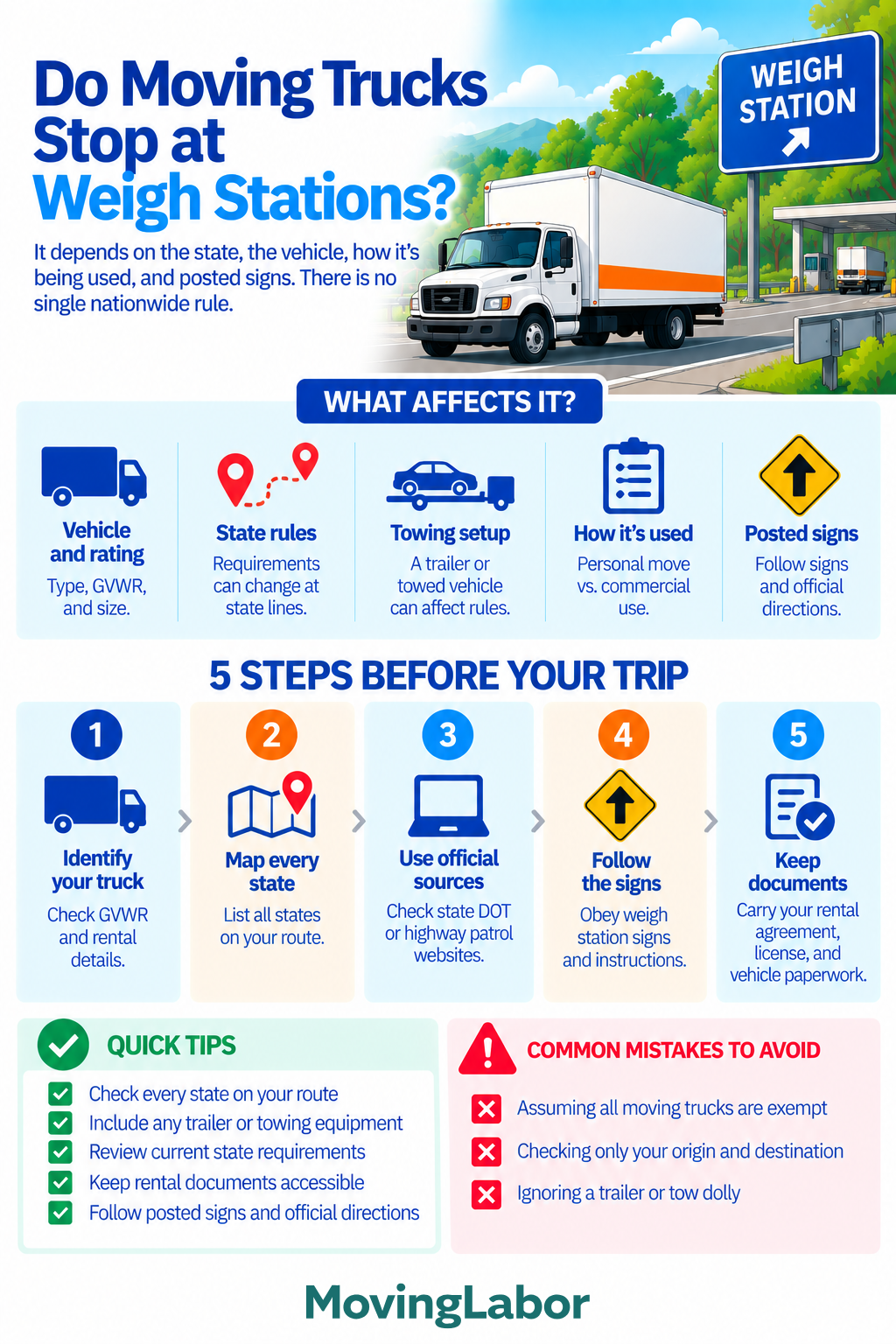
Whether you need to stop at a weigh station while driving a rental moving truck depends on the state, vehicle, weight or rating, how the truck is being used, towing setup, and instructions posted at the station.
There is no single nationwide rule that applies to every U-Haul, Penske, Budget, or other customer-rented moving truck.
For an interstate DIY move, check the current requirements for every state on your planned route before departure. Use official state transportation, highway patrol, state police, or commercial-vehicle enforcement sources whenever possible.
When approaching a weigh or inspection station, pay attention to posted signs and official instructions rather than relying on a general rule you found online.
Quick Answer
A rental moving truck may or may not be required to stop at a weigh station.
Before your trip:
- Identify the exact rental truck
- Check its GVWR and other relevant vehicle information
- Include any trailer or tow equipment
- List every state on your route
- Check current official requirements for each state
Do not assume that a personal household move is automatically exempt everywhere, and do not assume that renting a large moving truck automatically means you must enter every weigh station.
Follow applicable posted signs and official directions while driving.
Step-by-Step Plan
1. Identify the Exact Vehicle
Before researching weigh-station requirements, know what you will be driving.
Record information such as:
- Truck type
- Gross Vehicle Weight Rating (GVWR)
- Rental status
- License/registration information available with the vehicle
- Whether you will tow a trailer or vehicle
The advertised truck length alone does not determine whether you need to stop.
2. Check Every State on Your Route
Requirements can change when you cross a state line.
Make a list of every state on both your primary route and any realistic alternate route.
For example, a long-distance trip may pass through several states even though you are only moving between two of them. Check each applicable jurisdiction rather than researching only your origin and destination.
3. Use Official State Sources
Look for current information from agencies such as the state's:
- Department of Transportation
- Highway patrol
- State police
- Commercial-vehicle enforcement agency
Be careful with forums, old blog posts, social-media answers, and generalized weigh-station charts. They can be outdated or may describe commercial trucks rather than a privately operated rental truck carrying personal household goods.
State rules matter for moves within a state as well; FMCSA directs consumers to state or local authorities for state-specific moving requirements.
4. Follow Posted Signs and Instructions
As you approach a weigh or inspection station, read the signs carefully.
Instructions may identify which vehicles or weight classes must enter, and station operation can vary by location.
Do not bypass an open station solely because a general article, forum post, or previous trip suggested that your rental truck was exempt.
If an officer or other authorized official directs you to enter, follow that direction.
5. Keep Your Rental Documents Accessible
Keep important documents somewhere the driver can access safely when stopped.
These may include:
- Driver's license
- Rental agreement
- Vehicle paperwork supplied with the rental
- Protection or insurance documentation
- Towing documentation, when applicable
Also know the truck's relevant vehicle information so you are not trying to determine it while approaching a station.
6. Recheck Before Departure
Do not research the route months in advance and assume nothing has changed.
Review the applicable state information again close to your departure date, particularly for a multi-state trip.
If an official source is unclear about how its rule applies to a privately rented moving truck carrying your own household goods, contact the relevant state agency for clarification.
Decision Checkpoints
- Before choosing the route: List every state the truck will travel through.
- Before pickup: Research current weigh- and inspection-station requirements for those states.
- At pickup: Verify the exact truck's GVWR and relevant vehicle information.
- If towing: Recheck whether the vehicle combination affects applicable requirements.
- Before departure: Review the route and current official information again.
- On the road: Follow posted signs and official directions.
Move-Day Checklist
- Record the truck's GVWR
- Keep rental documents accessible
- Confirm every state on the route
- Review current state requirements
- Include trailer or towing information
- Watch weigh-station signs
- Follow official instructions
- Keep an alternate route plan available
Common Mistakes to Avoid
- Assuming every rental moving truck is exempt. Requirements vary, so check the states on your route.
- Assuming every moving truck must stop. Rules may depend on vehicle characteristics, use, state requirements, and posted instructions.
- Checking only the origin and destination states. Include every state the truck will travel through.
- Using truck length instead of relevant weight information. A label such as “26-foot truck” does not by itself determine weigh-station requirements.
- Ignoring a trailer or tow dolly. Towing can change the vehicle combination you need to evaluate.
- Relying on an old online chart. Use current official state information whenever possible.
Where Professional Moving Labor Fits
Moving labor can load or unload a customer-rented truck, but it typically does not supply or drive that truck.
Hiring workers to load or unload your rental truck does not replace the driver's responsibility for the vehicle, route, rental agreement, weigh-station requirements, and driving decisions.
Give the moving labor provider accurate information about the truck, inventory, heavy items, parking, stairs, and access conditions so the loading or unloading work can be planned appropriately.
Use Truck loading and unloading help or the Truck and Container Calculator to continue planning.
Confirm the truck separately, and confirm the moving labor scope, crew size, minimums, availability, arrival window, and price in writing.