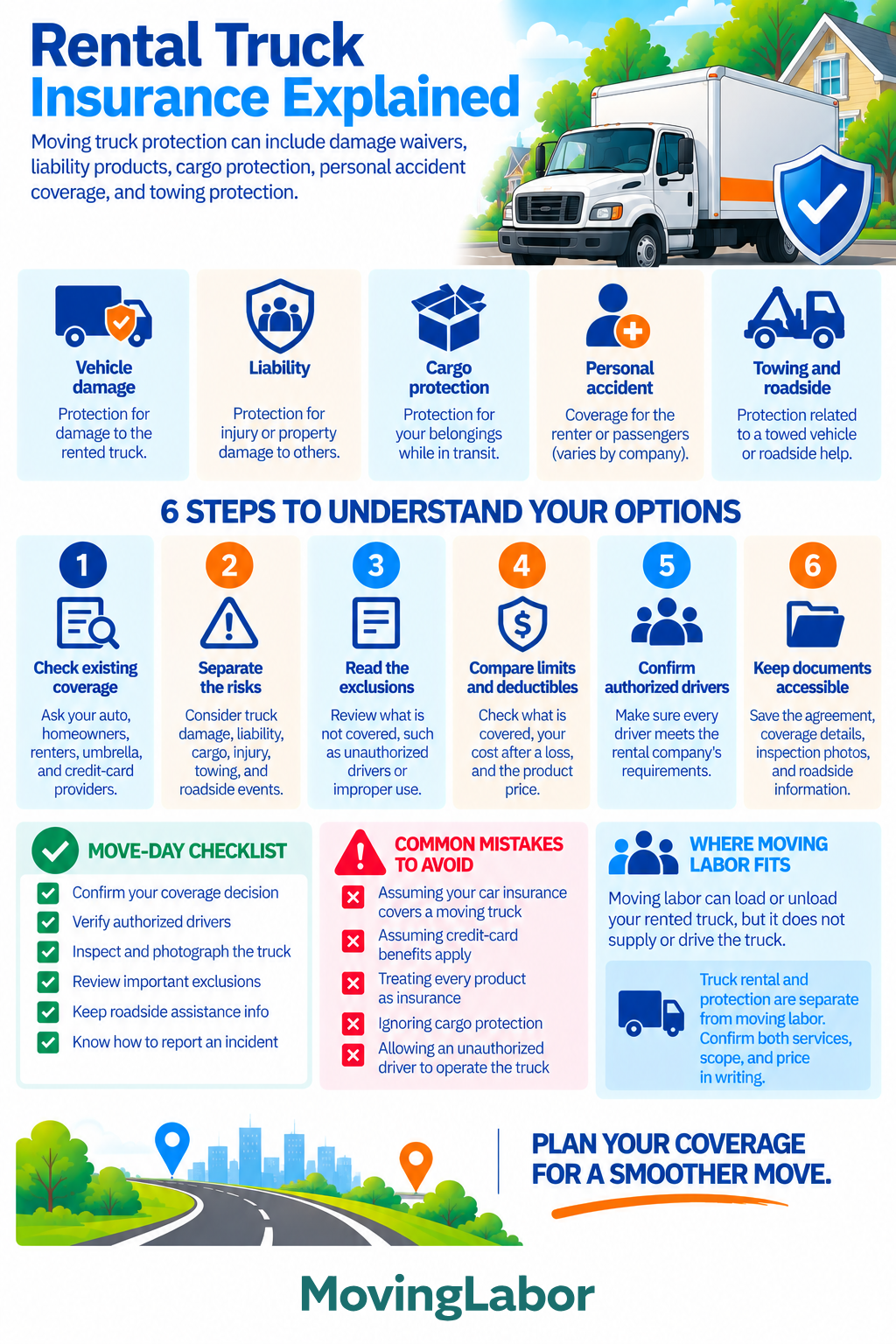
Moving truck rental companies may offer several types of optional protection, such as damage waivers, supplemental liability products, cargo protection, personal accident coverage, or protection related to towing. These products do not all cover the same risks, and some may be waivers or contractual protection rather than insurance.
Before renting a moving truck, check whether your existing auto, homeowners, renters, umbrella, or credit-card benefits apply to the exact rental vehicle and situation. Then compare that protection with the rental company's current options, limits, deductibles, exclusions, and rental agreement.
This guide focuses on four important decisions: check existing coverage, separate the risks, read the exclusions, and compare limits and deductibles. Coverage products and requirements can vary by rental company, vehicle, reservation, and state, so verify the current terms before making a coverage decision.
Quick Answer
Do not assume your personal auto insurance or credit card automatically protects a rental moving truck.
Before accepting or declining rental-company protection, contact your existing providers and ask specifically about the truck you plan to rent. Then review the rental agreement to understand which risks are covered, excluded, or still your responsibility.
Pay particular attention to damage to the rental truck, liability to others, your belongings, personal injury, towing, and roadside incidents because these may be handled separately.
Step-by-Step Plan
1. Check Existing Coverage
Contact your insurance providers before renting the truck.
Depending on what you already carry, relevant policies may include:
- Personal auto insurance
- Homeowners insurance
- Renters insurance
- Umbrella liability coverage
- Credit-card rental benefits
Do not simply ask whether you have “rental vehicle coverage.” Give the provider details about the actual moving truck, including its type or size and how it will be used.
Ask whether the policy covers the rental vehicle itself, liability to others, personal belongings, and any other risks relevant to your move.
Get important coverage information in writing when possible.
2. Separate the Risks
Think about each type of potential loss separately.
Important categories can include:
- Rental truck damage: Damage to or loss of the rented vehicle
- Third-party liability: Injury or property damage involving other people
- Cargo or belongings: Loss or damage involving items being moved
- Personal injury: Injuries to the renter or passengers
- Towing: Damage involving a vehicle being towed
- Roadside events: Breakdowns or other roadside assistance needs
A product covering one category does not necessarily protect you against the others.
3. Read the Exclusions
Coverage is only useful if you understand when it applies.
Review the current terms for exclusions or restrictions involving issues such as:
- Unauthorized drivers
- Certain overhead or roof damage
- Improper or prohibited use
- Unsecured cargo
- Towing
- Driving outside permitted areas
- Violations of the rental agreement
- Other excluded losses or circumstances
The exact exclusions depend on the rental agreement and protection product. Read the current terms rather than assuming similar-sounding products work the same way across rental companies.
4. Compare Limits and Deductibles
Do not compare protection products by name alone.
Review:
- What is protected
- Coverage or protection limits
- Deductibles or renter responsibility
- Major exclusions
- Cost of the product
- Who is eligible
- Which drivers are covered
- What happens after an incident
A less expensive option may provide different protection rather than simply being a cheaper version of another product.
5. Confirm Authorized Drivers
Determine who will drive the moving truck before pickup.
Every planned driver should meet the rental company's requirements and be listed or authorized when required by the rental agreement.
Do not assume another person can take over driving simply because they have a valid driver's license.
If your own insurance is involved, also verify how coverage applies to each planned driver.
6. Keep Important Documents Accessible
Keep the information you may need during the rental somewhere you can access it quickly.
This can include:
- Rental agreement
- Protection or coverage documents
- Existing insurance information
- Vehicle inspection photos
- Roadside assistance contact information
- Rental-company contact information
- Incident-reporting instructions
Do not pack important documents somewhere inaccessible inside the cargo area.
Decision Checkpoints
- Before choosing protection: Contact your existing insurance and benefit providers about the exact rental truck.
- Before booking: Identify which risks are already covered and which may remain your responsibility.
- Before accepting or declining rental protection: Review the product's limits, deductibles, exclusions, and cost.
- Before driving: Confirm authorized drivers and keep the rental, protection, and roadside information accessible.
Move-Day Checklist
- Confirm your coverage decision
- Save the rental agreement
- Keep protection documents accessible
- Verify all authorized drivers
- Inspect and photograph the truck
- Record existing visible damage
- Know the truck's height
- Review important exclusions
- Save roadside assistance information
- Know how to report an incident
Common Mistakes to Avoid
- Assuming personal auto insurance automatically covers a moving truck. Verify coverage for the exact type of rental vehicle before relying on your existing policy.
- Assuming credit-card rental benefits apply. Vehicle types and benefits can be restricted, so verify the exact rental before depending on credit-card protection.
- Treating every protection product as insurance. Damage waivers, liability products, cargo protection, and other products can have different legal structures and purposes.
- Looking only at the price. Compare limits, deductibles, exclusions, and the risks addressed.
- Ignoring cargo protection. Protection for the rental truck does not necessarily protect the belongings inside it.
- Allowing an unauthorized driver to operate the truck. Confirm driver requirements before anyone gets behind the wheel.
Where Professional Moving Labor Fits
Moving labor can help load or unload your customer-rented moving truck, but the truck rental, authorized drivers, and rental protection decisions remain separate from the labor booking.
When using professional moving labor, provide an accurate inventory and disclose heavy, oversized, fragile, or specialty items before move day. Also confirm the scope of the labor provider's services and understand that protection associated with the rental truck should not be assumed to cover the moving labor service or vice versa.
Use Truck loading and unloading help or the Truck and Container Calculator to continue planning.
Confirm the rental truck and protection choices separately, and confirm the moving labor scope, crew size, minimums, availability, arrival window, and price in writing.