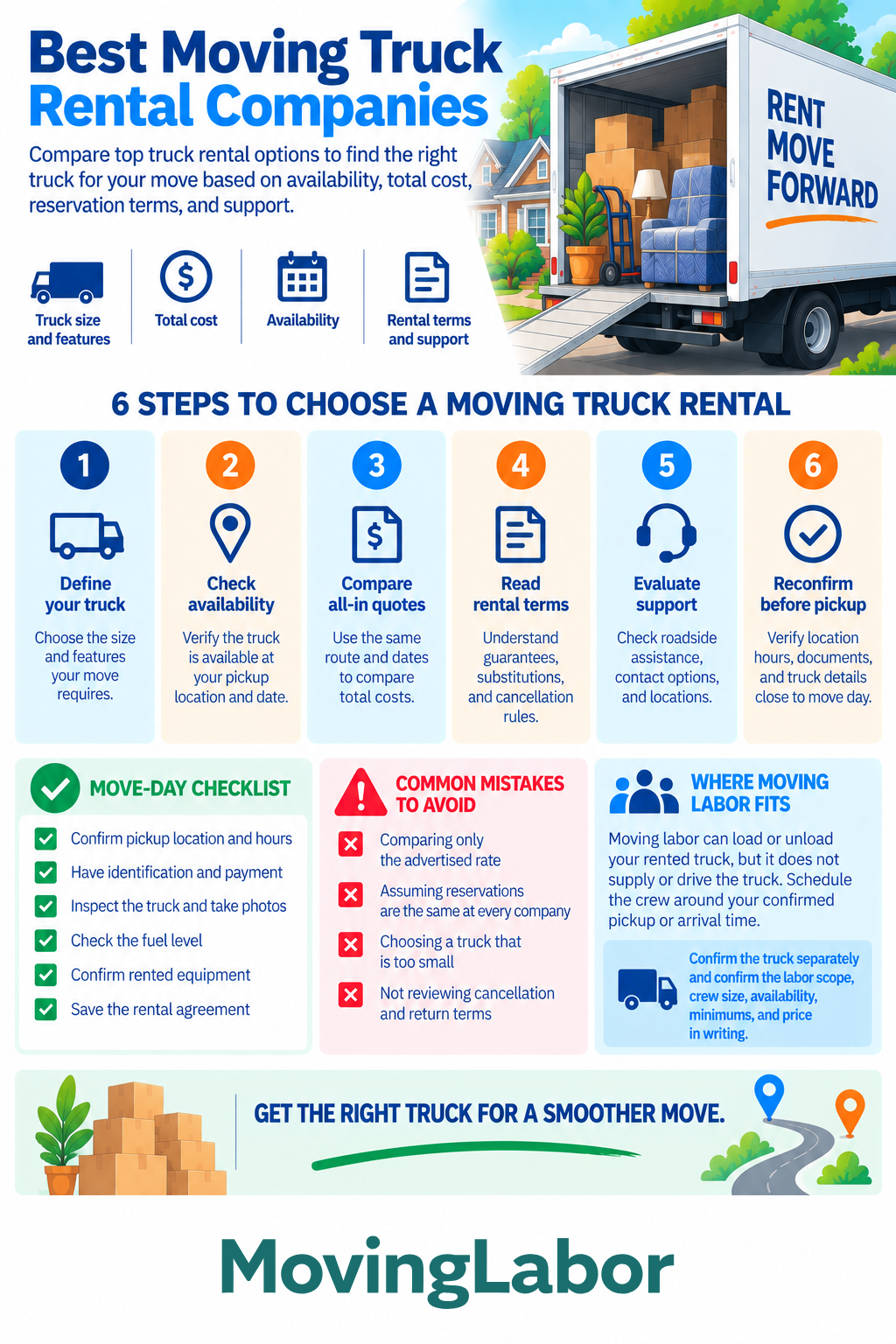
The best moving truck rental company for your move depends on your route, date, truck requirements, local availability, and rental terms. Instead of relying on a permanent national ranking, compare major rental companies and qualified local options based on vehicle availability, total cost, reservation terms, support, coverage options, and pickup and return requirements.
Common national companies to compare include U-Haul, Penske, and Budget Truck Rental. Their fleets, rates, availability, and reservation policies differ, so check current quotes and terms for your specific move before booking.
This guide focuses on four important decisions: define the required truck, check current local availability, compare all-in quotes, and read reservation terms. Truck availability, rates, coverage products, and rental policies can change. Verify the vehicle and current rental agreement when booking and again at pickup.
Quick Answer
Start by determining the truck size and features your move requires, then compare availability and quotes for the same route and dates.
Do not compare companies using the advertised base rate alone. Consider mileage charges or allowances, rental duration, equipment, coverage options, taxes and fees, expected fuel costs, pickup and return locations, and reservation terms.
Pay particular attention to how the company handles equipment availability or substitutions. Current policies differ among U-Haul, Penske, and Budget, making the reservation terms an important part of the comparison.
Step-by-Step Plan
1. Define the Required Truck
Estimate the cargo space and payload needed for your belongings before comparing companies.
Also consider features relevant to your move, such as a loading ramp, seating, towing capability, clearance, and any equipment you plan to rent.
Avoid choosing a truck solely by the number of bedrooms advertised for a particular size. Inventory volume and weight can vary substantially between households.
2. Check Current Local Availability
Check the truck you need for your actual pickup location, destination, date, and rental type.
A company's national fleet does not guarantee that a particular truck will be available at your preferred location. Availability can also affect rates and pickup options.
For one-way moves, verify both pickup and return arrangements before booking.
3. Compare All-In Quotes
Request quotes using the same move details so the comparison is meaningful.
Consider:
- Base rental rate
- Included or additional mileage
- Number of rental days
- Taxes and applicable fees
- Equipment rentals
- Coverage or protection options
- Expected fuel
- Tolls and parking
- Additional-driver charges, if applicable
- Extra-day or mileage charges
- Pickup and return requirements
Rental rates can change with demand and availability. Budget and Penske, for example, both state that rates can fluctuate based on factors such as demand or availability.
4. Read Reservation Terms
Understand what the reservation actually confirms.
Check whether the selected truck, pickup location, and pickup time are guaranteed or subject to availability, and determine what happens if the requested equipment is unavailable.
Policies differ by company. Penske currently states that, except for certain reservations made within 24 hours of pickup, it guarantees the reserved vehicle or an equivalent or larger vehicle at the selected time and location. U-Haul uses reservation-guarantee conditions that depend on how the reservation is confirmed. Budget states that equipment is subject to availability and that reservation location, time, date, and equipment preferences may be replaced with alternatives.
Also review cancellation, modification, late-return, and no-show terms.
5. Evaluate Support and Logistics
Consider what happens if something goes wrong during the rental.
Review roadside assistance information, contact options, pickup and destination locations, after-hours procedures, and what to do if the vehicle has a mechanical problem.
For a one-way move, make sure you understand where and when the truck must be returned.
6. Reconfirm Before Pickup
Review the reservation before move day.
Confirm:
- Pickup location and hours
- Pickup date and time
- Truck size or class
- Required identification
- Authorized drivers
- Payment or deposit requirements
- Equipment reservations
- Return location and deadline
- After-hours procedures, if applicable
Keep the reservation confirmation accessible during pickup.
Decision Checkpoints
- Before requesting quotes: Estimate the required cargo space, payload, rental days, mileage, and equipment.
- Before comparing companies: Use the same route, dates, truck requirements, and optional services for each quote.
- Before booking: Review availability, reservation and substitution terms, cancellation rules, coverage options, and the expected all-in cost.
- Before pickup: Reconfirm the location, hours, truck details, required documents, authorized drivers, and return instructions.
Move-Day Checklist
- Confirm pickup location and hours
- Have required identification and payment available
- Verify authorized drivers
- Confirm truck size or class
- Review mileage and return terms
- Inspect the truck before leaving
- Photograph existing visible damage
- Check the fuel level
- Confirm rented equipment is present
- Save the rental agreement
- Verify the return location and deadline
- Keep roadside assistance information accessible
Common Mistakes to Avoid
- Choosing a company based only on the advertised rate. Compare the expected total cost using the same route, mileage, rental period, and optional services.
- Assuming a reservation means the same thing at every company. Equipment guarantees, substitutions, locations, and pickup terms differ by rental company.
- Choosing a truck that is too small for the inventory. Estimate cargo requirements before booking instead of relying solely on a low rental price.
- Ignoring mileage and fuel. These can materially affect the total cost depending on the rental structure and route.
- Skipping the pickup inspection. Inspect the truck and document existing visible damage before leaving the rental location.
- Ignoring return requirements. Verify the return location, deadline, fuel requirements, and procedures in the rental agreement.
Where Professional Moving Labor Fits
Moving labor can handle the physical loading or unloading of a customer-rented moving truck while the customer remains responsible for arranging and driving the rental vehicle.
When coordinating a rental truck with moving labor, schedule the crew around the confirmed truck pickup or arrival time. Provide the moving labor provider with an accurate inventory, truck size, heavy or specialty items, stairs, parking conditions, and other relevant access details.
Use Truck loading and unloading help or the Truck and Container Calculator to continue planning.
Confirm the truck separately from the moving labor booking, and confirm the labor scope, crew size, availability, minimums, arrival window, and price in writing.