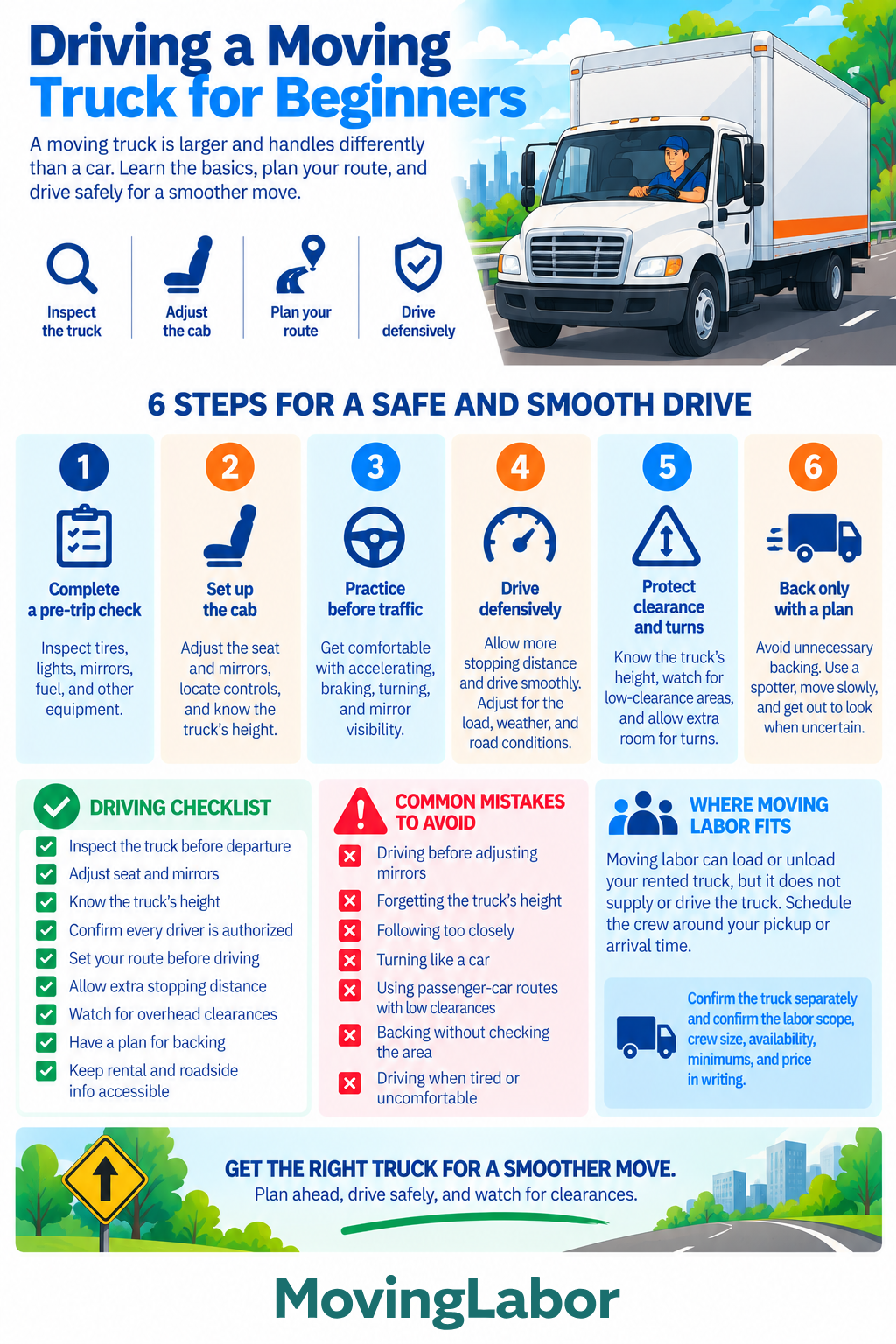
Driving a moving truck is different from driving a passenger car. A rental moving truck may be wider, taller, heavier, slower to stop, and less maneuverable than the vehicle you normally drive. Before entering traffic, learn the controls, adjust the mirrors, verify the truck’s height and other important dimensions, and become comfortable with its braking, turning, and visibility.
This guide focuses on four important steps: complete a pre-trip check, set up the cab, practice before entering traffic, and drive defensively. Always follow the rental company's instructions, posted traffic controls, and applicable state and local laws for the exact vehicle you are driving.
Quick Answer
Before driving a rental moving truck, inspect the vehicle, adjust the seat and mirrors, locate the controls, and verify the truck's height. If possible, spend a few minutes in a safe open area getting familiar with acceleration, braking, turning, and mirror visibility before entering traffic.
Once on the road, allow more space for stopping and turning than you would in a passenger car. Pay close attention to overhead clearance, road restrictions, surrounding traffic, and the truck's wider turning path. Avoid backing whenever a safer alternative is available.
Step-by-Step Plan
1. Complete a Pre-Trip Check
Inspect the rental truck before leaving the pickup location.
Follow the rental company's inspection instructions and check the condition of the tires, lights, mirrors, windshield, cargo area, doors, and other relevant equipment. Note warning lights and verify the fuel level.
Document existing visible damage according to the rental company's procedures before driving away.
If the truck has a ramp, towing equipment, or other rented equipment, confirm that it is properly stored or secured before driving.
2. Set Up the Cab
Adjust the seat so you can comfortably reach the pedals and controls. Position the mirrors to give yourself the best available view along both sides of the truck.
Before driving:
- Locate important controls
- Fasten your seat belt
- Verify the truck's height
- Secure loose items in the cab
- Set navigation before moving
- Make sure every driver is authorized under the rental agreement
Do not rely on your memory of another truck's dimensions. Verify the information for the vehicle you are actually driving.
3. Practice Before Entering Traffic
If a safe and permitted open area is available, take a few minutes to become familiar with the truck before entering normal traffic.
Practice gentle acceleration and braking, wide turns, mirror checks, and judging the vehicle's width and length.
Remember that the rear of a moving truck can follow a different path through a turn than the front. Give yourself additional room and avoid rushing.
4. Drive Defensively
Increase the space between the moving truck and the vehicle ahead so you have more time to slow or stop.
Brake early and smoothly, reduce speed before curves and turns, and avoid abrupt steering or lane changes.
Adjust your driving for the truck's load as well as traffic, road, grade, visibility, and weather conditions. Follow posted speed limits and any lower limits or restrictions that apply to the vehicle or roadway.
If conditions make you uncomfortable, find a safe place to stop rather than continuing beyond your comfort level.
5. Protect Clearance and Turns
Know the truck's height before driving and watch carefully for posted clearance limits.
Pay particular attention around:
- Parking garages
- Covered entrances
- Drive-thrus
- Low bridges
- Building overhangs
- Tree limbs
- Utility structures
- Other low-clearance areas
Do not enter an overhead space when you are uncertain that the truck will clear it.
Moving trucks also need more room to turn than passenger cars. Slow down, use your mirrors, and account for the path of the rear wheels and body of the truck.
Plan your route with the truck's dimensions and applicable road restrictions in mind rather than assuming every passenger-car route is suitable.
6. Back Only With a Plan
Avoid unnecessary backing when you can safely position the truck to leave forward.
Before backing, check the area around and behind the truck. If you are uncertain about available space, stop in a safe position and get out to inspect the area before continuing.
When a spotter is available, agree on signals before moving. Keep the spotter where the driver can see them without placing the spotter in the truck's path.
If you lose sight of the spotter or become uncertain about an obstacle, stop.
Decision Checkpoints
- Before leaving the rental location: Inspect the truck, document existing visible damage, verify the fuel level, and learn the basic controls.
- Before entering traffic: Adjust the seat and mirrors, verify the truck's height, secure loose items, and become familiar with braking and turning.
- Before starting the route: Check for relevant vehicle restrictions and potential clearance concerns along the planned route.
- Before backing: Inspect the area, identify obstacles, and use a spotter when appropriate and available.
Move-Day Checklist
- Inspect the truck before departure
- Document existing visible damage
- Verify the fuel level
- Adjust the seat and mirrors
- Know the truck's height
- Locate important controls
- Confirm every driver is authorized
- Secure loose items
- Set the route before driving
- Allow extra stopping and turning room
- Watch overhead clearances
- Inspect the area before backing
- Keep rental and roadside-assistance information accessible
Common Mistakes to Avoid
- Driving away before adjusting the mirrors. Set the mirrors and seat before entering traffic.
- Forgetting the truck's height. Verify the exact vehicle's clearance information and watch for overhead restrictions throughout the trip.
- Following too closely. A loaded moving truck may require more time and distance to slow or stop than the passenger vehicle you normally drive.
- Turning like you are driving a car. Allow additional room and watch the truck's position through the turn.
- Relying blindly on a passenger-car route. Pay attention to posted restrictions and clearance limits that may affect the truck.
- Backing without checking the area. Stop and inspect when visibility or clearance is uncertain.
- Continuing when tired or uncomfortable. Take appropriate breaks and stop somewhere safe if conditions exceed your comfort level.
Where Professional Moving Labor Fits
Moving labor can help load or unload a customer-rented moving truck, allowing you to reduce the amount of physical moving work you handle yourself. Labor-only moving services typically do not provide or drive the rental truck.
Coordinate the labor booking with your truck pickup, loading schedule, travel plans, and destination. Give the crew accurate information about your inventory, truck size, heavy or specialty items, stairs, parking, and access conditions.
Use Truck loading and unloading help or the Truck and Container Calculator to continue planning.
Confirm the rental vehicle and authorized drivers separately, and confirm the moving labor scope, crew size, availability, minimums, arrival window, and price in writing.