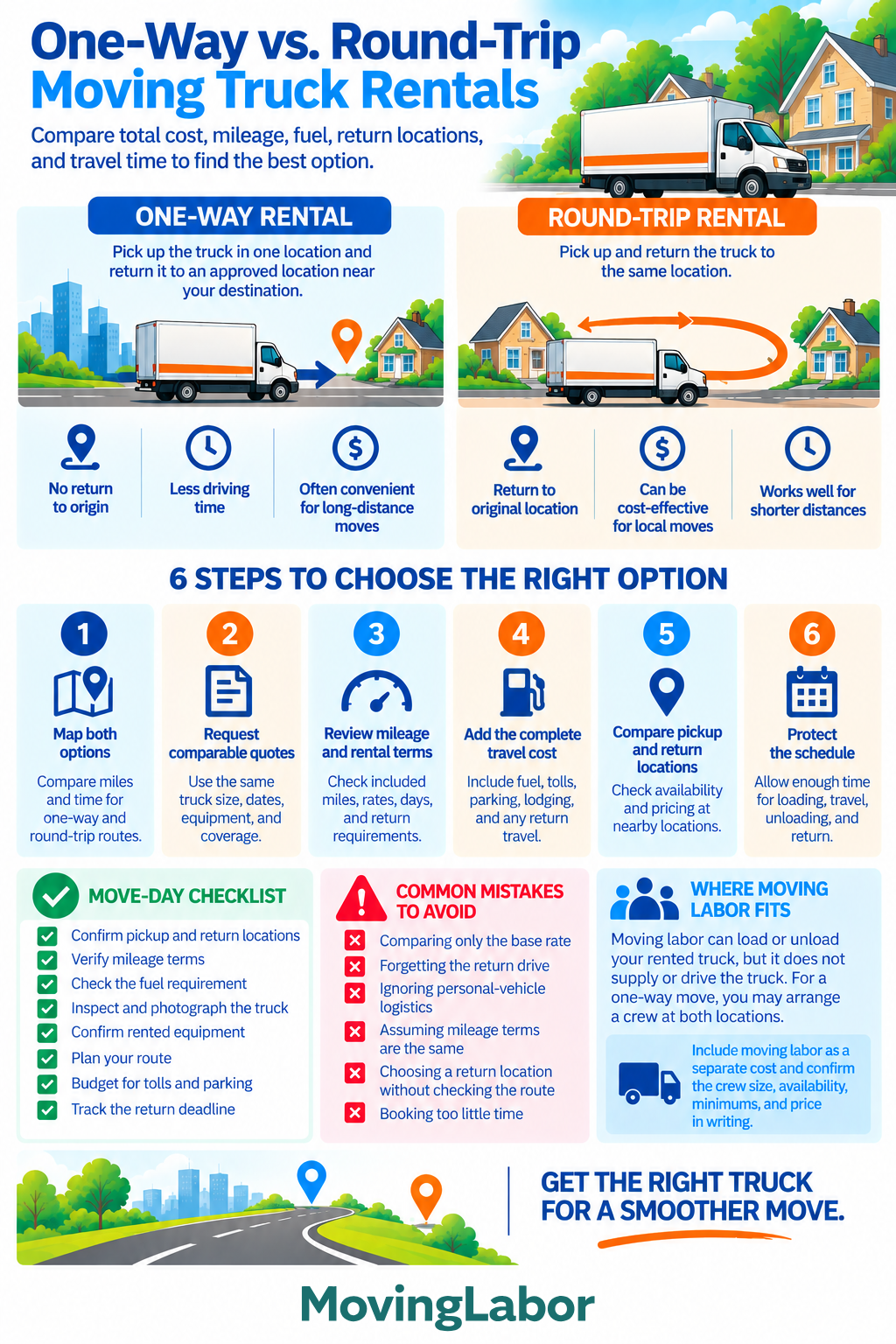
A one-way moving truck rental lets you pick up the truck in one location and return it to an approved location near your destination. A round-trip rental requires you to return the truck to the original rental location.
The better option depends on more than the rental rate. Compare total driving distance, mileage terms, fuel, tolls, rental time, pickup and return locations, vehicle availability, and any additional travel required to return the driver or a personal vehicle.
This guide focuses on four important decisions: map both options, request comparable quotes, review mileage and rental terms, and add the complete travel cost. Pricing, availability, and rental terms vary by company, location, route, and date, so verify the current quote and rental agreement before booking.
Quick Answer
A one-way rental can make sense when returning the truck to your starting point would add substantial driving, fuel, mileage, or travel time.
A round-trip rental can work well when the move is relatively close to the pickup location and returning the truck is practical.
Do not decide based only on the quoted rental rate. Calculate the expected all-in cost and total travel time for both options.
Step-by-Step Plan
1. Map Both Options
Calculate the actual driving required for each rental type.
For a one-way rental, consider:
Origin → Destination → Approved return location
For a round-trip rental, consider:
Origin → Destination → Origin
Also account for any additional driving needed to reposition a personal vehicle or get the driver home after returning the truck.
Comparing the complete routes makes it easier to see how much additional mileage and time a round trip may require.
2. Request Comparable Quotes
Request both rental options when they are available for your move.
Use the same:
- Truck size
- Pickup date
- Expected rental period
- Equipment
- Protection or coverage options
- Route assumptions
For the one-way quote, enter the actual destination or approved return location. For the round-trip quote, use the original location as the return point.
This gives you a more meaningful comparison than looking at advertised starting rates.
3. Review Mileage and Rental Terms
Check what each quote includes.
Compare:
- Included mileage, if any
- Additional mileage charges
- Included rental days
- Extra-day charges
- Pickup location
- Required return location
- Return deadline
- Fuel requirements
- Cancellation or modification terms
Do not assume one-way and round-trip rentals use the same mileage or pricing structure.
4. Add the Complete Travel Cost
Add the expenses created by the entire trip, not just the truck rental.
Depending on the move, these may include:
- Fuel
- Mileage charges
- Tolls
- Parking
- Lodging
- Additional travel time
- Transportation for the driver
- Repositioning a personal vehicle
A round-trip rental with a lower base rate may cost more overall if it requires substantial additional driving.
5. Compare Pickup and Return Options
Truck availability and pricing can vary between rental locations.
For a one-way move, compare reasonable nearby pickup and return locations when practical. A different approved location may have different truck availability or pricing.
Consider convenience as well as price. A lower quote may not be worthwhile if the location adds significant driving or creates scheduling problems.
6. Protect the Schedule
Make sure the rental period allows enough time for:
Pickup - Loading - Travel - Unloading - Return
For a round trip, remember to include the drive back to the original rental location.
Avoid creating a schedule that depends on everything going perfectly. Traffic, loading delays, weather, rest breaks, or unloading time can affect the trip.
Decision Checkpoints
- Before requesting quotes: Map the complete one-way and round-trip routes, including any return or vehicle-repositioning travel.
- Before comparing prices: Use similar truck sizes, dates, equipment, and protection options.
- Before booking: Compare mileage terms, rental duration, fuel, tolls, return requirements, and expected travel costs.
- Before pickup: Confirm the pickup location, return location, truck details, rental period, and return deadline.
Move-Day Checklist
- Confirm pickup location and hours
- Verify the required return location
- Review mileage terms
- Confirm the rental period
- Check the fuel requirement
- Inspect and photograph the truck
- Confirm rented equipment
- Review the truck-safe route
- Budget for tolls and parking
- Track the return deadline
- Keep the rental agreement accessible
Common Mistakes to Avoid
- Comparing only the base rental rates. Calculate mileage, fuel, tolls, rental time, and other travel expenses for both options.
- Forgetting the round-trip return drive. Include the mileage, fuel, time, and possible travel expenses required to bring the truck back to the starting location.
- Ignoring personal-vehicle logistics. Determine how the driver and any personal vehicles will reach the destination or return home.
- Assuming mileage terms are identical. One-way and round-trip rentals may use different pricing and mileage structures.
- Choosing a return location without checking the route. Consider the additional driving required to reach and leave the approved return location.
- Booking too little time. Allow enough time for loading, driving, unloading, rest, and returning the truck.
Where Professional Moving Labor Fits
Moving labor can handle the physical loading or unloading of a customer-rented truck while you remain responsible for arranging and driving the rental vehicle.
With a one-way rental, you may arrange one crew to load at the origin and a separate crew to unload at the destination when service is available in both locations.
With a round-trip rental, coordinate the labor schedule with the additional time required to return the truck to its original rental location.
Use Truck loading and unloading help or the Truck and Container Calculator to continue planning.
Confirm the truck rental separately, and confirm the moving labor scope, crew size, minimums, availability, arrival window, and price in writing.