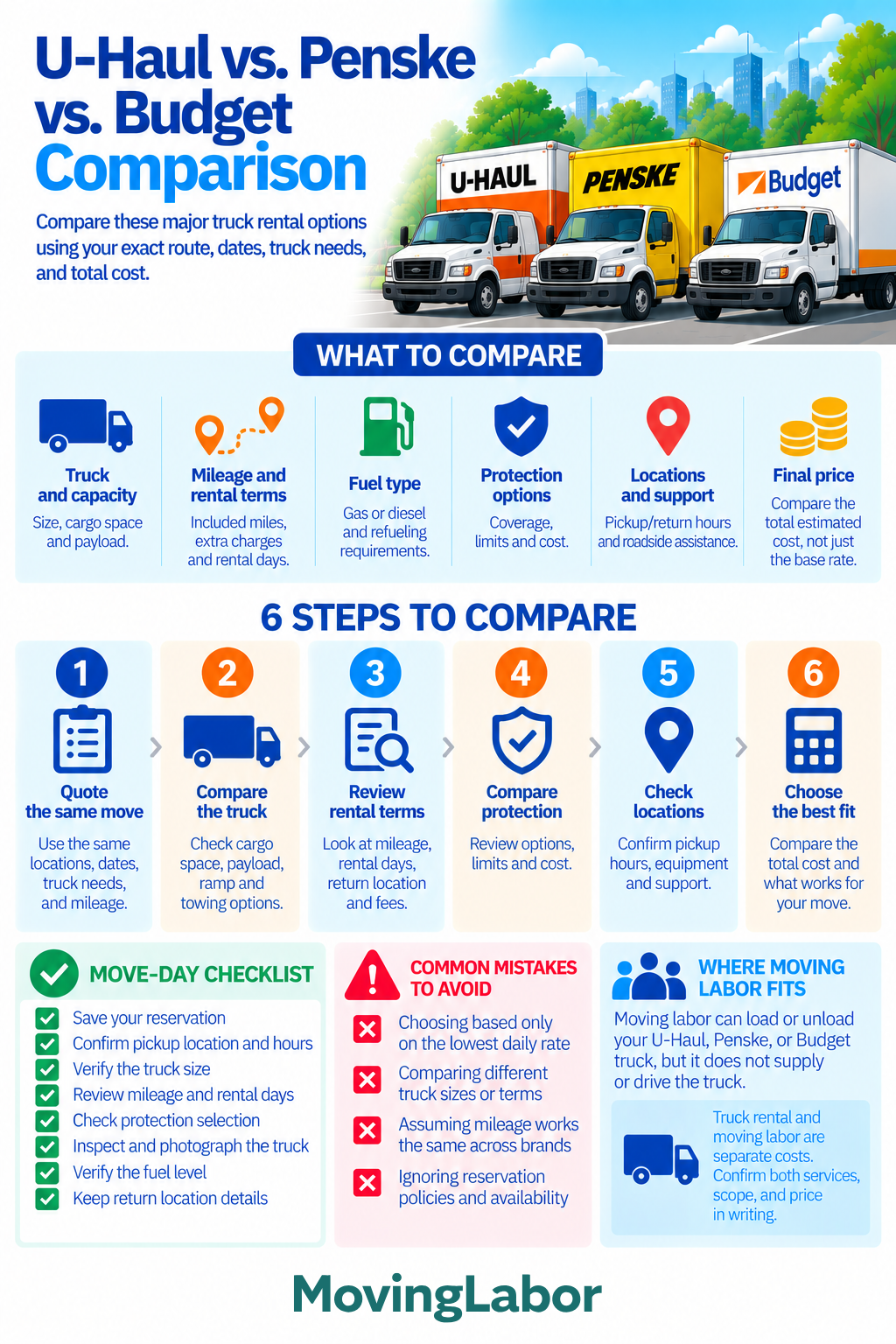
U-Haul, Penske, and Budget are major U.S. moving truck rental options, but no single company is the right choice for every move. Pricing, truck availability, mileage terms, pickup locations, equipment, and reservation policies can vary by route and date.
The most useful comparison starts with the same move details for all three companies. Compare the available truck, cargo needs, mileage terms, rental period, fuel, towing options, protection products, pickup and return locations, reservation terms, and expected final cost.
Current policies also differ. For example, Penske advertises unlimited mileage on one-way rentals, while Budget's one-way rentals include specified days and miles and may charge for additional use. U-Haul's terms depend on the specific rental and contract.
Quick Answer
Compare U-Haul, Penske, and Budget using your actual pickup location, destination, dates, and truck requirements.
Do not choose based solely on an advertised daily rate or a generic national comparison. Check:
- Final estimated rental cost
- Available truck and cargo capacity
- Mileage and rental-day terms
- Pickup and return locations
- Reservation terms
- Protection options
- Towing and equipment needs
- Roadside support
Availability and pricing can change by location and date, so live quotes are more useful than a permanent brand ranking.
Step-by-Step Plan
1. Quote the Same Move
Enter the same move details with each company.
Use identical or comparable:
- Pickup and destination locations
- Moving dates
- Truck requirements
- Rental duration
- Estimated mileage
- Towing needs
- Moving equipment
- Protection choices
Comparing different assumptions can make one quote appear cheaper when the rentals are not actually equivalent.
2. Compare the Available Truck
Do not compare trucks based only on an advertised length such as 16, 20, or 26 feet.
Depending on your move, compare:
- Cargo dimensions
- Payload information
- Loading height
- Ramp or loading equipment
- Seating
- Fuel requirements
- Towing compatibility
Truck models and local availability can vary, so verify the vehicle information associated with your reservation and the actual truck at pickup.
3. Review Mileage and Rental Terms
Mileage and rental structures can differ between companies and between local and one-way rentals.
Review:
- Included mileage
- Additional-mile charges
- Included rental days
- Extra-day charges
- Required return location
- Fuel-return requirements
- Modification or cancellation terms
For example, Penske currently advertises unlimited mileage on U.S. one-way rentals. Budget says its one-way rentals include an allowance of days and miles, with additional charges possible for extra use.
Verify the terms for your actual reservation rather than assuming a company uses the same structure for every rental.
4. Compare Protection Options
Review the current protection products offered for your reservation rather than comparing them by name alone.
Depending on the company and rental, products may address risks involving:
- Rental truck damage
- Liability to others
- Cargo or belongings
- Personal injury
- Towing
Review limits, exclusions, deductibles or renter responsibility, eligible drivers, and cost.
Also check whether any personal auto, homeowners, renters, umbrella, or credit-card benefits apply to the exact rental vehicle before relying on them.
5. Check Reservation and Support Details
A low quote becomes less useful if the pickup or return arrangement does not work for your move.
Check:
- Pickup location and hours
- Return location
- Equipment availability
- After-hours procedures
- Reservation terms
- Roadside assistance
- Customer-support options
Reservation policies are especially important. U-Haul currently uses several reservation scenarios, with its $50 reservation guarantee applying under specified conditions. Penske says it guarantees the reserved vehicle or an equivalent/larger vehicle at the selected time and location, except for reservations made within 24 hours of pickup, when availability is not guaranteed and an alternate location may be provided. Budget states that certain reservation details are preferences and equipment remains subject to availability.
6. Compare the All-In Fit
Once you have comparable quotes, evaluate the complete rental rather than choosing solely by the base price.
Consider:
Rental + mileage + fuel + equipment + protection options + taxes/fees + additional travel = expected rental cost
Then consider the practical side: Does the available truck fit your inventory? Is the pickup location convenient? Do the mileage terms work for your route? Are you comfortable with the reservation and return requirements?
The answer can differ from one move to another.
Decision Checkpoints
- Before requesting quotes: Determine your route, dates, inventory, truck requirements, mileage, and equipment needs.
- Before comparing companies: Make sure all three quotes use comparable move details.
- Before booking: Compare the available truck, mileage, rental period, protection products, reservation terms, and expected final cost.
- Before pickup: Reconfirm the location, hours, reservation details, required documents, and equipment.
- At pickup: Verify the actual truck, fuel level, visible condition, and rental agreement before leaving.
Move-Day Checklist
- Save the reservation confirmation
- Confirm pickup location and hours
- Verify the truck size or class
- Review mileage and rental days
- Confirm towing or rented equipment
- Review the protection decision
- Inspect and photograph the truck
- Verify the fuel level
- Confirm the return location
- Keep roadside-assistance information accessible
Common Mistakes to Avoid
- Declaring one company universally cheapest. Pricing and availability depend on the specific route, date, truck, and rental terms.
- Comparing different truck requirements. Make sure each quote can handle your actual inventory and equipment needs.
- Looking only at the base rate. Include mileage, fuel, equipment, protection products, fees, and additional travel.
- Assuming mileage works the same across brands. Local and one-way rental structures can differ substantially.
- Assuming every reservation works the same way. Current reservation and equipment-availability policies differ among the three companies.
- Counting a promotion before checking the final price. Compare the actual checkout totals and applicable terms.
Where Professional Moving Labor Fits
Professional moving labor can load or unload a customer-rented U-Haul, Penske, Budget, or other suitable rental truck. The customer remains responsible for arranging the truck, authorized driver, transportation, and rental agreement.
When coordinating moving labor with a rental truck, provide the crew with the truck size, inventory, heavy or specialty items, stairs, parking conditions, and access details.
Use Truck loading and unloading help or the DIY vs Movers Calculator to continue planning.
Confirm the rental truck separately, and confirm the moving labor scope, crew size, minimums, availability, arrival window, and price in writing.