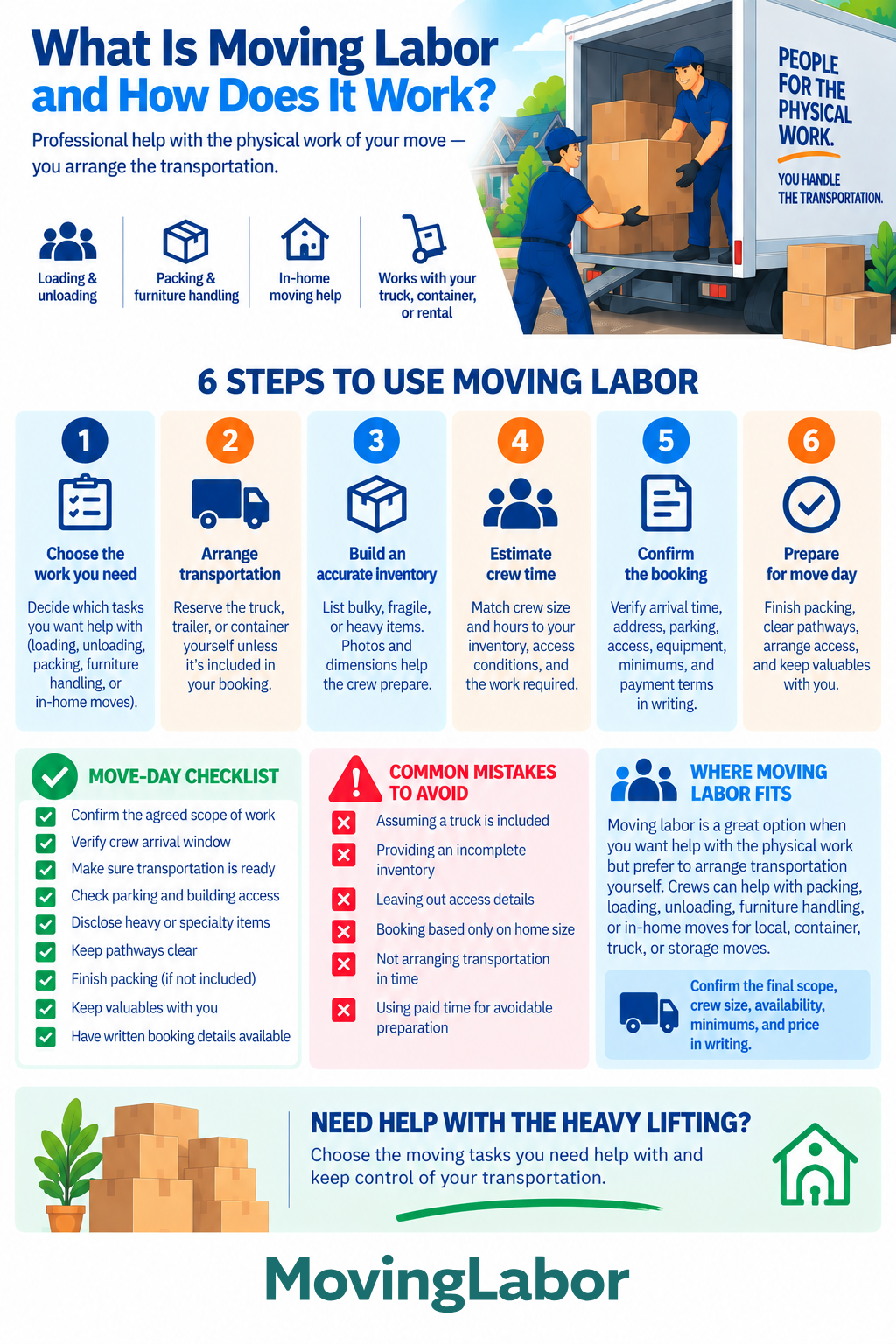
Moving labor is professional help with the physical work of a move, such as packing, loading, unloading, furniture handling, or moving items within a home. With labor-only moving, the customer typically arranges the truck, portable moving container, or other transportation separately when transportation is needed.
This guide focuses on four important decisions: choose the work you need, arrange transportation, build an accurate inventory, and estimate crew time. Understanding these responsibilities before booking helps you choose the right crew, schedule enough time, and clearly define what you need the movers to do.
Quick Answer
Moving labor provides the people to help with agreed physical moving tasks without necessarily providing transportation. You can hire a crew to load or unload a rental truck or portable moving container, help with packing or furniture handling, or move belongings within the same home, depending on the provider's services.
For a labor-only move, arrange transportation separately, provide an accurate inventory and access details, and confirm the crew size, booked time, scope, minimums, and pricing before move day.
Step-by-Step Plan
1. Choose the Work You Need
Decide which physical moving tasks you want the crew to handle. These may include packing, loading, unloading, furniture handling, approved assembly or disassembly, or moving items within the same home.
Tell the provider about stairs, elevators, long carries, heavy items, and other conditions that may affect the work.
2. Arrange Transportation
If you are booking labor-only moving help, transportation is typically your responsibility. Depending on the move, you might use a rental truck, portable moving container, trailer, or another separately arranged transportation option.
Confirm what your booking includes rather than assuming a vehicle or driver is provided.
3. Build an Accurate Inventory
Create a realistic list of the belongings the crew will handle. Identify bulky, fragile, oversized, unusually heavy, or specialty items separately.
Photos, dimensions, and specific item descriptions can help the provider understand items that may require additional planning.
4. Estimate Crew Time
Estimate the crew size and work time based on the actual job rather than home size alone.
Inventory volume, stairs, elevators, walking distance, parking, furniture preparation, loading conditions, and other access factors can affect how long the work takes.
5. Confirm the Booking
Before move day, confirm the service address, date, arrival window, crew size, booked time, minimum hours, scope of work, access instructions, pricing, and payment terms.
Also confirm what equipment or supplies the provider expects to bring and what you are responsible for providing.
6. Prepare for Move Day
Finish packing before the crew arrives unless packing service is included in your booking. Label boxes, clear pathways, arrange parking and building access, and make sure the truck or container is ready when needed.
Keep valuables, identification, medications, keys, important documents, and other personal essentials with you rather than placing them in the moving load.
Decision Checkpoints
- Before requesting a quote: Decide which tasks you want the moving labor crew to perform and create an accurate inventory.
- Before booking: Confirm transportation, crew size, expected time, pricing, minimums, and the exact scope of work.
- Before move day: Verify parking, stairs, elevators, building access, truck or container availability, and heavy or specialty items.
- Before work begins: Review priorities with the crew and make sure the property and transportation are ready for the agreed work.
Move-Day Checklist
- Confirm the agreed scope of work
- Verify the crew's arrival window
- Make sure transportation is ready
- Review crew size and booked time
- Confirm parking and building access
- Keep pathways clear
- Finish packing unless packing service is booked
- Disclose heavy or specialty items
- Keep valuables and essentials with you
- Have written booking and pricing details available
Common Mistakes to Avoid
- Assuming a moving truck is included. With labor-only moving, transportation is typically arranged separately. Confirm exactly what the booking includes.
- Providing an incomplete inventory. Heavy, oversized, fragile, or specialty items should be disclosed before booking.
- Leaving out access details. Stairs, elevators, long carries, parking distance, and building restrictions can affect the work and time required.
- Booking based only on home size. Inventory, access, furniture, and loading conditions can make similar-sized homes require different amounts of labor.
- Waiting until move day to arrange the truck or container. Coordinate transportation and moving labor so the equipment is available when the crew is scheduled.
- Using paid moving time for avoidable preparation. Finish packing and clear pathways ahead of time unless those tasks are included in the booked service.
Where Professional Moving Labor Fits
Professional moving labor can be useful when you want help with the physical work of moving while keeping responsibility for separately arranged transportation.
Depending on the provider and agreed scope, a moving labor crew may help with packing, loading a rental truck or portable moving container, unloading, furniture handling, or moving belongings within the same home.
This approach can work well for local moves, rental truck moves, portable container moves, storage moves, and moves where loading and unloading help are needed at different locations.
Use Moving labor cost or the Move Inventory Builder to continue planning.
Before booking, confirm the final scope, crew size, availability, minimums, arrival window, and price in writing.