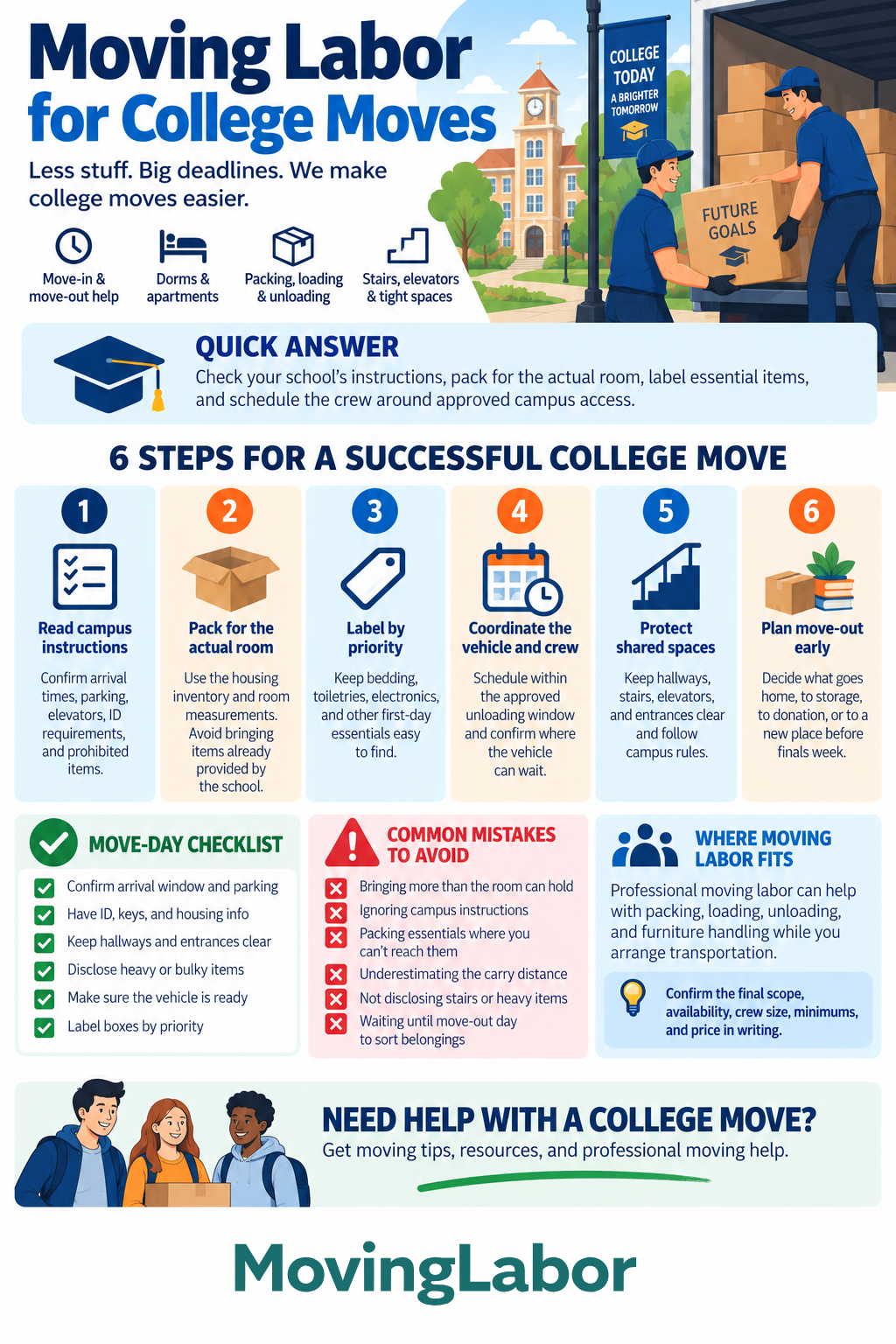
College moves may involve fewer belongings than a typical household move, but tight schedules and campus access can make them surprisingly complicated. Dorm check-in windows, campus parking rules, stairs, busy elevators, prohibited items, limited room space, and storage plans can all affect move-in or move-out day.
This guide focuses on four important decisions in a college moving labor plan: read campus instructions, pack for the actual room, label by priority, and coordinate the vehicle and crew. Labor-only moving works best when transportation and physical moving labor are treated as separate responsibilities. A clear inventory, accurate access details, and written scope help the crew understand the job and plan the work.
Quick Answer
Before booking moving labor for a college move, review the school's housing and move-in or move-out instructions. Confirm the assigned arrival window, parking and unloading procedures, elevator or stair access, identification requirements, and any restrictions on what can be brought into student housing.
Pack for the space the student will actually have, label essential items so they are easy to find, and coordinate the moving crew and transportation around the approved campus access window.
Step-by-step plan
1. Read campus instructions
Review the school's current move-in or move-out instructions. Confirm arrival times, parking or unloading procedures, permits if required, available carts, elevator access, identification requirements, and prohibited items.
2. Pack for the actual room
Check the housing inventory and available room information before packing. Avoid bringing furniture, appliances, or other items already provided by the school, and consider the limited storage space typically available in student housing.
Label by priority
Clearly label boxes by category and priority. Keep bedding, toiletries, electronics, chargers, desk supplies, and other first-day essentials easy to identify and access.
4. Coordinate the vehicle and crew
Schedule moving labor around the approved campus unloading window. Confirm where the truck or other vehicle can unload, how long it can remain there, and how far the crew will need to carry items.
5. Protect shared spaces
Keep hallways, stairs, elevators, entrances, and fire doors clear while moving. Follow campus or building instructions for carts, elevators, entrances, and other shared areas.
6. Plan move-out early
Before the end of the school year or semester, decide which belongings will go home, into storage, to another residence, or be donated or discarded. Planning before the busiest move-out period can make packing and transportation easier to organize.
Decision checkpoints
- Before packing: Review the housing inventory, room information, and prohibited-item rules so you know what should actually be brought.
- Before booking moving labor: Confirm the move date, campus access window, inventory, heavy items, stairs or elevators, parking conditions, and transportation plan.
- Before work begins: Verify where the vehicle can unload and make sure the crew can access the residence during the approved window.
- Before the crew leaves: Confirm that priority items are in the correct room and that important belongings are accounted for.
Move-Day Checklist
- Review current campus move-in or move-out instructions
- Confirm the assigned arrival or access window
- Verify parking and unloading procedures
- Confirm stair or elevator access
- Keep ID, keys, and housing information accessible
- Label boxes by room, category, or priority
- Keep hallways, stairs, entrances, and fire doors clear
- Disclose heavy or bulky items before the crew arrives
- Make sure the truck or other transportation is ready
- Keep the written moving labor scope and payment terms available
Common Mistakes to Avoid
- Bringing too much for the available space. Check what the school provides and consider the room's available storage before packing.
- Ignoring campus move-in or move-out instructions. Arrival windows, unloading locations, parking procedures, and building access can affect when and where the crew can work.
- Packing essentials where they cannot be reached. Keep identification, keys, housing documents, medication, valuables, electronics, chargers, and immediate necessities with the student.
- Underestimating the distance from the vehicle to the room. Campus parking restrictions or designated unloading areas can create longer carries than expected.
- Failing to disclose stairs or heavy items. Give the moving labor provider accurate access and inventory information before booking.
- Waiting until move-out day to decide what goes into storage. Sort belongings ahead of time so items going home, into storage, to another residence, or to donation do not become mixed together.
Where Professional Moving Labor Fits
For college moves, professional moving labor can handle agreed physical work such as packing, carrying, loading, unloading, and furniture handling while the customer remains responsible for separately arranged transportation when booking labor-only service.
Use the school's move instructions along with an accurate inventory and access details to describe the job clearly. Confirm the final scope, crew availability, minimums, arrival window, and price in writing before the scheduled work.
Use Moving labor services or the Move Inventory Builder to continue planning.