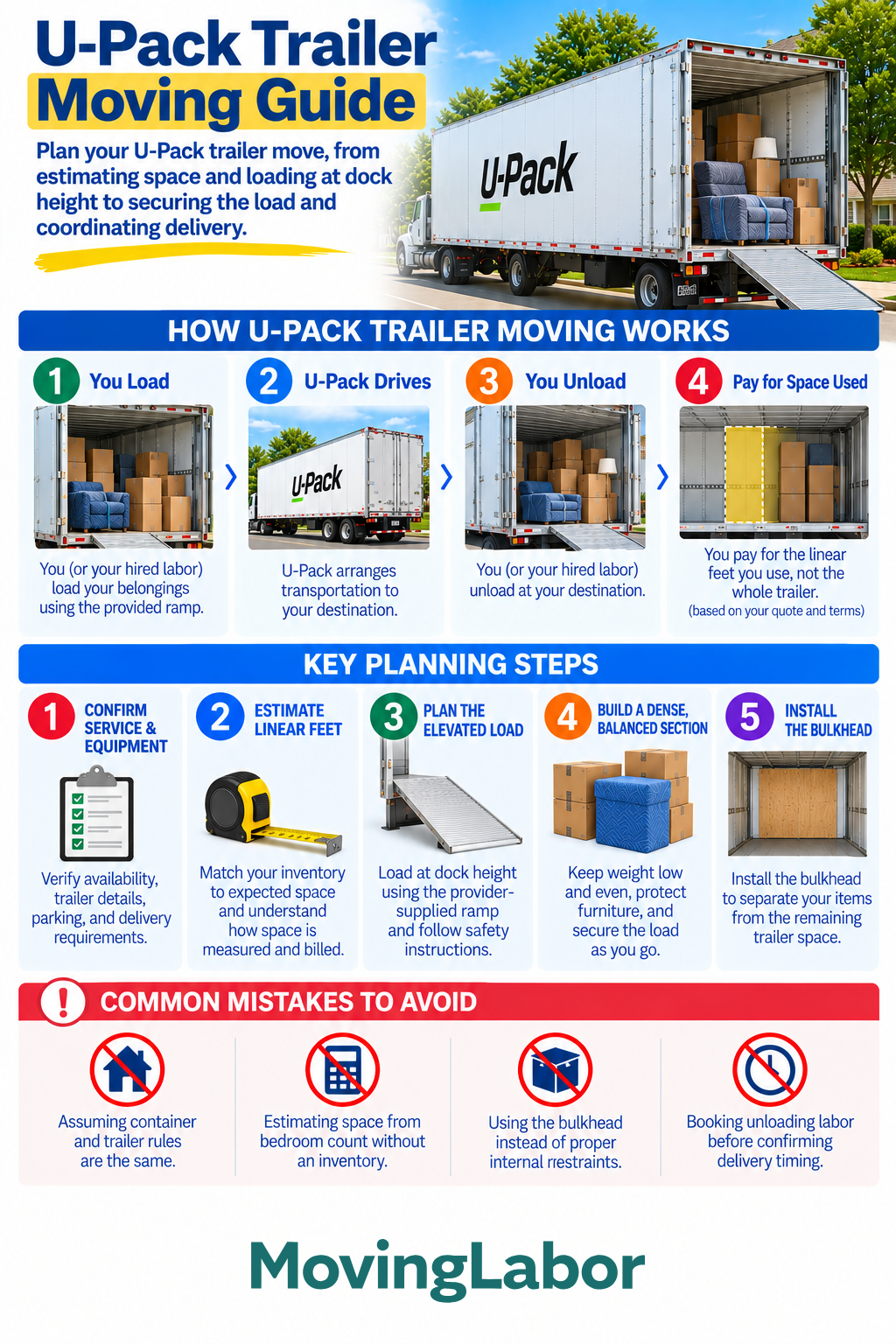
U-Pack's moving trailer service lets you load your own household belongings while U-Pack handles the transportation. Instead of renting the entire trailer, you can use part of the available space and your final price is based on the linear feet used, subject to the reservation terms and minimum space requirement.
U-Pack currently uses 28-foot moving trailers with approximately 27 feet of interior loading length. Because the trailer floor sits about 48 inches above the ground, a loading ramp is provided.
Before booking, confirm that trailer service works for both properties, particularly the parking and clearance requirements.
Quick Answer
With a U-Pack trailer, the basic process is:
U-Pack delivers the trailer → you load your belongings → you secure the load and install the bulkhead → U-Pack transports the trailer → you unload at the destination.
You do not have to fill the entire trailer. U-Pack measures the linear feet used and adjusts the final price accordingly, subject to a five-foot minimum. Any remaining trailer space may carry commercial freight separated from your household belongings by the bulkhead.
Step-by-step plan
1. Confirm trailer service and parking
Make sure a U-Pack trailer can serve both the origin and destination before planning the load.
U-Pack currently specifies approximately:
- 40 feet of space for trailer and ramp during delivery and pickup
- 10 feet of width
- 14 feet of overhead clearance
- A suitable solid, level parking surface
Permission or permits may also be required for street, apartment, HOA, or other restricted parking.
Check both properties rather than assuming that access at the origin means the destination will also work.
2. Estimate your linear feet
U-Pack trailer space is measured by length rather than by the number of boxes or total shipment weight.
One linear foot represents 12 inches of trailer length while giving you the trailer's available width and height within that section. U-Pack generally estimates the amount of space needed when quoting the move.
Your actual inventory still matters. Large furniture, irregular pieces, garage contents, and inefficient stacking can increase the amount of trailer space required.
If you use more or less space than estimated, U-Pack adjusts the price according to the actual linear footage, subject to its minimum.
3. Prepare for the elevated trailer
A U-Pack trailer does not load at ground level.
The trailer floor is approximately 48 inches above the ground, and U-Pack provides a ramp designed for its trailers. The current ramp is approximately 14 feet long and 2 feet wide with a stated 1,000-pound weight limit.
Follow U-Pack's current instructions when setting up and using the ramp. Consider the elevated loading path when planning dollies, furniture handling, appliances, and moving labor.
4. Build and secure the load
Load from the front of the trailer toward the rear while building stable sections.
Keep heavier belongings low, distribute dense weight appropriately, protect furniture surfaces, stack compatible boxes, and control gaps that could allow movement.
Secure completed sections with suitable rope or straps as loading progresses.
Do not depend on the bulkhead to stop an unstable load. U-Pack specifically states that the bulkhead is not designed to support the weight of your belongings.
5. Install the bulkhead
Once your belongings are loaded and secured, install the supplied bulkhead according to U-Pack's instructions.
The bulkhead separates your household shipment from unused trailer space and any commercial freight loaded beyond it. U-Pack recommends leaving a few inches between your belongings and the bulkhead.
Secure the belongings before installing the bulkhead.
Also keep the supplied ramp outside the household-goods section. U-Pack instructs customers not to pack the ramp behind the bulkhead with their belongings.
6. Coordinate destination unloading
U-Pack handles transportation, but you still need to coordinate trailer delivery and unloading at the destination.
Confirm destination parking and access before scheduling the unloading crew.
Allow enough flexibility around equipment arrival rather than booking labor around an assumed arrival time that has not been confirmed.
After unloading, remove all belongings and debris and follow U-Pack's instructions for the ramp, bulkhead, and trailer pickup.
Decision checkpoints
- Before booking: Confirm trailer availability and parking requirements at both properties.
- Before loading: Estimate the required linear feet and review the ramp, loading, prohibited-item, and equipment instructions.
- As the trailer is loaded: Monitor space usage, weight distribution, load stability, and restraints.
- Before pickup: Secure the load, install the bulkhead correctly, and make sure the ramp is not packed behind it.
- Before destination delivery: Confirm parking and coordinate unloading labor with the equipment schedule.
Move-day checklist
- Confirm the delivered trailer and parking location
- Inspect the trailer before loading
- Review prohibited-item rules
- Set up the ramp according to U-Pack instructions
- Keep heavy belongings low
- Build stable loading sections
- Protect furniture surfaces
- Secure sections as loading progresses
- Monitor linear feet used
- Restrain the final section
- Install the bulkhead correctly
- Keep the ramp outside the bulkhead
- Confirm pickup arrangements
Common mistakes to avoid
Treating a U-Pack trailer like a ground-level container
The trailer floor is approximately four feet above the ground. Plan around the supplied ramp and elevated loading path.
Estimating space only from bedroom count
Home size can provide a starting estimate, but actual inventory determines how efficiently the trailer can be loaded. Measure unusually large belongings and account for garage, outdoor, and storage-area contents.
Waiting until the end to secure the load
Tie down stable sections as loading progresses. Important attachment points may become difficult to reach after the trailer is full.
Using the bulkhead as a cargo restraint
The bulkhead separates your shipment from the remaining trailer space. It is not designed to support your belongings. Secure the household load independently before installing it.
Booking unloading labor around an unconfirmed arrival time
Coordinate the destination crew after reviewing the transportation and delivery arrangements. Leave appropriate scheduling flexibility until equipment availability is confirmed.
Where professional moving labor fits
Professional moving labor can load or unload a customer-arranged U-Pack trailer.
Because the trailer floor is elevated, tell the moving crew that the job involves a U-Pack trailer rather than a ground-level portable container.
When booking labor, provide the expected linear feet, inventory, heavy or difficult belongings, origin and destination access, stairs, and walking distance.
Use U-Pack loading and unloading help or the Truck and Container Calculator to continue planning. For this guide, apply the result to the Confirm service and equipment step and confirm the final scope, availability, minimums, and price in writing.