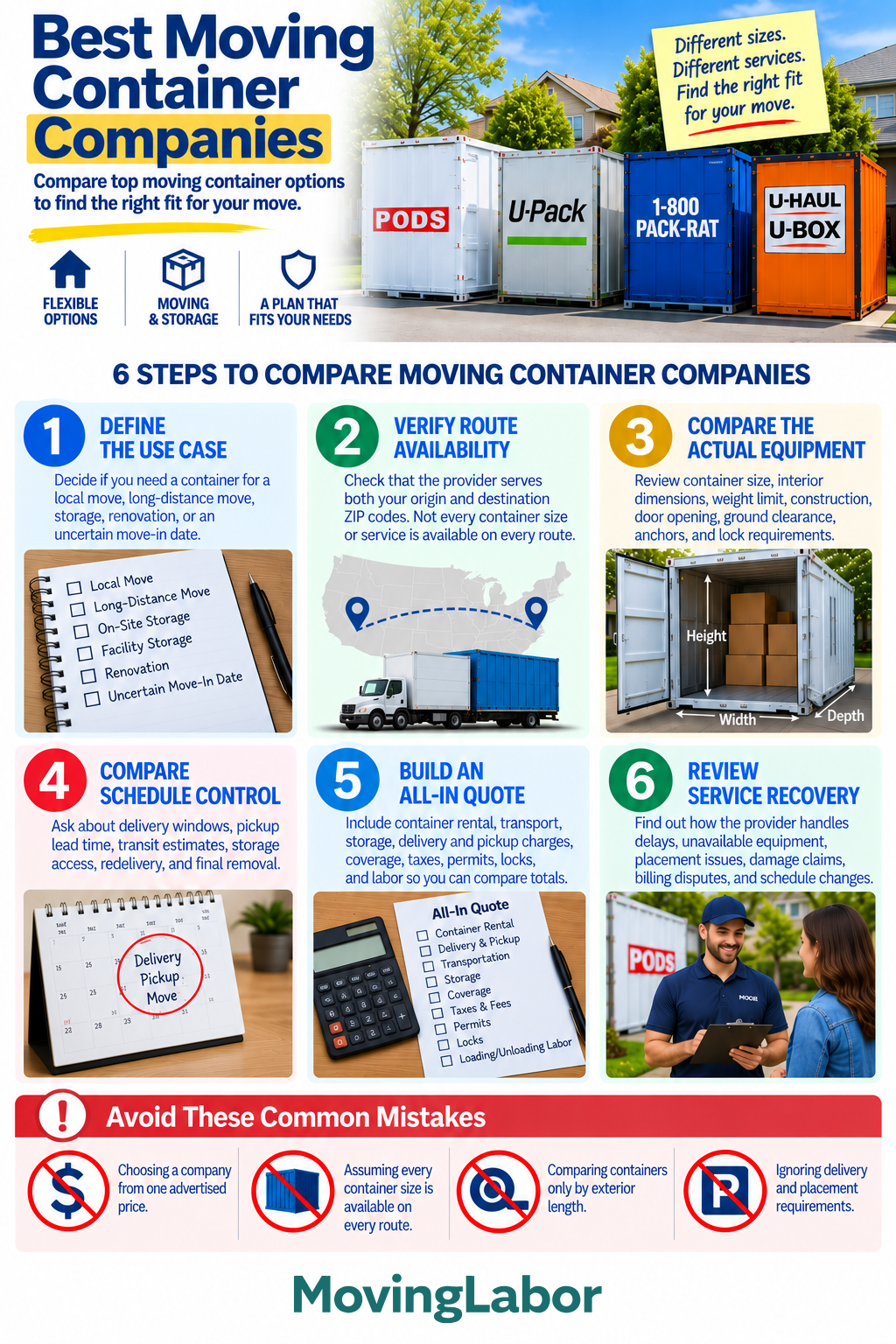
The best moving container company for a particular move depends on service availability, container size and weight limits, delivery and pickup options, storage, property access, pricing, coverage, and customer support. Compare current options from PODS, U-Pack, 1-800-PACK-RAT, U-Haul U-Box, and qualified regional providers based on the requirements of your specific move rather than assuming one company is always the best choice.
Container sizes, equipment, availability, service areas, loading rules, and prices can change by provider and route. For example, PODS currently offers multiple container sizes, while U-Haul's U-Box uses a smaller container format. Always confirm the equipment included with your reservation before relying on dimensions, capacity, access, or timing.
Quick Answer
Start by defining whether you need the container for a local move, long-distance move, temporary storage, or a combination of moving and storage.
Then check which providers actually serve both addresses and compare the specific container available for your route. Request comparable all-in quotes that include transportation, container rental, storage, delivery and pickup charges, coverage, and other applicable fees.
Step-by-step plan
1. Define the use case
Determine whether you need the container for a local move, long-distance transportation, on-site storage, storage at a provider facility, renovation, or an uncertain move-in date.
The right provider may differ depending on whether storage or transportation is the primary need.
2. Verify route availability
Check service using the actual origin and destination ZIP codes.
A company's broad service footprint does not mean every container size or service is available on every route. PODS, for example, currently notes that limited-service areas apply, and its 12-foot container is currently offered for local moves and storage rather than long-distance moves.
3. Compare the actual equipment
Compare the specific container offered for your reservation rather than relying only on advertised exterior length.
Review:
- Interior dimensions and usable space
- Door dimensions
- Maximum allowable load
- Container construction
- Loading height or ground clearance
- Tie-down or anchor provisions
- Lock requirements
Equipment can differ substantially. U-Haul currently lists its U-Box at approximately 5' × 8' × 7.5', with 257 cubic feet of capacity and a maximum load of 2,000 lbs. PODS currently advertises 8-, 12-, and 16-foot container options, although availability depends on the service being requested.
4. Compare schedule control
Ask how delivery, pickup, transportation, storage, and redelivery work.
Compare delivery windows, pickup lead times, estimated transit timing, storage access, destination redelivery, and final container removal. If your move-in date is uncertain, also compare how easily the storage period can be extended.
5. Build an all-in quote
Compare the complete expected cost rather than only the advertised container or transportation price.
Depending on the provider and move, costs may include:
- Container rental
- Initial delivery
- Pickup
- Transportation
- Destination delivery
- Storage
- Coverage
- Applicable taxes or fees
- Parking or placement permits
- Locks
- Loading and unloading labor
For example, U-Haul states that U-Box quotes break out container rental, delivery, pickup, shipping, transit, and storage fees, with optional services and coverage available separately. PODS states that its pricing depends on factors including container quantity and size, distance, timeframe, and season.
6. Review service recovery
Before booking, find out what happens if something does not go according to plan.
Review the provider's process for delivery delays, unavailable equipment, placement problems, property constraints, damage claims, billing disputes, and schedule changes.
Keep your reservation details, quote, equipment specifications, and important policies in writing.
Decision checkpoints
- Before requesting quotes: Define whether you need moving, storage, or both.
- Before booking: Verify service between the actual ZIP codes and confirm the container size and equipment being reserved.
- Before container delivery: Confirm placement, access, permits, delivery timing, loading rules, and weight limits.
- Before pickup: Confirm that the container is properly loaded, secured, locked, and ready under the provider's requirements.
Move-day checklist
- Confirm the specific container delivered matches the reservation
- Inspect the container before loading
- Review the container's weight limit
- Review prohibited-item rules
- Confirm placement and required permits
- Keep the loading area accessible
- Follow provider-specific loading instructions
- Secure belongings for transportation
- Use the required lock
- Confirm pickup arrangements
Common mistakes to avoid
Choosing a company from one advertised price
A promotional or sample price may not represent the total cost of your move. Compare quotes for the same route, dates, storage period, equipment, and services.
Assuming every container size is available everywhere
Availability can vary by market and route. Confirm the exact container being offered before planning the load around its dimensions.
Comparing containers only by exterior length
Usable dimensions, door opening, allowable weight, construction, and loading configuration can differ. Compare the actual equipment specifications.
Ignoring delivery and placement requirements
A container still needs an appropriate place to be delivered. Check driveway or parking access, property restrictions, local requirements, and any permits before delivery.
Where professional moving labor fits
Moving labor can provide the crew to load or unload a customer-arranged portable moving container.
Coordinate the labor appointment with the confirmed container delivery and pickup schedule. Before booking labor, share the provider, container type and quantity, inventory, heavy or difficult items, stairs, walking distance, and property access conditions.
Use storage moving or the Truck and Container Calculator to continue planning. For this guide, apply the result to the Define the use case step and confirm the final scope, availability, minimums, and price in writing.