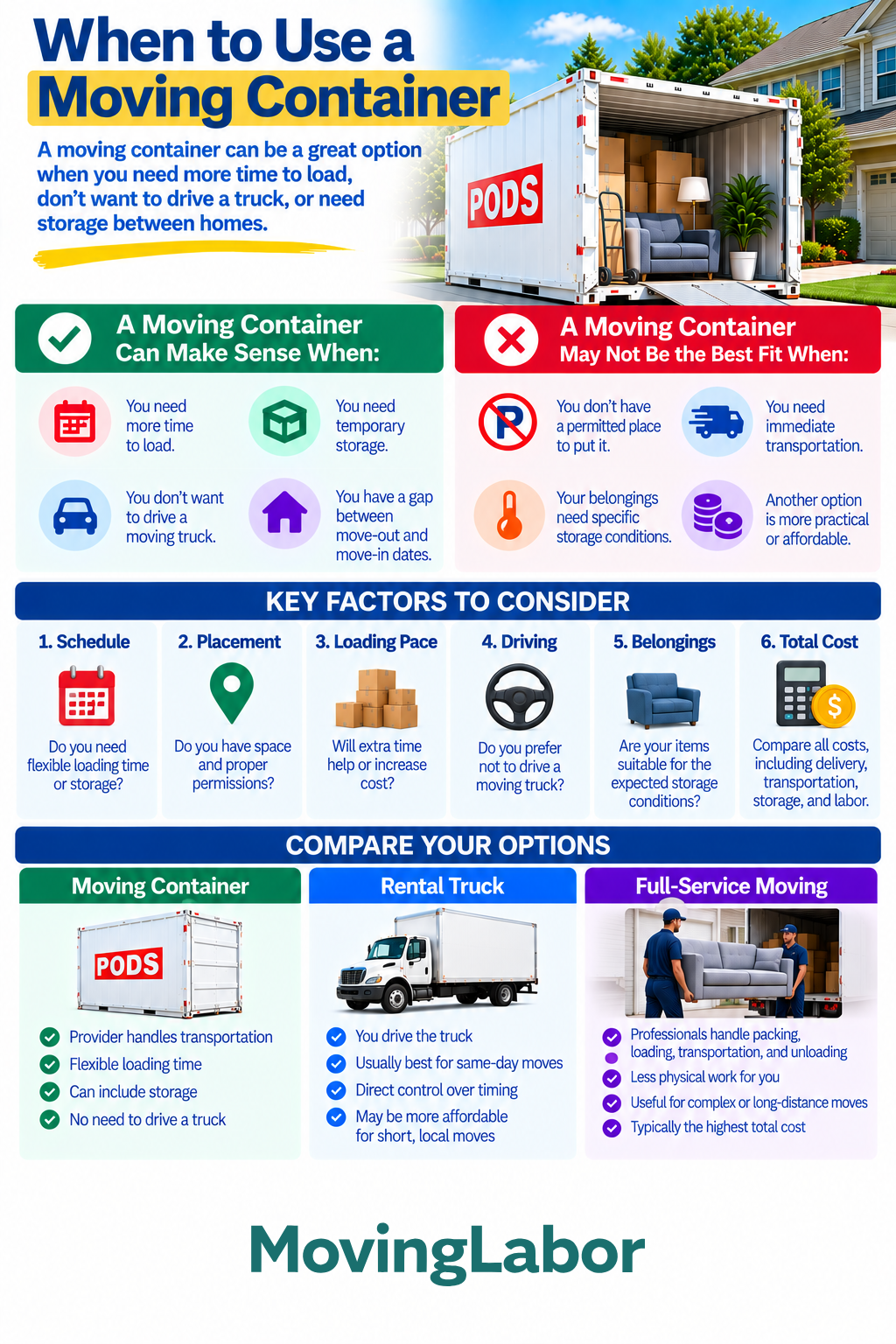
A moving container can be a practical choice when you want more time to load, do not want to drive a rental truck, need temporary storage, or have a gap between moving out and moving in.
It is not automatically the right choice for every move. Property access, placement restrictions, storage duration, equipment availability, inventory, scheduling, and total cost can make a rental truck or another moving service more practical.
Use the following factors to decide whether a portable moving container fits your move.
Quick Answer
A moving container is worth considering when:
- You want the provider to handle transportation
- You need several days or longer to load or unload
- Your move includes temporary storage
- Your move-out and move-in dates do not align
- Your property has suitable container placement
- You prefer to load yourself or hire labor separately
A moving container may be a poor fit when there is nowhere practical or permitted to place it, you need immediate transportation, your belongings are unsuitable for the expected storage conditions, or another moving method provides a better combination of schedule, capacity, and total cost.
Step-by-step decision guide
1. Consider your moving schedule
Moving containers are especially useful when the move cannot happen in one continuous trip.
For example, you may need to leave your current home before the next home is ready, temporarily store belongings during a renovation, or load over several days instead of completing everything on one moving day.
In these situations, the same loaded container may be transported or stored without requiring you to unload everything into a separate storage unit.
If you can load, drive, and unload in a short period and do not need storage, compare the container with a rental truck or other moving options before booking.
2. Confirm you have a place for the container
Check placement before choosing a container provider.
Depending on the property, this could involve a driveway, designated parking area, or permitted street space.
Confirm:
- Available placement space
- Provider delivery requirements
- Surface and slope requirements
- Overhead and side clearance
- Door orientation
- Pickup access
- Applicable parking permits
- HOA or building restrictions
Check both the origin and destination. A container that works at your current home may not work at the new one.
3. Decide how much loading time you need
One advantage of many moving-container services is that you do not necessarily have to complete the entire load in a few hours.
Extra loading time can be useful when you are packing gradually, preparing furniture yourself, working around a job or family schedule, or coordinating moving labor separately.
However, more time is not automatically better. Longer rental or storage periods can increase cost, and belongings may remain exposed to changing temperature and humidity conditions for longer.
Compare the actual loading and storage terms of the providers available for your route.
4. Decide whether you want to drive
With a rental truck, you or another authorized driver handles transportation.
With a moving-container service, the provider generally transports the loaded container.
A container can therefore be useful when you are uncomfortable driving a large rental truck, have multiple vehicles to move, or simply want transportation handled separately from loading and unloading.
The tradeoff is less direct control over transportation timing. Container pickup, transit, redelivery, and removal must be coordinated with the provider.
5. Consider storage conditions and your belongings
Think about what will actually be inside the container and how long it may remain there.
Belongings should be clean and dry before loading. Consider how temperature changes, humidity, and storage duration could affect furniture, electronics, documents, artwork, photographs, textiles, and other sensitive belongings.
Follow the provider's prohibited-item rules and keep essential, irreplaceable, highly valuable, or unsuitable temperature-sensitive belongings elsewhere when appropriate.
Also consider whether you will need access to anything while the container is stored. Facility-stored containers may have different access procedures than containers kept at your property.
6. Compare the complete cost and responsibility
Compare moving methods using the same move rather than comparing advertised starting prices.
For a container, consider applicable:
- Container delivery and pickup
- Transportation
- Storage
- Coverage
- Locks and supplies
- Permits or parking
- Loading and unloading labor
- Additional rental periods
- Redelivery or access charges
For a rental truck, consider the rental, mileage where applicable, fuel, tolls, parking, coverage, supplies, and driving responsibility.
For full-service moving, determine what packing, loading, transportation, unloading, and other services are actually included.
The better fit depends on the complete combination of cost, time, access, storage, and responsibility.
When a moving container can make sense
A container is particularly worth considering when you:
- Have a gap between homes
- Need temporary storage
- Want additional loading time
- Do not want to drive a moving truck
- Want to hire loading labor separately
- Are renovating or staging a home
- Have suitable placement at both ends
When another moving option may fit better
Consider alternatives when:
- Container placement is prohibited or impractical
- Street or driveway space is insufficient
- You need immediate transportation
- You need frequent access to stored belongings
- Your belongings require storage conditions the service does not provide
- Your move is straightforward enough for a short rental-truck schedule
- The all-in container quote does not work for your budget
Decision checkpoints
- Before requesting quotes: Determine whether you need storage, flexible loading time, or provider-handled transportation.
- Before booking: Verify placement and pickup access at both addresses.
- Before choosing equipment: Match the container capacity and weight limits to your actual inventory.
- Before scheduling labor: Confirm container delivery and pickup arrangements.
- Before loading: Review prohibited items, storage conditions, security, and the expected storage period.
Move-day checklist
- Inspect the delivered container
- Confirm placement works for pickup
- Review applicable weight limits
- Review prohibited-item rules
- Load only clean, dry belongings
- Protect furniture and fragile items
- Distribute weight appropriately
- Secure sections as loading progresses
- Keep the door area clear
- Coordinate loading labor
- Lock the container as instructed
- Confirm pickup arrangements
Common mistakes to avoid
Booking before checking placement
Verify that the container can legally and practically be delivered, stored, and retrieved at the property before committing to the move.
Comparing only advertised prices
Compare the expected total cost. Storage periods, delivery, transportation, permits, labor, supplies, and schedule changes can affect the final amount.
Assuming unlimited loading time
Loading, storage, and billing arrangements vary by provider and reservation. Know when additional charges begin.
Ignoring destination access
Check the destination as carefully as the origin. Apartment complexes, urban streets, HOAs, narrow driveways, and other properties may restrict container placement.
Assuming the container protects every type of belonging
Container construction and storage environments vary. Prepare belongings for the expected conditions and keep unsuitable items elsewhere.
Where professional moving labor fits
Professional moving labor can be useful when you want the flexibility of a moving container without handling all of the physical loading and unloading yourself.
Labor-only movers can load or unload a customer-arranged portable container while the container provider handles transportation.
When booking labor, provide the container type and size, inventory, heavy or difficult items, stairs, walking distance, and property-access conditions.
Use Storage Moving or the Truck and Container Calculator to continue planning. For this guide, apply the result to the Evaluate the schedule gap step and confirm the final scope, availability, minimums, and price in writing.