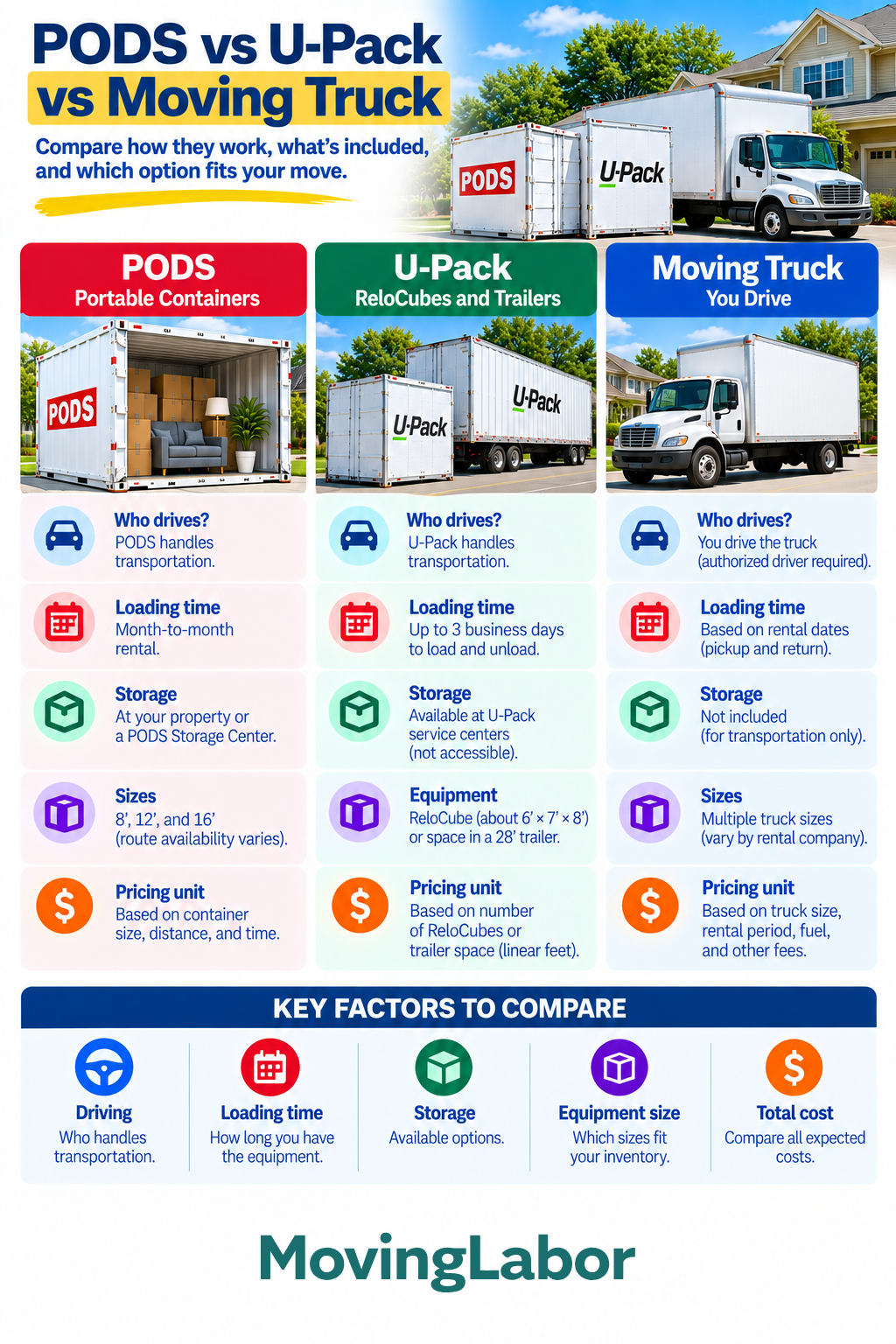
PODS, U-Pack, and rental moving trucks all let you handle some or all of the packing and loading yourself, but transportation and scheduling work differently.
With PODS, a portable container is delivered for loading and PODS handles transportation. U-Pack offers ReloCube containers or space in a moving trailer and handles the driving. With a rental moving truck, you control the transportation and drive the truck yourself.
Compare them based on who drives, loading time, storage needs, inventory, property access, scheduling, and total expected cost.
Quick Answer
The biggest difference is who controls transportation and how long you have the equipment.
PODS: The provider transports the container. Its container rentals are month-to-month, which can work well when loading, unloading, or storage requires more time.
U-Pack: The provider transports your ReloCube or trailer shipment. U-Pack currently provides up to three business days for loading and three business days for unloading. Trailer pricing is based on linear feet used, while ReloCube pricing is based on the number of containers used.
Rental truck: You arrange the truck and handle the driving. This provides direct control over departure and transportation but also makes the renter responsible for driving, parking, fuel, and the truck's rental schedule.
Step-by-step comparison
1. Decide who will drive
Start with whether you are comfortable driving a rental moving truck.
With PODS and U-Pack, the provider handles the transportation. You are still responsible for coordinating loading, unloading, equipment access, and other parts of the move unless additional services are arranged.
With a rental truck, an authorized driver handles transportation and follows the rental company's requirements.
2. Compare loading and unloading time
The amount of time available can substantially change how the move works.
PODS currently rents containers on a month-to-month basis, providing more flexibility when the container needs to remain at the property or in storage.
U-Pack currently provides up to three business days to load and three business days to unload. Keeping equipment beyond the allotted period can result in additional charges.
Rental-truck timing depends on the reservation. Confirm pickup, return, extension, and any mileage terms with the specific rental company.
3. Match the equipment to your inventory
Compare actual equipment instead of treating all three options as equivalent amounts of space.
PODS currently offers 8-, 12-, and 16-foot containers, although size availability and eligibility vary by move.
U-Pack offers ReloCube containers and 28-foot moving trailers. ReloCubes are approximately 6' × 7' × 8'. With a trailer, customers can use part or all of the available space, subject to U-Pack's minimum and pricing rules.
Rental trucks are available in different cargo sizes depending on the rental provider and location.
For any option, compare usable dimensions, weight limits, large furniture, dense belongings, and loading efficiency.
4. Verify property access
Portable containers and trailers need suitable delivery and pickup access.
For PODS, confirm the placement requirements for the specific property and equipment.
U-Pack states that a ReloCube requires approximately one standard parking space per Cube, plus maneuvering space during delivery and pickup. Its moving trailer requires substantially more parking space. Applicable permits or property permission may also be required.
A rental truck does not remain at the property in the same way, but you still need suitable parking and a practical loading route.
Consider driveways, apartments, HOAs, street parking, permits, overhead clearance, surface conditions, and walking distance before booking.
5. Compare total expected cost
Do not compare a container or U-Pack quote with only the advertised rental rate for a truck.
For each option, include applicable:
- Transportation or rental charges
- Delivery and pickup
- Mileage
- Fuel
- Tolls
- Storage
- Coverage
- Parking or permits
- Locks and supplies
- Loading and unloading labor
- Schedule extensions or changes
PODS states that its pricing varies with factors including container quantity and size, distance, time frame, and season. U-Pack's trailer pricing is based on space used, while ReloCube pricing depends on the number of Cubes used.
Use route-specific written quotes for the actual move rather than assuming one option will always cost less.
6. Plan the origin and destination
The best equipment choice still needs to work at both properties.
Confirm when the equipment will arrive, where it will be placed or parked, when loading labor will arrive, when the equipment will be picked up or returned, and what happens at the destination.
For provider-transported equipment, also review estimated transit and destination-delivery arrangements.
Decision checkpoints
- Before requesting quotes: Decide whether driving a rental truck is acceptable and whether storage is needed.
- Before booking: Compare equipment capacity, loading time, property access, and total expected cost.
- Before scheduling labor: Confirm equipment delivery or truck pickup timing at both ends.
- Before move day: Recheck placement or parking, permits where applicable, equipment availability, and loading arrangements.
Move-day checklist
- Confirm the specific equipment
- Inspect it before loading
- Review applicable weight limits
- Review prohibited-item rules
- Confirm placement or truck parking
- Coordinate loading labor
- Protect and secure belongings
- Keep required access areas clear
- Confirm pickup or return timing
- Prepare for destination unloading
Common mistakes to avoid
Comparing only the starting prices
A rental-truck rate does not necessarily include fuel, mileage, tolls, parking, or other trip expenses. Container and trailer quotes can have their own delivery, storage, or schedule-related charges. Compare the expected total for the same move.
Assuming the loading schedules are the same
They are not. PODS and U-Pack currently use substantially different time structures, while rental-truck timing follows the rental reservation.
Assuming every option works at the property
Container delivery, ReloCube placement, freight-trailer parking, and rental-truck parking require different amounts of space. Verify both properties before booking.
Booking labor before confirming equipment timing
Coordinate the moving crew with confirmed equipment availability. An equipment delay or schedule change can otherwise leave the crew waiting without anything available to load.
Where professional moving labor fits
Professional moving labor can load or unload a customer-arranged PODS container, U-Pack equipment, or rental moving truck.
For PODS or U-Pack, coordinate the crew with confirmed equipment delivery and pickup windows. For a rental truck, coordinate labor with the truck pickup, loading schedule, transportation plan, and return deadline.
When booking labor, provide the equipment type and size, inventory, heavy or difficult items, stairs, walking distance, and property-access conditions.
Use U-Pack loading and unloading help or the Truck and Container Calculator to continue planning. For this guide, apply the result to the Choose who drives step and confirm the final scope, availability, minimums, and price in writing.