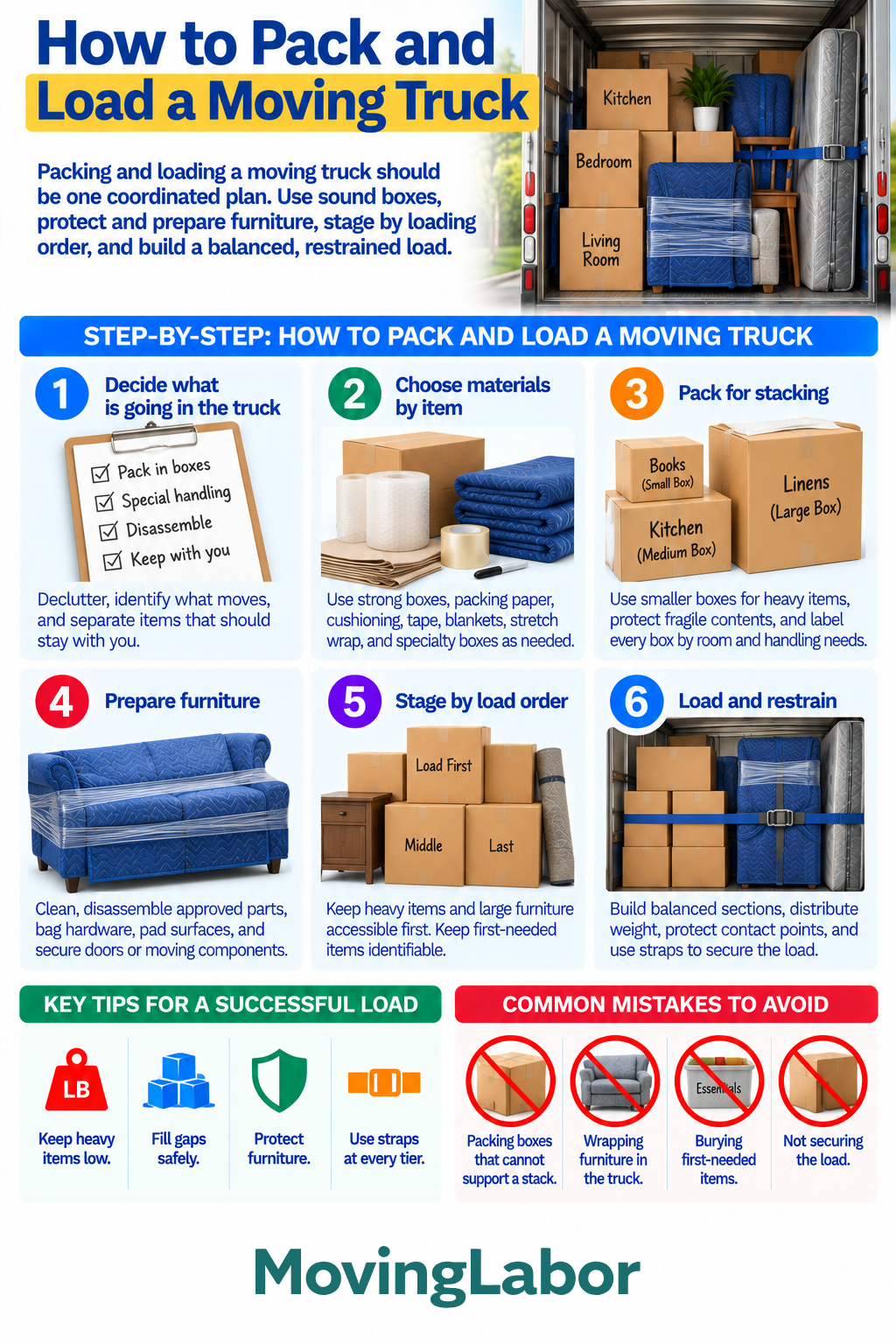
Packing and loading a moving truck should be treated as one coordinated process. Pack belongings so they can be carried and stacked safely, prepare furniture before loading begins, stage items in a useful order, and build a balanced load that is secured as the truck fills.
Good preparation before moving day reduces loose items, unstable stacks, unnecessary handling, and last-minute furniture wrapping.
Quick Answer
Pack and prepare everything before loading begins. Use smaller boxes for dense belongings, sturdy medium boxes for general household goods, and larger boxes mainly for lightweight bulky items.
Before loading the truck:
- Close and securely tape every box.
- Protect fragile contents inside their boxes.
- Label boxes by destination room and handling needs.
- Disassemble appropriate furniture and keep hardware organized.
- Wrap and pad furniture before it reaches the truck.
- Separate belongings that should not be loaded.
- Stage items so large, sturdy pieces are accessible without burying things you need first at the destination.
Inside the truck, distribute weight appropriately, build stable sections, protect items from contact, and use suitable restraints as the load progresses.
Step-by-step plan
1. Decide what is going in the truck
Finish decluttering and identify what will actually be transported before packing becomes time-critical.
Separate belongings that:
- Will be packed in boxes
- Need specialty protection
- Require furniture padding
- Need disassembly
- Should remain with you rather than go in the moving truck
Keep important documents, medications, keys, valuables, and other essential personal items separate from the general moving load.
2. Choose packing materials by item
Use packing materials appropriate for the belongings being protected.
Depending on the move, these may include:
- Small, medium, and large moving boxes
- Packing paper
- Cushioning materials
- Packing tape
- Moving blankets
- Stretch wrap
- Mattress bags
- TV, mirror, artwork, wardrobe, or other specialty boxes
Avoid relying on one box size or one packing material for everything.
3. Pack boxes for carrying and stacking
A moving box needs to protect its contents while also remaining practical to carry and stable enough to stack.
Use smaller cartons for books and other dense belongings. Reserve large boxes primarily for lightweight bulky items such as linens and pillows.
Fill empty space appropriately so contents do not shift excessively, and avoid boxes that bulge, collapse, or cannot close properly.
Label each carton with its destination room and any necessary handling instructions.
4. Prepare furniture before loading
Complete furniture preparation before the item reaches the truck.
Where appropriate:
- Remove detachable parts
- Bag and label hardware
- Secure doors, drawers, or moving components
- Protect finished surfaces
- Cover vulnerable corners and edges
- Use moving blankets or other suitable protection
- Secure protective coverings so they remain in place
Follow manufacturer instructions when disassembling or preparing furniture with specialized mechanisms or components.
5. Stage belongings by loading order
Create an organized staging area rather than carrying items to the truck in whatever order they become available.
Keep larger protected furniture and sturdy items accessible for the early stages of loading.
At the same time, identify belongings you expect to need soon after arrival. When practical and safe, position these so they can be accessed without unloading a large portion of the truck first.
Keep walkways and access to the truck clear while staging.
6. Build and secure the load
Loading should progress in stable sections rather than becoming one large unsecured pile.
Place heavier, sturdy items appropriately and keep excessive weight from becoming concentrated in one small area. Use lighter belongings above heavier items only when the lower items can support them.
Protect furniture and other belongings where surfaces may contact one another.
Use suitable restraints and available truck tie-down points to limit movement during transportation. Secure the load progressively instead of waiting until the truck is completely full.
Before closing the truck, check that the final section is stable and that loose belongings cannot easily shift toward the door.
Decision checkpoints
- Before packing: Decide what will travel in the moving truck and what will remain separate.
- Before sealing boxes: Make sure cartons are properly packed, reasonably liftable, and suitable for stacking.
- Before loading begins: Finish furniture disassembly, padding, labeling, and other preparation.
- Before carrying items to the truck: Organize the staging area according to loading order.
- As each section is loaded: Check weight distribution, stability, furniture protection, and restraints.
- Before closing the truck: Inspect the final section for loose or unstable items.
Packing and loading checklist
- Decluttering finished
- Truck inventory identified
- Boxes securely closed
- Dense belongings packed in smaller boxes
- Fragile contents protected
- Boxes labeled by destination
- Furniture prepared before loading
- Hardware bagged and labeled
- Moving blankets and protective materials available
- First-needed belongings identified
- Loading area and walkways clear
- Heavy items positioned appropriately
- Furniture contact points protected
- Load secured progressively
- Final section checked before closing the truck
Common mistakes to avoid
Packing boxes that cannot support a stack
Overfilled, underfilled, damaged, or irregular boxes can make the load less stable. Use sound cartons and pack them so they close properly and maintain their shape.
Using large boxes for heavy belongings
A large carton filled with books or other dense contents can become difficult to control. Use smaller boxes for heavier belongings.
Preparing furniture inside the truck
Wrapping, disassembly, and other preparation are easier before furniture enters the loading area. Prepare each piece before it is carried to the truck.
Loading in whatever order items become available
Random loading can make it harder to build stable sections and may bury belongings that need to remain accessible. Stage the move before loading begins.
Waiting until the end to secure the load
Restrain the load as sections are completed. Waiting until the truck is full can leave interior sections difficult to secure effectively.
Burying first-needed belongings
Clearly identify belongings you expect to need soon after arrival and account for them when planning the final loading sequence.
Where professional moving labor fits
Professional moving labor can help with furniture preparation, carrying, loading, and unloading while you provide and drive the rental truck.
Before booking, confirm which services are included. Ask whether the crew provides moving blankets, stretch wrap, dollies, straps, or other equipment, or whether you need to have those items available.
If you are packing your own boxes, complete ordinary packing before the loading crew arrives. Clearly label cartons, finish decluttering, separate belongings that should not be loaded, and identify furniture that may require preparation or disassembly.
Use Professional packing help or the Truck and Container Calculator to continue planning. For this guide, apply the result to the Design the inventory step and confirm the final scope, availability, minimums, and price in writing.